Friday, 29 November 2019

[REVIEW] Wormskin #01–#08

Wormskin #01–#08 (2015–2018)
by Gavin Norman and Greg Gorgonmilk (with further contributions by Yves Geens, Matthew Schmeer, Andrew Walter and Brian Richmond)
Published by Necrotic Gnome Productions
Low-to-mid-level

Fanzines may be the ideal vehicle to publish offbeat, visionary RPG ideas. The format is suitably inexpensive to produce and buy, and the scope of a single issue just right for personal, creative takes on a game or setting. Zines can speak to niche audiences, and afford to be small enough to be unconcerned by the dictates of mass-market viability – if you have a zine you are selling to a circle of 30 happy friends and acquaintances, it may still be worth it just for the pleasure of creating something. That is the theory: in practice, zines are all over the place, from the deadly dull to the inspired, and from dodgy photocopies to lavishly produced physical artefacts. A lot of them will have no meaning outside a small scene – they are memorabilia, physical embodiments of collective memories and ephemeral personal networks. A lot of them are, also, hipster bullshit. Yet sometimes, zine creators strike solid gold, and produce a run that develops into something amazing, and sets standards for years to come. Welcome to Wormskin.

Wormskin #1-3
Wormskin is a zine with a precisely defined theme: it presents guidelines, background detail, and materials for Dolmenwood, a faerie-haunted woodland setting “somewhere” in a fantastic England. It is a setting with no link to a precise time and place, and if you look deeper, it is a mishmash of mediaeval superstitions and folk tales, Victorian fantasy (mostly Dunsany and Morris), and romanticised Georgian-era rural life – in roughly the same way vanilla D&D is a hodgepodge of disparate influences from the “Appendix N” novels to monster movies, fantasy wargaming, and comic books. And yet, this mixture has a strong internal consistency, with a characteristic rustic and earthy feel to it, conjuring images of muddy roads, mossy tree trunks, crumbling monasteries in the deeper forests, stone circles avoided by men, and rowdy taverns offering sweet and savoury delicacies with bitter ales and the warmth of the fireplace.

This imagery has a long presence in D&D, whose idyllic forests, wayside inns and sleepy rural communities are intristic parts of the assumed milieu, even if they often feel more like more early 1900s American farming settlements than historical English villages. Which is not a criticism: D&D, even at its most specific (and it can get very specific), deals with a wider range of influences from westerns to planetary romance, while Dolmenwood focuses on a much narrower range in an undiluted fashion. It is a setting with a strong and peculiar flavour, something that has been done before many times, and subsumed into the tired cliché of Merrie Olde Englande so that all its individuality has been lost in modern renfaire fantasy.  But Dolmenwood is not that setting: by returning to its imaginary roots, it highlights the fresh, fantastic and uncanny aspects of the English countryside.

Issue #02, back cover
One of the primary strengths of Dolmenwood come precisely from its synthesising and (particularly) transformative nature: it can accommodate and blend together ideas from very dissimilar sources, and make them work in a whole that becomes a new, original thing of its own. It takes folktales and ballads about forest-dwelling faeries and witches, and recreates them as the powerful antagonists of a role-playing game; or it tackles the legends of druids as the secretive order of the Drune, complete with machinations around ley lines and places of power. All of this has a veneer of familiarity, but the end result always comes with a clever twist or surprise – not deconstruction (a gotcha that’s more tired now than playing things straight), but a few steps towards reaffirming the unfamiliarity and oddness of the woodlands.

In particular, the zine is very skilful about repurposing Victorian kitsch: syrupy and domestic source material (bowdlerised fairy tales with red-cheeked garden gnomes and talking animals, idealised depictions of “the good country life” with its rotund monks and beer-loving farmers, and so on) becomes great game fodder in the creators’ hands; random public domain woodcuts are given new life in a newly imagined context. The village of Prigwort, renowned for its brewmasters, is accompanied by a random table of fantastic beverages (the minstrel’s cordial is a frothy orange with a taste of malty rye, and encourages the imbiber to engage in unexpected poetry), and gingerbread golems have been known to lurk in certain bakeries. The zines pay a lot of attention to the material comforts of the region – beers, common tavern fare, fashionable garments and places worth visiting all receive their due. This is a place painted with warm tones, yet without sentimentalism.

***

The articles in Wormskin range from setting background and hex descriptions to game procedures, the obligatory monsters/magic items, and random tables. Not unlike early Judges Guild, it offers a diverse selection of materials, which are useful enough on their own, but also come together to form a certain vision of running a campaign. There is a free introductory PDF to serve as an overview; but Dolmenwood is mostly described by way of example, through the tone and content of its more specific articles. Somehow, it works admirably well.


The Drugsssss of Dolmenwood
Some of the ideas are idiosyncratic, and open up new aspects of play. Moss dwarves (stunted gnomes from the deep forests) and grimalkin (a race of mischievous and creepy talking cats) are not simple character options, they are more or less new specialist character types, adding a specific spin to the way we play D&D. A set of guidelines on identifying, consuming, and buying/selling the fungi of Dolmenwood introduces a new possibility for wilderness expeditions, and comes with a d30 table featuring such entries as sludgenuts (smell like wet dog, nourishing but repulsively slimy), polkadot pig (a mild psychedelic causing creeping paranoia), or jack-in-the-green (found in fairy rings, random enchantment). This is a table I adapted for my own campaign, for the benefit of a hobbit character, whose expertise in mushrooms added flavour to both the character, and the fun of wilderness expeditions. A different issue features guidelines for camping out – these are way too detailed for my taste, with fiddly modifiers for fetching firewood and the effectiveness of sleep, but they can be scaled down, and there is, again, a table of random campsites which can lead to new adventures (a ring of identical trees haunted by strange sounds, or a verdant clearing with signs of ancient habitation). What these ideas have in common is encouraging actual play, and providing new ideas to expand the scope of running a game in an enchanted forest.

It bears mention that Dolmenwood is a complex and heavily interconnected mini-setting. You can run it by using the details (and you can also take it apart to use the bits and pieces), but there is a deeper layer to the setting where the pieces fit together, and even the footnotes refer to other footnotes. Locations, rival factions, setting-crossing elements like the ley lines and sun stones, and new guidelines make for a mighty tangle of moving parts. The resulting network of references is very rich, revealing the thought and careful planning behind the milieu; it is also too much for a casual game, and rather hard to keep in mind. It does not help that, owing to its piecemeal publication history and the variety of content on the pages of a zine, all of this material is disorganised, lacking any sort of index or reference. This level of the Wormskin materials is perhaps best used as an occasional spice, instead of the compulsion to use all of it all the time. In a way, “learning” your way around Dolmenwood is fairly close to learning a new D&D-based game system – and it is best done gradually.

Don't Lose Your Head
Occasionally, the wealth of detail also obscures the clarity and intent of the articles. This is not that apparent in the case of the hex descriptions, even if they are far more detailed than the usual hex-crawl fare. These issues do, however, haunt the faction descriptions and the adventure scenarios. The Ruined Abbey of St. Clewd, a major adventure location, is split between two issues – and while it is a good one, it is rather overdone for a place with 26 keyed areas. In another issue, the description of a three-room cottage (The Atacorn’s Retreat) spans seven pages, offering a loving detail of interesting clutter. It is a very good article, yet it is overpoweringly dense, and would be a logistical nightmare to run at the table. In these aspects, Wormskin feels like too much of a good thing.

And with these flaws in mind, it still comes across very clearly. Perhaps the best aspect of the articles is how the pieces reflect the whole, and vice versa. Even after eight issues, the materials on Dolmenwood are fragmentary – there are guidelines for magical waters, but no comprehensive encounter tables; we know the goat-headed lords of Lankshorn, but not the Court of the Nag-Lord or the lake of the Dark Mirror. A lot is missing, and a lot is too much to commit into memory. However, even after a single issue, the reader gets a sufficient idea about the setting and its workings that allows him to extrapolate from the details. The campaign materials are very helpful in setting the tone and encouraging you to go further on your own. And this is what great game supplements are made of.

***

With respect to production values, issues of Wormskin come in the form of handsome digest-sized booklets. It is printed in colour, and features colour maps and artwork. Once again, its use and repurposing of “found art” from the fin de siècle tradition is exemplary, and it is done with such a sure hand that it feels visionary rather than cheap. Tasteful layout and good accessibility are also a positive. It has a rich writing style which is a pleasure to read in comparison with the myriad stale game texts you can encounter out in the wild. This is a classy, elegant series. Perhaps it even feels “out of genre” for the wild and unruly zine scene – are zines allowed to look so good?

The Drune Issue
In summary, Wormskin is a visionary product with an intriguing setting. It uses its source material masterfully, turning the generica of Old England into a particular, cohesive experience. Once you get the central idea, it works like a charm. Dolmenwood wears the B/X D&D rules like a familiar and comfortable outfit, while altering them to fit its own tone and set of influences. It doesn’t simply present a few house rules, or small variations on the basic D&D framework, neither does it create something radically new; rather, it presents a new way of thinking about D&D’s core concepts and building blocks without compromising either. Campaigns set in Dolmenwood should be halfway between the familiar and the strange, with sufficiently fresh takes on a lot of D&D’s common elements to feel fresh and ripe for exploration. I do not believe much in the proliferation of old-school systems as long as they offer the same underlying experience (once you have one system based on OD&D, AD&D and B/X, you are set for life), but I would make the jump into a Dolmenwood campaign because the distance is just right to make that jump worthwhile.

All that is old is new again: like the best of the old school on offer, Wormskin provides a fresh take on concepts we had thought tired, and innovates while staying true to the game’s traditions. It is visionary, colourful, game-oriented and above all, just very well made. This is the reason why Wormskin ranks among the best of the best in old-school gaming, a position previously shared by The Tome of Adventure Design, Anomalous Subsurface Environment, and Yoon-Suin.

For the first time in the history of this blog, I hereby award Wormskin a rating of five stars with the Prestigious Monocled Bird of Excellence.

Rating: ***** / *****


Wednesday, 6 November 2019

[NEWS] Castle Xyntillan: Announcement and Preview

Castle Xyntillan (cover by Peter Mullen)


“The immense, rambling complex of Castle Xyntillan has stood in its mountain valley for many years. Built over several generations, it has now been deserted by its former owners, and left to time and the elements. However, that is not the end of the story, for Xyntillan’s fabulous treasures and Machiavellian deathtraps continue to fascinate the fortune-seekers of a dozen lands – and never mind the ghost stories!”

I am happy to announce the (now truly) forthcoming publication of Castle Xyntillan, a funhouse megadungeon for the Swords&Wizardry game. Xyntillan will be a 132-page hardcover, describing the three massive levels of the eponymous haunted castle, from the soaring tower of the Donjon to the inky depths of the Oubliette (and beyond). The module will ship with four map sheets with both GM’s and player’s cartography by Rob Conley, cover art by Peter Mullen (whose work, above, should speak for itself), and interior illustrations by Denis McCarthy, Stefan Poag, Peter Mullen (again), and The Dead Victorians. The hardcover set should sell for $40 plus shipping, and should be available at the end of November or very early December – allowing ample time for delivery before Christmas. And now, the details!

With Castle Xyntillan, my goal was to create a classic-style megadungeon based on the following design principles:
  • Versatility: The dungeon should be suitable for different game groups and play styles. It can make for fun one-off expeditions and convention games, it can be played as its own campaign, or ­it can become the tentpole dungeon of a broader campaign setting. It can be played with permanent groups, or a “West Marches”-style player and character pool. It is designed for levels 1 to 6, but otherwise, anything goes – from smaller parties relying on stealth and infiltration to more hack-and-slash affairs involving a small army of disposable flunkies, Xyntillan should offer a fun experience – at all levels of experience.
  • Open-ended exploration: The dungeon should accommodate many different approaches to exploration. Multiple entrances and an open structure built around interconnected sub-levels provide several possible paths through the Castle, including two- and three-dimensional exploration puzzles, hidden sections, and fabulous rewards secreted in secret places. Of course, openness also involves a healthy level of risk management: dangerous areas are not usually cordoned off from nosy characters, and the dungeon is not broken down into neat “levels” of difficulty; rather, it is the players’ responsibility to decide when to push their luck, and when to retreat to safety.
  • Open-ended gameplay: Groups (and players) with quite different interests should all find something to their liking. Whether they relish combat or prefer furtive exploration; confront Xyntillan’s denizens with sword and holy water in hand or play them off against each other; go for the choice treasures or seek the castle’s deeper mysteries, it should be possible. Likewise, GMs with different ideas should be able to customise it to their liking with little effort. Nothing is prescribed, but many things are possible – and Castle Xyntillan is a framework that enables and invites experimentation.
  • Complexity and interactivity: Rooms should offer many things to discover and mess with. While some are straightforward puzzles or traps, there are many which involve (or benefit from) a bit of lateral thinking and experimentation. They also have a depth that should not be overwhelming in play, but offer opportunities to come up with daring plans and unexpected combinations – especially when the players start leveraging multiple things in different rooms to their advantage.
  • Variety of challenges: While it does not pull punches, Xyntillan is not a hardcore killer dungeon – it is deadly, but resourceful groups who think on their feet should do well, and, if things go bad, have opportunities to cut their losses and run to fight another day. Not everyone and everything in Xyntillan is out to get you – or, at least, not immediately. However, those looking for trouble will soon find it.
  • Ease of use: The material should be easy to understand and use at the table, and the GM should never be lost in a sea of information. Accordingly, the room key uses a nested bullet point structure, starting from an overview of each room and proceeding towards the finer details and interaction possibilities (a two-page example is provided below). Bolded keywords are used to help navigate the text, which is also carefully cross-referenced for easy navigation. Map slices are placed close to their point of use to reduce page flipping. The map is extensively labelled for ease of use. Finally, the physical book and the accompanying maps are planned to be sturdy and user-friendly. It is printed and bound locally where me and my printer can oversee the production process at every step.
  • Surrealism: Xyntillan is founded on dream logic and loose association instead of strict realism or full narrative consistency. It should be entertaining, fascinating, and always a bit mysterious. As a funhouse dungeon, it is full of the improbable – but there is a method to the madness. Likewise, it is not a serious affair, but it is not a “joke module” either – it is intended to be a storehouse of the macabre and whimsical, where the jokes write themselves – there is no background laugh track.

Careful... careful.....
In summary, the goal was not to make the biggest dungeon (a goal I have, frankly, always considered stupid), but one that’s just the right size, comfortable to use, good to handle, and built to last. Castle Xyntillan also has a (perhaps unfair) advantage: in one way or another, I have been working on these materials since 2006, from my sections of a never-published Tegel Manor manuscript to the finalised module, and there has been abundant time to contemplate, revise, add to, remove from, and playtest the adventure. It has been tried in many different contexts, and with many different groups. It has taken a long time, probably more than it is rational to develop a dungeon. It is, in one word, polished. It is, also, that thing I have been rambling about all these years. And I hope you will also find it to your liking.

For now, here is a two-page example from one of the easier-to-find sublevels: Castle Xyntillan Sample (4 MB PDF).

Q&A (Additions)

"Sounds good but I see nothing about factions. I want factions!"
"Xyntillan has no formally spelled out "factions", but it does have the remnants of the eccentric and corrupt Malévol family, who have their own agenda (represented by a global escalation mechanic) and internal disagreements. There are also (very loosely described) outside parties with their own interests in Xyntillan.

It is up to the GM and the players to decide what to do with this, but the emergent potential is there, and some suggestions are offered in the Introduction. During our playtest, reaction rolls and morale played a significant role, and negotiation with the dungeon denizens became an important source of information, shady bargains, and allies of convenience."

"How large is the dungeon?"
"WRT the size of the dungeon, it is large enough to sustain its own campaign, and to feel like you are exploring something substantial. It is large enough to result in emergent complexity, which is a major appeal of megadungeons. But it is limited in the sense that it should not take over your gaming life (something that has frustrated me about other megadungeons), and it is basically built around three large, loosely "levels" (a sprawling ground floor, various upper floors, and a dungeon level - all with more or less hidden sub-sections and plenty of interconnections). I had a second dungeon level under development but scrapped it because it felt too much."
 

Saturday, 26 October 2019

[REVIEW] More Than Meets the Eye

More Than Meets the Eye

More Than Meets the Eye (2019)
by Kelvin Green
Published by Lamentations of the Flame Princess
Low and mid-level

How much are you willing to pay for an idea? The answer to this question will greatly influence your reaction to this adventure, because it is basically An Idea with some expansion on what you might do with it in your game. It is, also, the companion/sequel to Fish Fuckers, probably the classiest adventure title in gaming history. Finally, it is an homage to Transformers, a cartoon series I never watched, so half of the module’s allusions might have gone right over my head.

The Idea is great: bizarre-looking, shape-changing aliens have crash-landed in a podunk coastal village. Another group of aliens have also arrived in their pursuit, resulting in a standoff that has pretty much wrecked the place, and introduced an opening where a crafty band of outsiders could play a decisive role between the antagonistic groups. So, as the module acknowledges, “[i]t’s basically Yojimbo with aliens, so to prepare, watch Yojimbo. Or A Fistful of Dollars. Or Django.” This is great. I am a sucker for primitive places getting wrecked by the appearance technologically superior outsiders (or vice versa), and doubly so for anything based on Red Harvest and its successors, so I bought the adventure based on this strength.

But The Idea is mostly what the module has. There are loosely described locales with monster statistics, but they are all basic concepts without worthwhile elaboration. Here is the coastal village. Here is a manor house. Here is a ruined priory (mapped on a full page for no functional effect) with a set of (unmapped, potentially important) cellars under it. This feels like an adventure in the idea stage, and it could be presented on three or four pages without any loss if you put some thought into it. You could run it, and it could be a lot of fun if you let the situation develop. It is a potentially great launching pad for improvisation, and in the usual LotFP fashion, seriously derailing a campaign. But most of the added value would come more from the GM–player dynamic, and not the module text. As a developed scenario to help that dynamic, it is sorely lacking, even in curveballs and ideas which would stimulate the action.

Much of the module is taken up by the oddball aliens, described in loving detail. There is a gimmicky random chart for trying to use advanced alien technology, which has results ranging from the creepy (“The character devolves into an ape-like protohuman”) to the lolrandumb (“The character becomes ethnically Austronesian”). There is another gimmicky random chart for a sentient giant bio-mechanical spaceship – getting on board, which is unlikely but possible, is both sort of awesome and sort of almost certainly campaign-wrecking. Much attention is also dedicated to the aliens’ reproductive habits, which is accomplished “by using a sort of penis to fill an object with DNA-rich goop, then the Primal Matrix™ is used to activate the goop” (and so on). Each alien present in the adventure has custom statistics describing ?his? (I am at loss for the proper pronouns – is this a SWORD*DREAM scenario in hiding?) “penis-like organ”, and what happens when ?he? sticks the penis-like organ into the target character. This is certainly what I would expect from purveyors of good taste like LotFP, and only wish more adventures were as meticulous.

More Than Meets the Eye is written in a breezy, conversational style, which occasionally verges on the overly chummy. On one hand, it is entertaining to read; on the other hand, it says less than you’d expect. It reads like an awsum, indulgent shaggy dog story told by someone who is obviously in love with his own ideas. The enthusiasm is infectious. It is, also, kinda empty. Accordingly, I rate this adventure two out of five penis-like organs.

No playtesters are credited in this publication. In fact, no cover artist is credited in this publication either, although I suspect it is the author himself. This is not made entirely clear.

Rating: ** / *****

Sunday, 20 October 2019

[BLOG] Beyond Erillion


It was over. The five adventurers turned their backs on the twilight battlefield with its scattered boulders and the great standing stone over an ominous burial mound, walking back through the dark forests towards the slowly fading rainbow bridge which would lead them out of the enchanted valley among the silent mountains. The Inheritance which had eluded them all this time was safely contained, to be gradually forgotten again by living men – or was the Inheritance the secret they now held in their hands, as its new guardians?

A proper ending to a long-running campaign is not something you see every time. Most attempts at continuous games trail off, fall apart due to scheduling issues or a clash of interests, stop in their tracks as the participants run out of ideas or encounter an insurmountable roadblock, or are just replaced by newer and newer ideas. The “full-length AD&D experience” as envisioned in the rulebooks is often more ideal than practice. It is quite nice, then, that we could finish The Inheritance, our latest game series, on a suitably high note. It is done – and here are my reflections and findings about the experience.

Enchanted mountains
Campaign dynamics

Our campaign lasted the better part of three years, running from October 2016 to September 2019, covering exactly 100 in-game days over 35 sessions. Our sessions grew more scarce in the last year – scheduling issues, sure, but also the changing nature of the adventures as the game flowed towards its finale. This is a common pattern in campaigns I have been involved in: a relatively unfocused, exploratory first phase; consolidation towards sub-objectives; and finally a more straightforward resolution arc (with fewer, but individually longer game sessions). Character power also contributes here: low-level adventurers must be careful opportunists looking for openings where they may succeed, while mid- and high-level ones can increasingly dictate the pace and enforce their will on the game world. As it happens, the characters in our game were exactly name level when we wrapped it up, going from 3rd to 9th at a rate of approximately 4-5 sessions per level (with some setbacks due to dead characters). This is faster than the Gygaxian standard, but at the frequency we can meet and sit down to game, my relative generosity with XP made for a good pace of advancement.

This is Bait
This was also a campaign which had chewed up all of the starting characters. I started out with a common motivation for the party – a mysterious letter of inheritance they had all received, promising riches and power in a ruined manor house. My idea was to use this initial spark to establish a common party goal, create hooks for further adventures, while allowing for complete freedom in reaching the clues leading to the Inheritance proper. My original plan was derailed pretty much instantaneously as the players followed an ad-hoc adventure hook instead of the main course, then followed it up with a colossal blunder that got them sold into galley slavery. Furthermore, the initial sequence of adventures ended in disaster as all but one player character was unceremoniously killed by a fireball under the ruins of Perladon Manor, a place of no outstanding significance.

As a result, a lot of the middle arc of the campaign was spent reorienting and finding our way again. Ironically, this left the planned “rival NPC adventurer party” to pretty much act unimpeded, and gather the magical geegaws required to obtain the mysterious Inheritance for their own – essentially becoming the protagonists of their own campaign until they were successfully (although not at all easily) dispatched in the grand finale. This changed the campaign in ways I did not foresee: it made it much longer (I originally expected it to end when the character were around level 6 or 7), and refocused it fairly thoroughly. A “tentpole dungeon” I envisioned for multiple forays as the campaign would progress, the tombs beneath the Valley of Barzak Bragoth, never came into play, and was left as a vague outline (if you ever play a campaign on Erillion, you can use Barrowmaze or a similar dungeon in its place). Areas I thought would become important became footnotes, while others gained significance. In the end, Erillion became a more complex place for it – larger in scope and detail than I had envisioned, and with a layer of unsolved puzzles which, in my mind, help establish it as a “real” place. Some discoveries shall wait for a different group to solve!

As an important aside, the party mostly lacked something usually taken for granted in D&D: a cleric. The cleric characters who joined the group died or left, leaving a constant need for non-magical healing. I employed a mixture of low-yield healing options, from first aid rules to healing berries and natural rest, all treated a little more generously than the rules tend to do, but turning hit points into a more strategic resource. Likewise, the party never gained access to raise dead spells (although it was not out of the question), and dead characters were simply buried and replaced with new 3rd-level adventurers (6th-level ones in the last stage of the campaign). This is not an entirely new experience, as the concept had been germinating since our second Fomalhaut campaign and the historical fantasy of Helvéczia, but it worked out especially well. Modern D&D loses a lot from its long-term dimension due to the abundance of player resources, and sometimes, even old-school D&D feels overly generous when it comes to replacing spells and hit points. In this game, the players often had to consider the hard choice between timed tasks (events moving at their own pace if they didn’t act) and fully replenished resources, and were often forced to operate at sub-optimal efficiency, particularly on higher levels. This made the campaign more low-powered than the default, and kept it challenging and tense to the very end.

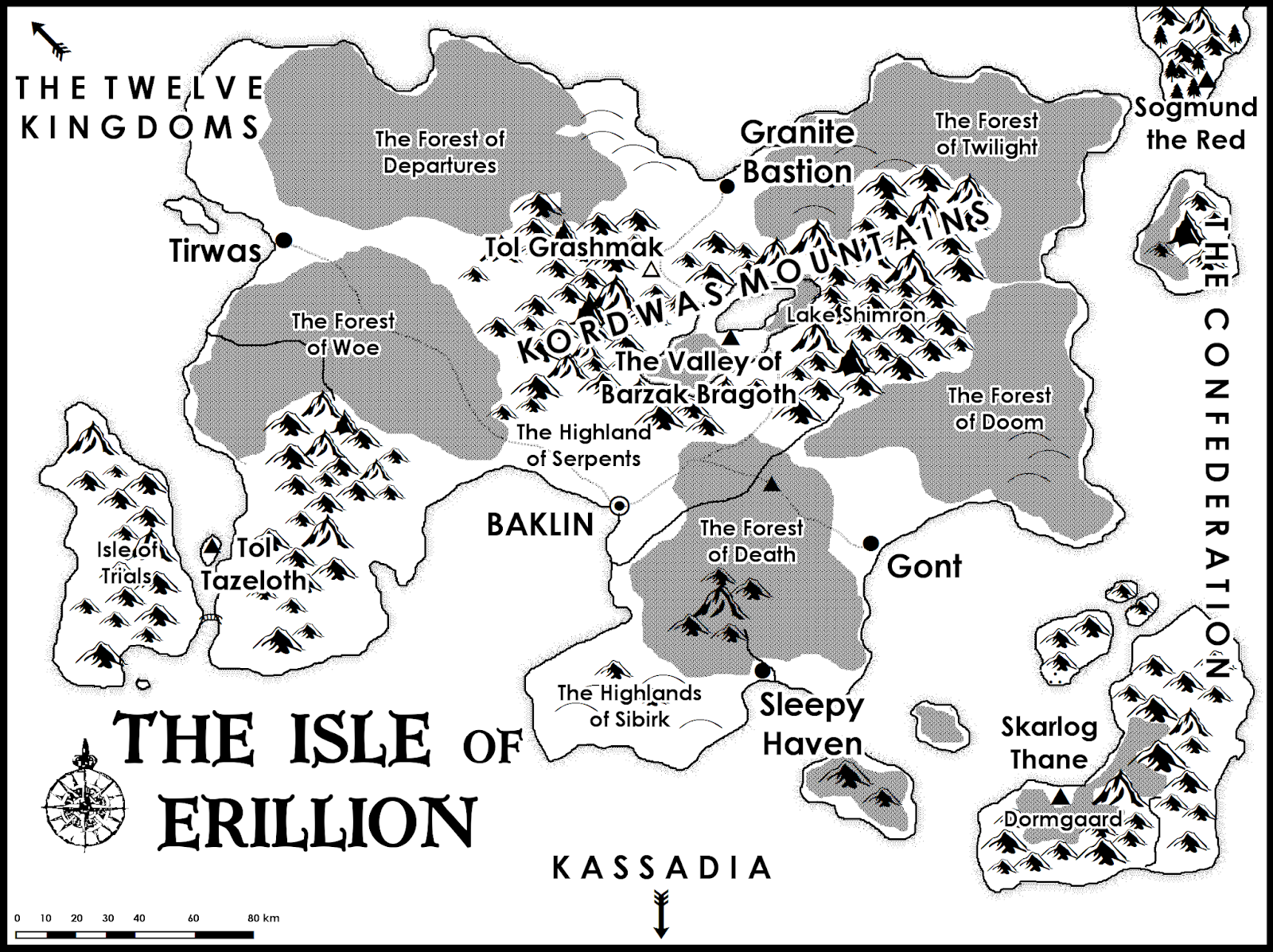
The Isle of Erillion
Adventures and the campaign setting

As vanilla fantasy does, Erillion was clearly inspired by the British Isles, a place I only know from secondary sources (my one brief visit to London was a trip to a strangely placeless global metropolis, and does not count). The mood of the island was influenced by the idea of successive civilisations each leaving their mark on territory before fading away, and leaving behind their ruins and half-remembered legends. This is perhaps best captured by The Ruin, an Old English poem wondering about what had once been, and which, along with the painting to the top of this post, gave me the initial spark for the setting.

Of course, the main texture of the adventures comes from 1st edition AD&D, particularly the DMG and The Secret of Bone Hill (through a Hungarian pulp fantasy series), and my aim was to capture that kind of experience, to return to that particular brand of adventurer fantasy I had always loved. I seeded my sandbox setting with adventures borrowed from the classics library: Huberic of Haghill became the main hub for the start of the campaign, Citadel of Fire was used for “The Mage Tower”, a place where magic-users and illusionists would go for their trials, and all three Giants modules were placed in remote mountain locations of the map (the characters never found G2, gave G1 a wide berth, and mistakenly entered the gates of G3, but fled once they realised they were in over their heads). A few more modules, old and new, were distributed in various locales. Bone Hill and Restenford could not be used directly – every old-school gamer in Hungary knows it too well through those novels to be of use – so I ended up paraphrasing them in The Mysterious Manor (Echoes #01) and the city of Baklin (hopefully published early 2020), places of my own creation.

I envisioned the campaign as a mixture between hex-crawl-based wilderness exploration and site-based dungeoneering and city adventuring. Somewhere along the way, I got infatuated with smaller pointcrawls, and ended up designing multiple forest adventures (and a large mountain expedition) in a “deep wilderness sandbox”. Enchanted forests are not too commonly seen among D&D adventures, and I liked the challenge of this unexplored domain. As it turns out, they are very rewarding to construct and run using a combination of trail maps and landmark-based navigation. In these adventures, the “dungeon walls” are permeable (although increasing random encounter frequency, the chance of being lost, and convenience tend to keep parties mostly on the road), and finding a high observation point gives away, if not the full map, at least some of its interesting features. Two examples of these adventures were published as The Swine Lord and The Wandering Glade (in Echoes #02 and #06, respectively); I can wholeheartedly recommend other people to try their hands at making one – just describe your forest or swamp as a regular dungeon, and go wild with it.

The Valley of Lost Graves
How do you keep a vanilla fantasy setting fantastic? My solution was to use a basic texture of (relative) realism for most of the milieu, but keep plenty of hidden or distant places as enchanted locales – sometimes what Moorcock described in Wizardry and Wild Romance as “the exotic landscape”. If you stay in the well-trod areas, you are in a world of scheming orcs, craven magic-users, feudal lords, Northman raiders and ambitious merchants, but go off track, and you enter an unexplored and mostly uncharted world of faerie enigmas, spatial anomalies, lost ruins and shadowy forest realms, where mundane logic gradually gives way to the working mechanisms of symbolism and uneasy dreams. One of the guiding concepts behind Erillion was that civilisation mostly stuck to the coastal areas and a small road network connecting mostly maritime cities, and civilisation could never really make great headway further inland. The deep woodlands and forbidding mountains of the island could contain entire pocket worlds far from human eyes. The key to the experience was keeping alive this contrast – and gradually, letting the players come close to the island’s deeper and more carefully guarded mysteries where all bets were off.

For its small size and self-contained nature (with about the land mass of Ireland), you can put a lot of stuff in a sandbox of this scope. One of the things that informed the campaign background was the variety of competing cultures and ideas, for whom Erillion would be both meeting point and place of conflict: barbaric Northmen raiders living in a combination of anarchy and petty tyrannies in an archipelago of island kingdoms; the disintegrating Twelve Kingdoms, locked in a perpetual civil war; the southern empire of Kassadia, the local equivalent of a Roman Empire that never fell to outside invasion but effectively dissolved into competing city states; and Erillion’s lost kingdoms, which had all left behind ideas and legacies, however vague. I did not really think through all of these details at the setting’s inception (the setting information was consciously almost all bottom-up and adventure-derived), but the details emerged over play, and made for a nice, cohesive whole, influencing internal divisions, and contributing to the different feel of different parts of the island.

So what’s next beyond Erillion? I still have two campaigns of variable frequency to run: Morthimion, an OD&D dungeon; and Kassadia, a game set in the aforementioned Roman/Italian setting. I also have plans outside D&D, for a Mini-Six (simplified D6 Adventure) campaign set in a setting inspired by the Cherubion trilogy, my favourite set of Hungarian science-fantasy novels (this is where the character of Melan comes from), and featuring the clash of primitive and advanced civilisations. As for Erillion, the paper folders now return to the bookshelf, although some materials are still to be published in Echoes or elsewhere – and we will see how it goes.

Drusus the Historian and Phil the Terror of Turkeys make a new friend
Characters (in order of appearance)

+Gadur Yir (Gabor Izapy): half-orc Fighter 5. The only survivor from the first party, Gadur Yir was resourceful, lucky, and sometimes even up to the ideals set by Haldor, god of heroism… until he was cornered and killed by Argul the Demented, an undead barbarian warlord buried beneath the city of Baklin.

+Jonlar Zilv (Kalman Farago): human Bard 4. He was petrified by a cockatrice among the ruins of Perladon Manor.

+Harmand the Reckless (Gabor Acs): half-orc Cleric 4 (of Zeltar, God of Fortune). An adventurer in the classic sense, he sought risk and reward in equal measure. He was eventually fireballed by Godfred Perladon in the crypts beneath Perladon Manor.

+Einar Sigurdsson (Istvan Boldog-Bernad): Northman Fighter 4. Einar’s origins as a sea wolf came handy after the company orchestrated a slave uprising and took over the dragonship of Lady Geranith, a northern princess. He would have become an able sea captain, were he not also fireballed by Godfred Perladon in the crypts beneath Perladon Manor.

+Sufulgor del’Akkad (Laszlo Feher): human Cleric 3 of Kurlakum of the Seven Misfortunes. A truly wretched follower of an evil deity with delusions of grandeur (“just call me the Master of the Night!”), his way towards more substantial villainy was cut short during the siege of a homestead ruled by a small clan of werewolves. Trying to save his skin, he offered his cut-off nose and a terrible oath as a sacrifice to his deity, but it was of no use, and he was torn apart by wolves.

+Elandil Hundertwasser (Laszlo Feher): elf Cleric 3 of Irlan the Merciful. Coming from “the forests of song and harp-music in the distant West”, he made an instant impression with his flower-embroidered green cloak, and sayings like “It is a great sorrow, that man may not become a flower”. He was fireballed by Godfred Perladon in the crypts beneath Perladon Manor.

Drölhäf Haffnarskørung (Kalman Farago): Northman Fighter/Thief 9. Coming from a culture best known on Erillion for raiding and indiscriminate violence, Drolhaf (who earned his ümläüts over the span of the campaign) was a civilised barbarian who even had “soap” listed on his character sheet. Serving the interests of Gladuor, God of Aqueducts and human progress, he survived the campaign, and joined the Knights of Jolanthus Kar to keep peace on the island.

+Franz Who Wasn’t Even There (Laszlo Feher): human Illusionist 4. A talented “background player” who manipulated things from the back ranks with 6 Hp, he was, eventually, flattened into a paste by a boulder trap in the Singing Caverns.

Phil the Terror of Turkeys: hobbit Thief 9. Using several aliases (“Greg the Rat-catcher”, “Jan Quietstep”, “Uncle Philemon”, “Karl, the Guardian of the Flower”), this jovial and portly-looking hobbit grew into a frighteningly efficient killer by the end of the campaign, especially once he got his hands on the ring of gateways (which gave him the ability of using dimension door). He was also known for his love for mushrooms, which he knew very well.

+Dawn of the Southern Climes (Istvan Boldog-Bernad): elf Bard. His name a poor translation of the much more flavourful “Délszaki Hajna”, he was encountered in a valley known for an enchanted flower. On the way out through a sequence of cavern passages, he was caught and strangled by a ghost.

+Balthasar the Elf-bane (Istvan Boldog-Bernad): dwarf Cleric 3 of Haldor, God of Heroism. He was flattened into a paste by a boulder trap in the Singing Caverns.

(+) Buck (Laszlo Feher): half-orc Cleric 3 of Agak the orc-god. A walking disaster instantly hated by the rest of the party, he saw fit to retire after just one adventure. He was encountered much later as a much more powerful NPC cleric in the orc fortress of Tol Grannek, and was defeated during an epic battle at what would later be called Orc-Kill Pass, backstabbed by Phil the Terror of Turkeys with a dagger carrying rock spider venom. Petrified, the lifeless body of Buck was left as eternal reminder of the great slaughter.

Drolhaf Haffnarskorung, Silver Olaf Thorvaldson and Armand the Scumbag
encounter suspicious barbarians on the Plateau of Faces
Lafadriel Hundertwasser (Laszlo Feher): elf Fighter 9. An armoured knight and much less talented minstrel (with a Strength of 12 and a Charisma of 8!), Lafadriel came from “the distant West” to find and bury his dead brother, Elandil Hundertwasser. Of a gloomier disposition than Elandil, his poetic adventures were either wildly successful or complete flops, with no place in between. He survived the campaign, and true to his word, returned to his homeland with Elandil’s remains.

Armand the Scumbag (Istvan Boldog-Bernad): human Assassin 9. An ominous stranger from the distant and decadent, Italy-inspired lands of Kassadia, Armand, who had sometimes also called himself “Yil the Mysterious” (but was really called Arianus) was sent by his brotherhood to investigate the opportunities for expanding the business on the Isle of Erillion. Finding himself in the middle of a bid for power by the assassins of Gont, who had betrayed, and were slowly killing off the rival crime networks on the island, his cover soon compromised, he successfully turned the tables to his own advantage, and – when the campaign was finished – managed to take over the local crime business.

+Drusus the Historian (Gabor Izapy): human Magic-User 6. Coming from the southern lands, Drusus was tasked by his new mentor, the wizard Slarkeron, to bring him the brain of a mind scrambler to let him take the Test of Mastery. Ironically, Drusus met his end much later in the icy mountains, in the secluded tower of a mind scrambler, which had reduced him to a drooling vegetable and sucked out his brains.

Silver Olaf Thorvaldson (David Barsony): northman Cleric 3 of Edoran the Mysterious. A puzzling figure who would occasionally appear out of nowhere, join the company for an adventure or two, then disappear just as mysteriously. This is something the others had found creepy – was he following them? Was he a spy? A dimensional anomaly? He was not telling.

+Yaxur (Gabor Izapy): human Cleric 6 of Roxana, Goddess of Death. Yaxur joined the party after Drusus’ unfortunate demise, and lasted all of a half session. Coming to a great stone throne on a high mountain peak buffeted by icy winds, Yaxur was the first to encounter Kornax the Revenger, a powerful anti-paladin cursed to this place. Yaxur won the fight by ambushing Kornax with a hold person spell and killing him outright (thereby winning the powerful sword of chaos), but he did not count on Kornax coming back from the dead next night and massacring him without breaking a sweat.

Zartan (Gabor Izapy): Illusionist 7. He was the last to join the group, suddenly appearing among the mountains in his elegant clothes. Was he motivated by anything more insidious than a desire for loot and new spells? The world would never know.

Grey Ooze : Magic Spear 1:0
Notable quotes

Jonlar Zilv, musing about the party alignment: “If I sold you lot out to Lord Gramantik, my alignment would move a notch towards ‘good’.”

Gadur Yir: “Werewolf wounds! We must burn them out with fire.”
Jonlar Zilv: “I am already feeling better!”

Einar Sigurdsson: “I believe we should stop exploring hypothetical realms of fantasy, and go loot that manor house.”

Jonlar Zilv, stoned: “I call it ‘temporary invulnerability’.”
Harmand the Reckless: “I call you our ship’s new figurehead.”

Elandil’s player, after a near-TPK, where Elandil and the rest were torn into bits by a fireball: “But who will now make the world a better place?”
Someone else: “Not you.”
Someone else 2: “Was this a homemade module?”
Elandil’s player: “Do you really think anyone else could make up something like a shadow shooting a fireball?
Someone else 3: “The ecological footprint of Gygaxian Naturalism strikes again.”

Gadur Yir, about 500 gp worth of cave crystals: “The two of us mined it together, while the rest of you were cowardly homos. It is ours.”
Drolhaf Haffnarskørung: “In civilisation, everyone does his own share of work. We guarded the passage while you were exploring, and we have our due.”
Gadur Yir: “A Marxist barbarian!”

Phil the Terror of Turkeys, under attack by a giant stag beetle, to Drolhaf: “It is going for your horned helmet; it just wants to mate with you!”
(…)
Gadur Yir: “I wipe the bug juices from my rations.”
Franz Who Wasn’t Even There: “You wanted to play David Fucking Attenborough, wise guy.”

Franz Who Wasn’t Even There: “This must be a gender-conscious sphynx.”

“Favoured enemy: Doors.”
Franz: “I am not really in love with this fucking door.”

Drolhaf Haffnarskørung, after Buck sent his new followers to their certain doom: “…But you are the follower of Agak, NOT Ayn Rand.”

Phil the Terror of Turkeys: “I slide the poor widow a coin as my condolences, and as a form of carousing.”
GM: “It is worth no XP because there is self-interest involved.”
Phil: “I take back the coin.”

Lafadriel’s player: “The menu is… gelatinous cube in aspic. And then, black pudding.”

Phil the Terror of Turkeys: “This was no random ambush.”
Armand the Scumbag: “It couldn’t have been meant for me.”
Lafadriel Hundertwasser: “Who could have done such a thing?” – I ask the cruel stars, but there is no answer.
Phil the Terror of Turkeys: “I know these things and it was definitely meant for you. Look, Armand, it might be time for you to assume a fake name.”
Armand the Scumbag: “I am not very creative with these…”
Phil the Terror of Turkeys: “You could be… Armand the Clod!”

Drusus the Historian, dripping with water: “The grand master of sailing found us a leaky boat.”

Lafadriel Hundertwasser: “My whole wealth amounts to 25 gold pieces, but at least the light of the stars is mine.”

Someone: “Have the mugs been cleaned [in this pub]?”
Lafadriel Hundertwasser: “When the world was young...”

“My god is Erdogan... no, Edoran!”

Lafadriel Hundertwasser: “This is a low-budget valley.”

Drolhaf to Lafadriel (after Drusus tried on the expensive boots and the golden diadem): “Is your god also Robespierre?”

Lafadriel Hundertwasser: “Rest here? In the Forest of Death?”
Drolhaf Haffnarskørung: “This is where we will screw the pooch.”
Drusus the Historian: “Just two or three days?”
Someone: “You have already died twice in this campaign.”
Someone 2: “Yeah right, the Forest of Death is famous for providing a healing rest.”

Silver Olaf Thorvaldson joins the party.
“We could use a few strong hands.”
“That’s two of them, because that’s how many you’ve got.”

Lafadriel Hundertwasser: “The spiders are not evil… they are just different.

Armand the Scumbag, to a new party member: “Can you break curses?”
“Impotence is no curse!”

Silver Olaf Thorvaldson, looking at small figures in the distance: “Are these giants? …or dwarves?”

Phil the Terror of Turkeys, after encountering some giant goats guarding a gold vein: “We shouldn’t tell this tale in the pub… crapping our pants and chickening out when we saw a bunch of goats.”

“Why do you think you are the destined bearer of this sword?”
“The world has carried no greater scumbag than I.”

“What kind of moss isn’t suspicious?!”

“There is no more paper this way, let’s go in the other direction.”

Zartan has donned a helm of opposite alignment, turning from Chaotic Neutral to Lawful Neutral.
“Wait… he can’t steal from the party anyore!”
“Oh YEAH!”
“Yesssss!”
“It was worth it.”
“You are the reason we set guards at night.”


Saturday, 5 October 2019

[REVIEW] Tower of the Moon


Tower of the Moon (2019)
by David Pulver
Published by Night Owl Workshop
Levels 3-6

Towers adventures are hard to design. Limited by their shape, most are linear, small affairs that don’t really offer many exploration opportunities; the exceptions tend to experiment with fantastic architecture (The Ghost Tower of Inverness, Sision Tower), add extra areas below or near the tower (Citadel of Fire), or both (Dark Tower, which is cheating a bit). To its credit, Tower of the Moon makes good use of the simple tower format: it presents a complete, 23-area mini-dungeon in as many pages.

Tower of the Moon
This is a “fairy tale gothic” ghost tower, featuring a heavy werewolf theme. It describes what was the sacred place of a neutral/good-aligned goddess associated with wolves, love, dance and hunting. As the premise goes, the tower fell after Mordark, a magic-user whose very name must have evoked the denizens’ trust, betrayed the tower’s high priestess and destroyed the place with a powerful curse. Now, of course, the haunted ruin is active again, and a young local noblewoman has disappeared inside along with a company of adventurers. The tone of the adventure is more 2nd-edition era high fantasy than murderhobo stuff; at points, it is unabashed gothic romance, and it is built on assumptions which would be better fit for a heroic 2e campaign than something more mercenary. In that respect, it uses both the werewolf theme and the romance element skilfully.

Hewing closer to 2e (where gold is no longer the main source of XP), the module has little in the way of treasure: its monetary rewards are almost comically meagre, with loot like 20 lbs worth of cooking implements valued at 10 gp, two glass goblets worth 2 gp each, a well-aged bottle of white wine marked Hawkwood Estates (4 gp), or a 200 gp throne weighing 400 lbs. This is agreeable as long as you use either a gp or an XP multiplier – I would use at least ×10 here, and still drop some of the junk loot. Then there is inexcusable stuff like 3 silver pieces in a giant rat nest, or a 25 gp crescent moon amulet “in the bottom of the muck in the chamber pot beside the nest”. It is hard to think of this stuff as “treasure” in any meaningful sense.

The encounters are an even mixture of the straightforward and the fantastic. The module is at its weakest when it goes into describing “cabinet contents” barracks rooms and storerooms in too much detail – there are worse offenders, but this is an area where the module could have been easily tightened up significantly. But there are also entries which show promise; the tower features multiple well-designed, creepy lycanthrope-based traps (although also a few poison needle traps too many – don’t bring Black Leaf on this expedition), innovative curses, and some fine custom magic effects. This is where the module clearly shines, and even the treasure gets slightly better.

There are some severe organisational problems in the module text. The room entries are written in a haphazard order where trivial details are followed by way more important stuff. Right in room 2, we learn about a lot of clutter and junk in the room before learning that there is, also, a cockatrice behind a barrel. In some places, the text actually jumps back and forth, in addition to hiding the room’s most important and utterly obvious features after an in-depth description of historical books on a dusty shelf (22B). Fixing these mistakes would have been a question of basic editing.

Altogether, Tower of the Moon is a mixed bag. The beginnings of a good module are there in the text, and I think the author’s next project could be quite good if he focused on the things he does well (good high fantasy adventure, interesting magical things to mess with), and fixed some of the mistakes. There is nothing fundamentally broken in the module, and a sequel could easily focus on its present strengths without doing something significantly different.

This publication credits its playtesters fairly.

Rating: *** / *****