Showing posts with label sandbox. Show all posts

Wednesday, 22 March 2023

[CAMPAIGN JOURNAL] The Inverted Tower of Hyél Singh

I bring you news of glory and death from the City of Vultures!

Four adventurers, sworn to take revenge for the destruction of the fair city of Avendar, have conspired to track down and assassinate their penultimate target, “He Who Is Not Known”, who has so far drawn many veils of secrecy around him. By now, dead was Isomarg, Maker of Images, identified at a ball of the rich and influential, and hunted down in his own residence. Dead was Ardaviraf, He Who Slumbers Deep Beneath, roused from his drugged torpor to which he had consigned himself, and confronted and killed as he emerged to a higher level of the Underworld. And dead was Vifranavaz, He Who Walks Beyond, followed to the Crystal Palace, an orbital pleasure resort, and found already dead in the dark vacuum of space among the stars he had sought with such obsession. But the price had been high: many of Avendar’s finest agents were also killed in action, with new operatives taking their place. The sole survivor of the second team (after the ill-fated first was unmasked and neutralised) was Farzan, Savant of the Seven Mysteries (Magic-User 9, recently reaching name level), and he was joined by Bron the Elder (Fighter 8, who could calculate the exact value of any object with mathematical precision due to a strange device implanted in his skull deep in the Underworld), Tigran Zard (Cleric 7, a servant of the baleful Sea Demon), and finally Farsi the Younger (Thief 6, Farzan’s created simulacrum).

Two more foes remained: Mehersimin, the Faithful Companion, who had chosen to abandon high society and marry the dreadful Kwárü Khan, a subterranean horror whose very name was only spoken in whispers; and “He Who Is Not Known”, who had practiced complete anonymity. A few fractions of information were known: that “He Who Is Not Known” was a high-ranking priest of the Temple of Jeng; and that he had once infiltrated Avendar’s avengers under the name “Jamal”, and feigned his death when he had presumably learned what he wanted – the latter fact revealed in the mirror of the vampire-mage Riamos in his sealed tower. Divine prophecy could not find “He Who Is Not Known”, only that he was hidden even from the eye of the gods. It was eventually theorised that “He Who Is Not Known” might be using an amulet of proof vs. detection and location, and the company’s objective was thus focused on tracing the route of these items through the City’s trade networks.

In the previous episode, Bron the Elder and Tigran Zard had masked themselves as desert nomads, and visited one Lady An-Raydn, an aristocratic socialite running the most exclusive trading house on Uugen’s Market. Here they learned that these items were indeed for sale, but in such high demand that there would be a long waiting list. Bron and Tigran Zard nodded, and took a good look at the document where the lady’s scribe had recorded their aliases. The same night, a quick heist was conducted to enter the trading house, procure the document, and make a copy – and leave quietly. The names had, indeed, revealed a clue: an amulet was purchased by one Hothog Mirza, as an intermediary for the Temple of Jeng. The infiltrators were left pondering in a dark street about their next move…

Tuesday, 2 November 2021

[BLOG] Hex-crawls: A Simple Guide

A slice of the Wilderlands
Irony: no longer just a diet rich in ferrous metals. Old-school gaming is now officially old, having lasted way longer than the period of gaming it looks back on. The line loops back on itself again; we are not just old, we are double-old, and with age, accumulated wisdom is lost, formerly self-explanatory ideas become objects of mystery. This constant erosion is unsurprising. You can fight back, but never win. Still, at least we can go down swinging, and that’s better than nothing. Today, we shall endeavour to do so by restating the idea of a great, simple game structure that surprisingly many people fail to understand, or pretend to fail to understand: the hex-crawl.

If Bryce Lynch doesn’t get it, others might be utterly lost. Perhaps what many of us considered obvious, isn’t. Perhaps so much detail-oriented guidance has been published that the basic, simple idea is getting lost in the discussion. But the main issue I am seeing – something even people like Justin Alexander have fallen into – is that people present an idea of hex-crawls that’s much more convoluted and hard to follow than what most of us actually need for our table. There is scattered wisdom in those pieces, but the maximalist approach they are advocating is not practical for most, especially beginners. The basic hex-crawl, in comparison, is dirt simple to understand, design, and run. Hence, this post. A simple, concise guide can explain the essentials – and if you would like, you can later expand your own procedures in a modular fashion.

* * *

Why run a hex-crawl?

Hex-crawls are a great way to run games based on wilderness exploration. Their main strength lies in turning a wilderness map into something you can describe and play with ease. Hex-crawls offer a good value for the effort that goes into creating them. Even a relatively small wilderness area described as a hex-crawl can be used and re-used several times. You can easily expand them both outwards (describing more of the map using this method) and inwards (adding more features and deeper detail). Hex-crawls can be developed piecemeal, and they are easy to scale to the interests of your adventuring party.

* * *

The basic principle

You might remember a common way to describe RPGs to outsiders: “This game is all in your imagination, played without a game board.” Hex-crawling is a lot like that game, but with a game board added to it. This board shall consist of two map sheets with numbered hexes. One of the maps is for the Gamemaster, and like your usual dungeon map, it is marked with terrain features, and an encounter key. Unlike dungeons, the key is not numbered sequentially, but by hex coordinates: a certain number of hexes may have varied features in them, while some are “empty”, consisting only of terrain. The second map is the one the players actually see: while it conforms to the first in most respects, this one is much more sparse, usually showing coastal outlines, a few major geographic features, and maybe a section of the “known” lands. The rest is left blank for later discovery.

Over the course of play, moving around and exploring the wilderness map, filling in its blanks, and coming across the keyed encounters shall be the focus of the game. The exploration process may be complicated by random encounters, navigation hazards, the depletion of food and equipment, and other complications like bad weather, or events keyed to the passage of time. Like dungeon adventures, hex-crawls are a combination of keyed encounters, random events arising from game procedures, and emergent gameplay created by GM–player interaction. A good hex-crawl is a lot like a good dungeon – reasonably open-ended, challenging, accommodating of player decisions, yet not overwhelming at any single decision point, since every given hex allows only six directions of travel from it.

* * *

Constructing the GM map

The Central Marches
Many game world focus on the big picture, the world at large. In a hex-crawl setting, we will be doing the exact opposite, by describing the micro-world. Our main concern is not the extent and ancient history of empires or the cosmology of the gods, but the local lord acting as an agent of the distant imperial seat, or the secretive monastery hidden in the woodlands. It may be useful to have a very general framework for the sake of style and internal consistency, but what really MATTERS is local detail and variety. The scale of the maps itself should reflect this. We are not making continents, we are making provinces or baronies. Many hex-crawl games use the six-mile hex (which became the default for Judges Guild’s Wilderlands setting), which is really fine-grain, and lets characters move through a lot of hexes in a single game session. I usually go with twelve miles (or around 20 kilometres). Greyhawk’s 30 miles per hex, as seen on the classic Darlene Pekul maps, is generally too large for the details we want – Greyhawk is definitely a big-picture place.

Accordingly, map a small corner of the larger world. A starting campaign can easily exist on a stretch of land measuring 12×12 six-mile hexes. Instead of large expanses of homogenous terrain, I would suggest making things varied in terms of both topography and land cover. Starting out with a random-generated map and adjusting it a bit to make the geography slightly more realistic works surprisingly well – there is a random terrain filling method in the AD&D DMG (Appendix B), and Hexographer comes with a default random generator, which I used for the example map here. You will notice a few features which tend to be desirable:

  • a single terrain type tends to cover 8-10 hexes, and rarely more: this makes the land mass varied and distinct;
  • there is a balance of easily navigable, challenging, and generally impassable terrain: choosing where and how to travel becomes an important player choice;
  • water is used prominently, forming seas, a lake, and river basins;
  • prominent features – castles, dungeons, settlements and temples – are distributed logically, but sparsely: travel is a necessity in the setting;
  • roads might link the most important centres of civilisation, but adventure lies off-road: we have a proverbial “points of light setting”, with relatively safe areas along the roads, and dangerous wilderness beyond them.

Not every map has to follow a similar structure, but this combination should make for a good mini-sandbox. If you would like to construct a larger region, Volume 4 of Seven Voyages of Zylarthen (on which more in a later post) describes a semi-random Hexographer-based method that shall create an entire campaign’s worth of terrain.

 * * *

Stocking the GM map

This is the meat of the hex-crawl. Interesting locations, lairs, and the more complex sort of encounters can be seeded across the hex map, waiting for the players to come across them during their explorations. After placing a few important locations by hand, it is most useful to turn to a random generation method. Establish hex locations via this method:

  • roll 2d6 for each 12-mile hex (or 2d12 for each 6-mile hex) with two different-coloured dice for each hex (this can take some time);
  • a “1” on the dice indicates either a ruin (usually marked with an “x”) or a lair (usually marked with an “L” or “·”) – mark these on the map;
  • for hexes with mixed terrain (e.g. forests meeting mountains), check both terrain types;
  • you may want to re-check hexes which have a feature to see if they may have a double one.

The Central Marches, with
locales of interest
The exact content of the hexes is written into the hex key, where entries are identified by the four-number coordinates. This is similar to a dungeon key in scope and detail, focusing on the essential and leaving the rest to improvisation. Like with dungeons, random idea generation tables can be useful for stocking a wilderness, at least beyond a range of initial entries which establish the mood and challenges of the place. Once you have a general idea for the region, the details shall fall into their place. For example, using our previous map, we may begin our hex key like this (stats and most treasure values not included):

0306 ANTZUN, village of 100 goblins eking out a miserable existence, and paying tribute to the orcs of Castle Gardak (0203). Some of them know a way through the mountains, and may be hired as guides, but 1:6 to be treacherous.

0310 FELL, village of 100 men, regularly suffering hobgoblin raids from the west (0109). Foreman Valumbe the Provider (Fighter 4) throws miscreants and evildoers into a dry well to starve, but some of the dead come back from the walls to claim the living.

0311 Fallen palisades surround a crumbling villa, inhabited by 35 bandits. Their companions and leader, Felso the Humble, have been captured by Valumbe the Provider (0310), and are in need of rescuing. 1200 sp, 100 gp.

0406 Lair of 60 brigands raiding the road from their temporary camp. They are led by Eilakolin the Merry (Fighter 8, treasure map) and his lieutenants, Priago the Fighter (Ftr 4) and Ethy the Quick (Ftr 4). They have buried their coins at a secret location, and currently have 1000sp, and a box of gems from a captured merchant (10 gp, 2*50 gp, 10*100 gp, 4*500 gp, 2*1000 gp).

(and so on, see the end of the post for the starting area)

The hex-crawl, of course, is not the complete campaign, but a component of it. Add a starter dungeon (and start thinking about one or two more – they don’t have to be large affairs), a few rival power centres and organisations, and you have a full landscape of adventure (see this post for a general idea). A hex-crawl is a great place to stick adventures written by other people, too, and it is one of the frameworks where mini-dungeons, even the better one-page dungeons can find a good home.

 * * *

Managing the crawl

Once we have the hex map, the key, and a few places with more detail, the campaign is ready to play. To start the crawl, set the players down on their version of the map, which can be as sparse or as detailed as you wish (the less detailed it is, the stronger the sense of discovery, but the more time will be spent with mapping). At this point, it is important to establish some basic context – where they are, what they have known or heard of the surrounding territory (a rumour each player may be a good way to accomplish this), and approximately where have they heard of capital A Adventure. We can begin!

Much of the hex-crawls occurs through simple procedures. Here are the essentials:

Descriptions: describe what the party sees in the surrounding hexes in a brief way. This should include terrain, visible landmarks, and maybe a little detail. For example, using our sample map, and starting from the castle home base at 0608, the GM could begin thus: “Day one breaks as you ride out through the gates of Krakhal. It is still misty, but you can see the roads meeting here: the Winding Way crossing the river to the NW and going through farmlands towards the mountains where stands the tower of Breezehall  to a day’s journey; the other direction heading SE and disappearing in wooded hills. A more narrow cart road crosses the river to the W, then heads SW through grassland. In this direction lies Fell, a village where you have heard of troubles with raiding humanoids and brigands. To the N and NE stretch thick forests, and to the S, you see tall peaks.” From here on, the descriptions can be even shorter: “You cross the grasslands into 0509, along the river running SW. NW lie woods, SW and S are flat grasslands, and SE are the mountains. The road continues SW.”

Here be giants
Movement: let the players declare the directions they are moving, and calculate how much terrain they can cross at their movement rate. As a rule of thumb, 4 6-mile hexes of terrain (plains, wastelands, coast), 2 hex of medium terrain (forest, hills), and 1 hex of hard terrain (mountains, swamp) can be covered on foot, or 6/4/1 while mounted. For 12-mile hexes, just halve this rate. For mixed terrain (likely), it is sensible to divide the day into a morning and afternoon stretch and see how much distance the characters cover. There are movement systems which use “movement point costs” to enter a hex of a specific terrain type, which are more abstract, but a bit easier to calculate with.

(Getting lost): This is a probability used in various A/D&D editions to see if the party veers off course or becomes lost while moving in the wilderness. It is not a rule we are actively using, but it adds a layer of uncertainty to exploration, and unless the party is moving along the roads, it may lead them to unexpected places of interest!

Encounters: the characters shall come across the fixed encounters on the hex key. There is also a good reason to use random encounter charts to vary things a bit. Generally, roll random encounters once per two six-mile hexes travelled with a 1:6 probability, or twice per day and thrice per night if camping (this can be reduced if the characters have discovered or created a safe shelter). Not all encounters will be fights to the death: hunting animals may avoid the party, while intelligent denizens may want to trade, negotiate, ask for directions, or provide the same… if the reaction checks are good enough.

Supplies: assume one ration per day of travel, and separate water rations where needed. Hunting and foraging may be a way to find food on the way. For a simple system, roll 1d6, with a +1 for skilled outdoorsmen and +2 for rangers and druids, and -1 for frood-sparse regions like high mountains. Food will be found on rolls of 4+, with an extra ration per point over the threshold.

Weather: this is simple and fun for situational variety. Just roll 1d6 per day to establish the dominant weather, from 1 (sunny, clear) to 6 (heavy rains, strong winds, heavy fog), add a situational modifier or two if needed (e.g. by terrain or season). If daily rolls make the weather too “swingy”, assume that stretches of weather will last 1d3 days or even more, or that changes will be in increments of one point at a time.

This is (more or less) the simple system we are using at our table. It is not completely realistic, but it is in keeping with the complexity of dungeon procedures, and makes for a rewarding procedural package which does not slow down play, works out fine, and can be messed with from time to time to shake things up a bit.

* * *

Details which are a matter of taste (but here is my opinion anyway)

Should a terrain type fill a whole hex, or not?

My hex maps are usually more organic, and the hex grid is simply overlaid on a map. This is also the way Judges Guild did things. Hexographer (which I used to illustrate this post) fills every hex with a discrete terrain type. This is okay, too, and slightly easier to adjudicate.

Some people suggest the hex map should be the GM’s tool only, and this “layer” should be hidden from the players. Which one should I pick?

This is the approach advocated by Justin Alexander for reasons of deeper immersion. For ease of use reasons, I would personally recommend the exact opposite, the use of identical player/GM maps with a different level of detail, like in the original Wilderlands products. This translates wilderness navigation into a game board you navigate and gradually fill in with terrain and points of interest. It is a game, and there is no harm in revealing most of its rules, including the hex numbers. In our campaigns, I rationalise the latter with the assumption that hex numbers represent astronomical navigation schemes, or (in science-fantasy campaigns) data from orbital GPS systems.

Do I have to create an entire map’s worth of content before beginning a campaign?

This actually matters! There is absolutely no need to create a whole setting in one go. Create a kay for a relatively small area, then expand outwards as it becomes necessary. Everything you need to know beyond the initial area can be handled as a simple rumour. “North of the Mountains of Fum lies a ruined city inhabited by ghouls. The Crown of Power lies underneath!” or “Monkeys are a delicacy in Katang, but sacred in Pand; and the two towns are almost at war over this matter.” – this much would be sufficient.

How detailed should hex entries be?

For personal consumption, as detailed as your average dungeon room. Some, like major towns and power centres may deserve a little bit more, maybe a bullet-point list. But keeping things brief and versatile is usually the for the best.

What if I have a map, but they don’t start exploring?

A handful of rumours with promises of adventure and treasure can be enough to get the characters going. It is also advisable to place adventure sites in out-of-the way corners of the world, so discovering their exact location requires travel through strange lands. Various quests and missions can also take characters to these fa-flung corners of the milieu.

What if they never go off the road system?

Many such cases! That’s why there should only be few roads, and many places the company has to visit should lie beyond them. This is best caught in the planning phase.

Since hexes cover a lot of territory, shouldn’t adventurers have a chance to miss keyed features?

This has always struck me as bad advice, since the point of hex-crawling is to find cool, interesting stuff, not walk by it. It is in both the player’s and GM’s interest to bring these encounters into play while travelling through the wilderness. You could rationalise it with the understanding that a given hex probably has multiple interesting features, and your party will find the one being described in the key. But generally, unless a feature is deliberately hidden, it is best to let the characters find it. You can always add secondary and tertiary sites later, if needed, although it is also vital to expand horizontally, and encourage players to seek out new lands and sights.

What about three-hex/seven-hex/hex-flower wildernesses?

Nah.

* * *

The Central Marches: A sample starting area

This is the slice of the region you might describe before the first session. You will note that there are 19 locations being described, including a few hubs of civilisation (the "points of light", with simple adventure hooks), seven ruins, and 6 monster lairs. You can place a larger starting dungeon somewhere close to the centre (this could be beneath the strange garden at 0407, two hexes from KRAKHALL), and a smattering of smaller ones all around: perhaps beneath the well in FELL (0310),  the buried passage in the ancient shrine (0506), the secret treasure cave (0610), the eccentrics' tower basement (0707), the Pavilion of Engadrok (0710), and the emperor's undersea villa (0808). If this sounds too much, that's because it is: you do not need to do it all at once, and many of the possibilities may never enter play (they are well hidden, the entrance is buried or enchanted, etc.).

It is also likely that the campaign will move beyond the initial area in some direction. Perhaps the players will want to visit the city at 1108, follow up on the humanoid raids originating from the advance hobgoblin camp to the west (0109), or travel north beyond the mountains and see what lies in that direction. Do not waste too much work: it does not hurt to be a little lazy in a hex-crawl campaign. If something is particularly important for you, link it to the players with multiple rumours and adventure hooks, and they will likely find their way there.

Once you have the ideas for the hex-crawls, connect, leverage and reuse them: let the brigands at 0406 start harassing merchants along the road, or the hobgoblins send a shipment of captives to the orcs in Castle Gardak (0203). Perhaps the greedy merchants ruling the city want to depose the incompetent Lord Fumme in WOOLBERG (0810) by kidnapping his daughter. A trail of investigation leads to the lawless village of WYRHOLM (0611), and at that place, the characters hear of a treasure-hunting expedition across the mountains (0610). These links and leads make the setting alive and interconnected, and will soon serve as an organic substitute to the rumour table. The campaign will be, to an extent, self-sustaining within its geographic and thematic boundaries.

The Central Marches:
Initial Scope
0305 A few walls and a collapsed tower remain from a wizard’s mountain stronghold, now inhabited by 4 griffons. In their nest, they have collected 3000 sp, an efreet bottle, and Helmbrand, a Neutral sword +1.

0306 ANTZUN, village of 100 goblins eking out a miserable existence, and paying tribute to the orcs of Castle Gardak (0203). Some of them know a way through the mountains, and may be hired as guides, but 1:6 to be treacherous.

0310 FELL, village of 100 men, regularly suffering hobgoblin raids from the west (0109). Foreman Valumbe the Provider (Fighter 4) throws miscreants and evildoers into a dry well to starve, but some of the dead come back from the walls to claim the living.

0311 Fallen palisades surround a crumbling villa, inhabited by 35 bandits. Their companions and leader, Felso the Humble, have been captured by Valumbe the Provider (0310), and are in need of rescuing. 1200 sp, 100 gp.

0406 Lair of 60 brigands raiding the road from their temporary camp. They are led by Eilakolin the Merry (Fighter 8, treasure map) and his lieutenants, Priago the Fighter (Ftr 4) and Ethy the Quick (Ftr 4). They have buried their coins at a secret location, and currently have 1000sp, and a box of gems from a captured merchant (10 gp, 2*50 gp, 10*100 gp, 4*500 gp, 2*1000 gp).

0407 35 gnolls are picking through the ruins of an extravagant garden. Brass idols of various animals on top of standing columns have magical effects: bull – save vs. spell or berserk rage, serpent – offers healing fruit bearing strange curse, wolf – save vs. polymorph or contract lycanthropy, swan – gives feather to most beautiful character, touch heals 1d6 Hp, bear – save vs. spell or sleep 1d6 days, pelican – gives key in exchange for a fish. Buried under a large pile of rubble is the villa of a magic-user, now a repository of mirages. [Ideal for a mini-dungeon]

0409 Crude rock monuments of a preshistoric people stand painted by the grassland road. 18 prize horses (2d6*100 gp each) are grazing nearby, belonging to Bobend the Bastard (Fighter 7), who lives nearby in a filthy tent with 5 wives and 9 mean, unruly children.

0505 BREEZEHALL, tower of the Lord Yverr the Silent (Ftr 9), served by 90 men-at-arms patrolling the mountain road, and Dalco the Orphaned (M-U 5), the descendant of a forgotten king. Lord Yverr is obsessed with five stone thrones on a nearby mountaintop, each struck through with a sword that shall not budge. He is welcoming to guests demonstrating nobility, but has been known to capture and fleece the soft and squeamish.

0506 6 brown bears live in a cave near the mountain road, and have 1:3 to venture out to prey on travellers who do not outnumber them 2:1. The cave is decorated with ancient cave paintings, and ends at a buried passage between two crude statues of snarling bears.

0507 There are giant trees near the road with 8 hippogriffs lairing in the branches. They are only 1:12 to venture out for men (1d4+4 coming), but horseflesh has 1:6 to draw all eight. The giant nests are strewn with bones, and a dagger +1, 3 vs. orcs and goblins is entangled in the branches.

0511 2 fire-breathing giant lizards, particularly colourful in their resplendent hide (worth 800 and 3000 gp intact), enjoy the sun on flat rocks. Their lair, a crack between the enormous boulders, is the source of a spring, overgrown with healing herbs (2d6 doses, +1 to nighttime Hp recovery if prepared as a tea).

0608 KRAKHALL, castle of the Lord Sinds the Righteous (Ftr 9), 90 men-at-arms, and 3 champions (Ftr 7) who serve him enthusiastically. Lord Sinds is the mortal enemy of Lord Fumme the Unlucky (0810), and even his foe’s name can send him into an uncontrollable rage. The moat has been populated with killer frogs as a form of defence, but this plan has not been thought through, and the beasts have become pests in the countryside.

0609 18 zombies wearing the garments of pilgrims shamble in an endless circular procession on a road that terminates shortly afterwards.

0610 Tajah the She-Wolf (Thf 8), noted robber, has come here with a retinue of 30 fighting men and 10 labourers to seek a cavern outlined on a treasure map, found somewhere near the lake coast. Their camp is overrun by small monkeys which prey on the supplies and gradually strip away their equipment.

0611 WYRHOLM, village of 300 men who resent taxation and outside interference, and have become a nest of outlaws and bandits, including armsmen from Woolberg (0810), and good but unscrupulous forest guides. Stolliviss the Eternal (Clr 2) is trying to convert the people to the worship of demonism. The Hack Rack Tavern caters to loggers and fighting men, featuring a bear pit; proprietor Klaint the Incomprehensible is a Thieves Guild man who buys and sells valuables “no questions asked”.

0707 A tower, once the retreat of rich eccentrics for their debauchery, now lies in a decrepit state, inhabited by Klaro the Tall (Fighter 6) and 70 bandits. The weird things the former occupants were into are safely locked down in the basement, while Klaro has converted the top room into a personal weapon and armour collection.

0710 The Pavilion of Engadrok lies in the middle of Lake Oopag, where a magic door leads to a fantastic maze created by a djinn, and the prison of an enchanted princess.

0808 The terraces of a fancy, submerged villa complex can be see beneath the waves here, the former coastal estate of Emperor Nobendses. 200 mermen inhabit the structure, and guard an undersea dungeon with the emperor’s treasures.

0810 WOOLBERG, castle of the Lord Fumme the Unlucky (Ftr 9), 150 men-at-arms, and Father Hsitisolodie (Clr 5). Lord Fumme’s incompetence and bad luck have brought him low in the eyes of the court and his neighbours, and placed him near ruin. The garrison is ill kept, and the men are often away on private ventures involving brigandage in Wyrholm (0611). Father Hsitisolodie is eager to have Lord Fumme’s daughter, Abigh the Mad married off to a worthy suitor to preserve an important prophecy.

Saturday, 31 October 2020

[REVIEW] Hunters in Death

Hunters in Death
Hunters in Death (2020)

by Tim Shorts

Published by GM Games

Beginner and low-level

Hello, and welcome to part five of **ZINEMASSACRE*2020**! This year, Kickstarter ran Zinequest 2, their second zine writing promotion campaign. Despite my utter distaste for the idea of a major fundraising platform intruding on a publishing genre for people with more ideas than money, I have to admit Zinequest was successful in motivating a whole lot of gamers to launch their personal projects. While many of them were completely alien to my interests (“A quiet space-faring rpg zine about being alone & not quite being alone.” and “A fluffy D&D Adventure featuring sock puppets, danger and imagination!” are probably for other people), I pitched in for fifteen which looked interesting. Here are the results.

***

One the scale from “meat and potatoes” to “paint-huffing pretentious”, Hunters in Death is way, way closer to the first endpoint. Here are your monster-haunted woodlands, here are your roadside inns and foresters, your goblins and barrow mounds. It is the basic texture of D&D played by the book, and offers more comfort than surprises. It is done decently, both as a coherent whole, and in its individual parts.

The zine provides a small wilderness environment where you can seek adventures. The tiny hamlet of Hounds Head is just one corner of the vast Komor Forest (the author’s home campaign), but its position on the crossroads always attracts peculiar travellers. Hounds Head is small, the proverbial flicker in a points-of-light setting. It has everything an adventurer needs: inn, general store, a smithy staffed by Kovac (a guy whose very name means “Blacksmith”), a chapel, a magic-user’s eccentric residence, and a village leader. More importantly, any direction you head out will make you hit ADVENTURE before you are halfway through the day. There are suitably good adventure hooks to provide a direction if you don’t know which way to begin. Or was that nooses? Yes, someone has been placing nooses around the woods, and hanged bodies have been cropping up with growing frequency. Something is amiss around Hounds Head…

The core adventuring material of this zine consists of three main sections. First, we have a random encounter chart to use during forest expeditions. This starts things on a strong note – more than an afterthought listing a few generic forest critters, this chart includes both commonly encountered monsters and animals, and less frequent locale-specific entries. These meetings can easily develop into mini-adventures of their own, or provide personality and an element of continuity to the campaign. Some of the encounters have sub-varieties, so no two “giant centipedes” encounter will be identical; and monster entries come with a listing of “harvest”, noting the parts a hunter may find valuable to sell. Second is a random table system to seed the 14 barrow sites scattered in the nearby area, generating their environment, inhabitants, and treasures (the grave goods of an ancient people, including their special magic items). This, again, has sufficient variety and surprise to make exploring them an entertaining venture. perhaps you will find a royal treasury, just make sure not to stumble on a Crow temple. The third section describes three mini-adventure locations: a semi-ruined hunter’s cabin that hides a horrifying surprise (this one is a winner, and scared my players witless), a crypt dedicated to a coveted magic item (this is a bit meh), and the mystery of the “hunters” alluded to in the zine’s title.

Hunters in Death is not a zine that will make you go “I could never have thought of this”, but it can fit most D&D campaigns seamlessly. It uses simple concepts and elements, but uses them with skill and fun variety. It has a consistent theme that makes it hang together, with a few genuinely creepy moments. You could take the mini-sandbox and place it in a larger one boxes-within-boxes style, or take it apart and use it as a grab-bag of stuff. I am currently running Hoard of Delusion, a low-level AD&D wilderness/dungeon module as our second wave Covid-campaign, and I found this zine very useful in rounding out the wilderness areas with extra material. It is chicken stock for the tired GM – just add water, some extra ingredients, and heat up to serve.

No playtesters are credited in this publication.

Rating: *** / *****

Thursday, 3 September 2020

[REVIEW] Sunlands

Silvery finish not depicted
[REVIEW] Sunlands (2020)

by Chris Longhurst

Self-published

Low to mid levels

Hello, and welcome to part three of **ZINEMASSACRE*2020**! This year, Kickstarter ran Zinequest 2, their second zine writing promotion campaign. Despite my utter distaste for the idea of a major fundraising platform intruding on a publishing genre for people with more ideas than money, I have to admit Zinequest was successful in motivating a whole lot of gamers to launch their personal projects. While many of them were completely alien to my interests (“Five experiences about communicating with yourself, nature, and others” and “Dreamrs, we are such stuff as dreams are *Powered* on, and our little life is rounded *by the Apocalypse*.” are probably for other people), I pitched in for fifteen which looked interesting. Here are the results.

***

Since the ancient days of gaming when Judges Guild walked the Earth, few have tried to cram an entire hex-crawl setting into a thin, zine-sized pamphlet (honourable mention goes to the infamous Carcosa and the dreamlike Sea of Vipers). Sunlands has tried, and without further ado, succeeded at giving you an entire, functional fantasy region in all of 32 pages.

This is a 17x21 hex area describing a mostly hilly area scarred in a divine confrontation, but now populated by a collection of oddball cultures. Beyond scattered human settlements and their usual fantasyland allies, the Pale Elves (a wood-dwelling elven subgroup with an affinity for riding giant insects) and the Vespix (a wasp-based civilisation based in the southern swamps) have carved out their domains. Much of the area, however, is unclaimed land, where adventurers may encounter strange loners, philosophical monstrosities, and weird ruins. That is, it is a fine borderland setting for exploration- and other travel-based fantasy campaigns.

Hex key

Preceded by a brief introduction and a series of encounter tables for the different terrain types (featuring both general and more specific encounters you might face, from wildlife and general monsters to expeditions, and even some of the major inhabitants of the specific sub-regions), the bulk of the book is dedicated to the hex entries. Unlike the Wilderlands and other hex-based wilderness modules following in its steps, Sunland has a feature of interest keyed to every one of the map hexes. Also unlike the common method, where you tend to encounter whatever the hex hides if you pass through it, it divides hex entries into OBVIOUS and SUBTLE places, and MANDATORY or OPTIONAL encounters. The former will be automatically found and engaged with (and are marked with helpful pictograms in the text – this is a really nice idea), while the others only come up on a thorough search, specific conditions, or random chance (a flat 1:10 roll). Thus, the Sunlands, while very densely keyed, may not actually appear so for every group playing in it; and every group, or even every expedition would find and interact with something else. This is a workable way to build a hex-crawl setting, even if it comes with a hidden effort the players might never appreciate. At least here, most of the basic work is already done for the group. As another bow to usability, hexes reference associated hexes. Want to know where this NPC’s arch-enemy is located? The reference is right there. Want to know where this lost item should be returned to? The zine will tell you. In some cases, these links build small scenarios which may become full adventures. The members of an infamous halfling crime family are hiding out in the Sunlands. Want to catch them? You have your campaign premise.

What kind of place do the hexes describe? The Sunlands is a place of pure gameplay – most locations prompt the characters to action, or have something interesting to interact with. This sort of active engagement is a positive feature of the design. Individually, the hexes offer small encounters, described in short paragraphs, like this (selected at random; 0512 and 1502 are examples of obvious/mandatory encounters):

0312 Someone's still, mid-distillation. There's half a demijon of moonshine to be had, and the owner's nowhere to be seen.

0512 π The small village of PYRE pays lip-service fealty to Sophia of Partisan (0712) but really their only lord and master is the evil fire god XITOCOX. Anyone captured by them will be tossed into the crater (0612) in a secret ceremony.

0915 The medusa stonemason KRISTINA lairs here, in a cave surrounded by statuary. Among the dozens of statues are a stone golem bound to Kristina's command, 2d6 gargoyles, and sometimes Kristina herself covered with grey body paint and practising her 'human statue' routine.

1210 A small dungeon hidden beneath a hill holds some minor threat, and a dust-covered mirror. When someone is reflected in the mirror, it assesses their feelings of guilt and suggests actions of restitution or redemption in curling, silvery script.

1502 β ERIN is lounging about, dressed in mismatched clothes. She claims to have come from a distant planet to experience life here, which may or may not be true. She IS one of the best healers in the Sunlands though.

1609 Situated here, far from anywhere else, CORDELIA owns and operates a breeding stable for horses. Due to a divine curse handed down generations back, Cordelia only exists at night, so while her steeds are fine they also have a tendency to be nocturnal.

This is obviously fine as a springboard for improvisation (which it requires), and also highlights the style of the zine setting. Sunlands is filled with monsters and NPCs demonstrating oddball personalities. Where the Wilderlands is a place of weird ruins and belligerent fiefdoms, and the Sea of Vipers is poetic, this place is filled with jokes, ironic reversals, and anachronisms (from the necromancer who got into the trade because he couldn’t persuade anyone to join his band, to a halfling–dwarf duo trying to invent and test-drive ‘automatic carriages’). Even most of the potential antagonists are more like funny weirdos than typical evil-doers, and if something can be played for a laugh, it is played for a laugh. The style is perhaps best described as now slightly creaky mid-2000s Internet comedy, which, I suspect, would be a stumbling block for some. Comedy settings (as opposed to regular ones generating funny situations) are an acquired taste, and hell, people had the exact same problem with Verbosh, Judges Guild’s excellent mini-sandbox. Much like Verbosh, Sunlands is eminently usable. It is also very silly, underscored by the interior art, sourced from slightly modified Victorian stuff.

Also the Queen of Comedy

Sunlands is a refreshingly no-nonsense product. Beyond the disappointing limitations of the skeletal one-page dungeon genre, but free of the bloat that plagues many professional game settings, this is a zine focused on supporting actual play by providing you with a densely stocked game board. Its presentation and format innovations are small but worth looking into. The jokes can get tiresome, but altogether, this is solidly made, and would serve as a good campaign base.

No playtesters are credited in this publication. 

Rating: *** / *****

Friday, 28 August 2020

[STUFF] Gloomywood: One-Afternoon Micro-Setting

Fearful Pesunts Fantasy
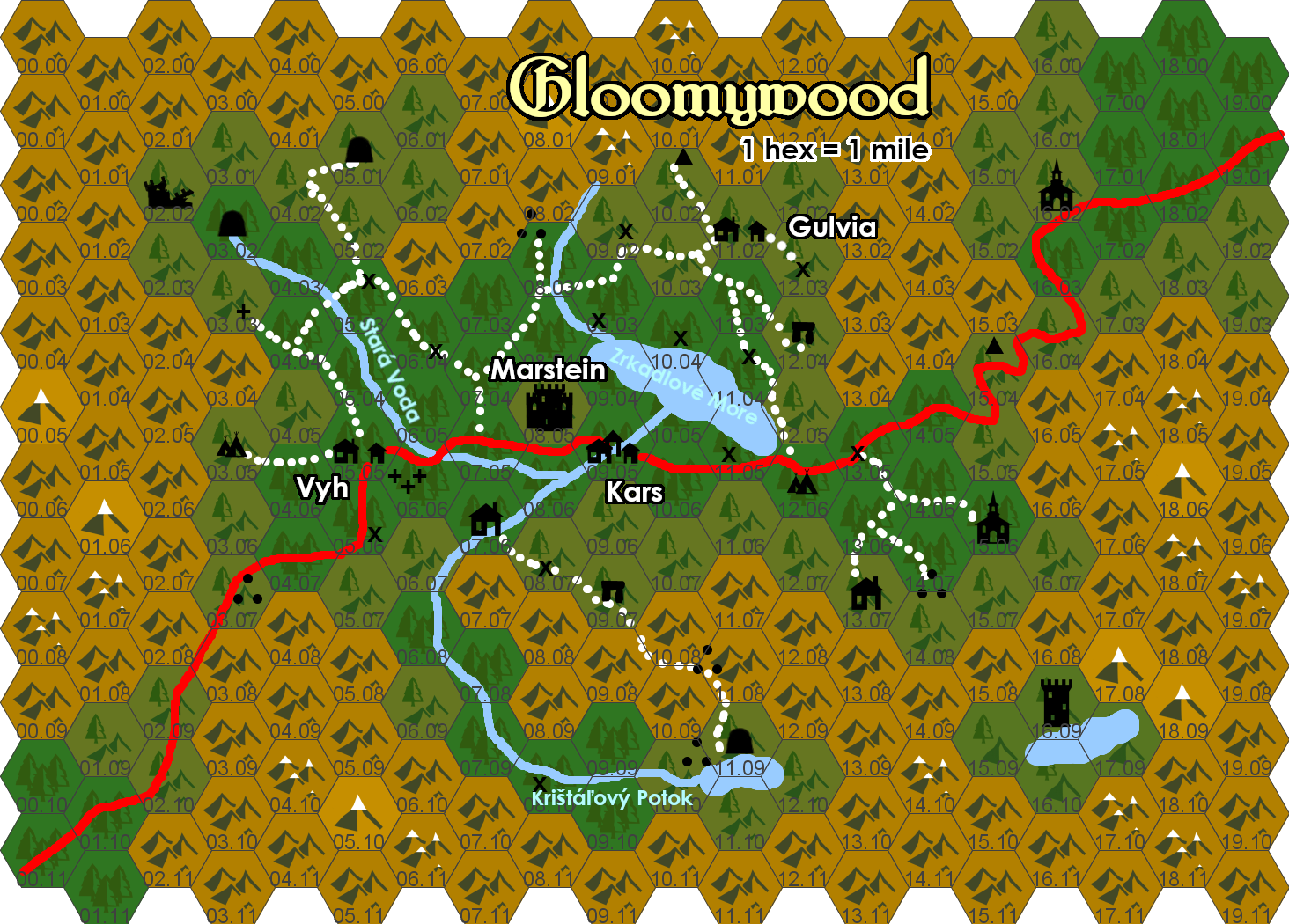
How much of a micro-setting can you do under an afternoon and evening? About this much. After getting myself worked up about the remarkably vacuous Vallakia zine, I decided on an experiment to see if I could make a playable, coherent mini-setting in a minimum amount of time. Thus is born Gloomywood, land of Ruritanian monster movie clichés. In truth, it could be longer, if not for some procrastination – I could have thrown in a dungeon or two. It is not the best thing I could do, but not bad for a day’s creative work either. There are ideas, springboards for action, agendas and connections, a rumours chart (most of it to inspire both GM and players). It is sandboxy. And it begs the real question: why isn’t something like this the minimum barrier for publishing something? Consider it.

Gloomywood 1.1 – PDF (3.8 MB PDF)

Hexmap

Wednesday, 17 April 2019

[BLOG] Shallow and deep wilderness sandboxes


Difficulties concerning this area of play notwithstanding, most of us manage to create and run rewarding wilderness adventures. The OD&D and AD&D rulebooks offer workable procedures to run an outdoors expedition, and there are multiple approaches to build a wilderness sandbox, from fixed, linear journeys along roads and rivers, to more free-ranging pointcrawls and hexcrawls. Only three ingredients are required:
  1. An underlying approach to turn the imaginary world into a game space (hexes or squares, connecting lines, visible landmarks) that can be described by the GM and navigated by the players.
  2. Procedures for outdoors expeditions: movement, exploration, encounters, food and other resources, and so forth.
  3. Points of interest which give a reason for visiting the wilderness at all, and differentiate going one way from going another way.
All three of these points can be satisfied in very different ways, usually with a mix-and-match approach. With a little preparation – or prodigious bullshitting – it is not hard to assemble and run a miniature setting.

However, there is an often unaddressed issue which makes a strong difference in how actual wilderness-based campaigns pan out. This is the issue of depth. The concept of deep and shallow settings is familiar. As the idea goes, you can generally sketch out a wide campaign setting in broad strokes, or select a more narrow area, and give it an in-depth treatment where every little corner has something. Doing both is theoretically possible (Tolkien, Greg Stafford and M.A.R. Barker did it, and so did the rather less reputable Ed Greenwood), but the resulting setting may become inaccessible for players, and burdensome or at least very hard to manage for the GM. The question of depth also poses questions for campaigns with a strong wilderness component: this is the subject matter of this post, which highlights the differences between shallow and deep wildernesses.

A shallow wilderness: single-layered structure

A shallow wilderness stretches far and wide, and its points of interest tend to be individually small and often unassuming – proverbial “grains of sand”. The Lord of Crows maintains a castle in hex 1212; 1214 is the lair of 26 gnolls living in a hilltop encampment surrounded by a palisade; and 1313 is a mysterious obelisk where wise old crows read glyphs only known to their kind. These are mostly encounter-level descriptions; they may be free-standing (like the gnolls) or interrelated (what about the crow motif?), smaller and larger, but they are about as complex as your usual dungeon room. There is a single "layer" of adventuring: the wilderness itself. That does not mean there are no cities or villages - but they mostly exist on the encounter level, without going into deeper detail. Wilderlands of High Fantasy is of course the main model of this approach, while The Sea of Vipers – which has partly inspired this post – is a more recent one.

The implications for play point towards lots of travel across a large number of hexes. Travel-related procedures such as random wilderness monsters, getting lost, managing food, and so on become an important aspect of play. Some character resources are going to be less of a going concern (spells and hit points can be replenished through rest), while issues like movement rates and daily random encounter frequency can become a bigger deal. All in all, the wilderness is most of the adventure, at least for a number of sessions: our large 3.0 Wilderlands campaign was mostly one long trek from one dungeon (Necromancer’s Rappan Athuk) to another dungeon (JG’s Dark Tower, although sadly, the campaign ended right before we got there). There were diversions and stops along the way, but the game was largely about wandering through the coastal areas of two enormous campaign maps, and wrecking stuff.

A deep wilderness: multi-layered structure

A deep wilderness is perhaps better connected to the common D&D experience: here, the wilderness expedition part is the connecting tissue between other kinds of adventures, which are substantial on their own. The resulting games may perhaps be better thought of as multi-layered: there are layers of declining size and increasing complexity as you drill down from the “overland map” to the individual hex, and below. To borrow an example from an intermittent campaign I am running,
  1. You have a general setting map (the fallen Roman-inspired empire of Kassadia and its early Renaissance successor city states)…
  2. …but some areas, like “The Forest of Gornate” in the embedded picture, are described in more detail; in my case, as a pointcrawl…
  3. …and some points on this maps are themselves detailed locations (the town of Mur) or separate dungeons (the Great Cleft; the Villa of Lucretia Vinalli; the Hanging Gardens of Marabundus, etc.). In our case, the Great Cleft has Keep on the Borderlands-style mini-dungeons of its own!
Obviously, only selected areas of the broad setting are described in this detail, since it would be extremely time-consuming, not to mention wasteful to extend this treatment to the whole.

A deep wilderness setting places somewhat less emphasis on prolonged travel and its associated procedures. In fact, it tends to anchor players in a smaller area; by drawing them to local adventure areas and getting them involved in local conflicts. Once you start getting entangled in the affairs of local nobles, or drawn deeper into the mysteries of the forest, it makes less sense to just cut ties and travel to Frabotia, let alone Thrygia or the borderlands beyond the northern edge of the map. You could play an entire mini-campaign in a limited area – and we had done so in various corners of the Wilderlands (around Tegel village, on the Wormshead peninsula, in the wastelands and island realms around Zothay).

The game can develop a complexity which does not happen as much on a long itinerary (which tends to encourage episodic play), and the same locations can be reused to an extent where they become familiar, while they can still reveal new challenges and threats. Finding out that the hideout of the beast-cultist was in the Hills of Ligonia all along, or arriving back in Mur to uncover an insurrection plot involving former friends, is an experience. However, you lose the magic of long-range travel: there is something liberating about wide, shallow settings where you can truly head for the horizons to see what is there.

At this point, I don’t know if our campaign in Kassadia will evolve in either direction – this is going to be the result of its natural trajectory – but I see potential in both routes. I would like my players to see red-walled Viaskar and its places of pilgrimage, and go toe-to-toe with the savage Harepsi and their rolling fortresses. Yet I would also like to get them involved in complex local schemes and let them discover interconnections and hidden details. And here is the dilemma: time and the natural lifespan of a campaign will limit how much we can grasp; and depth will have a decisive effect on where our adventures will take us.

Friday, 27 April 2018

[BLOG] The Rustic Monster Hunter Campaign (Concept)


Your bog standard podunk fantasy barony is menaced by monsters. The goblins are stealing the chickens, the werewolves are eyeing the chicks, you can’t go visit Uncle Rufus in the graveyard over the hill without him repaying the visit, orcs are plundering the merchant caravans, and there are rumours of a doom of wyverns nesting in the Raewynskill (the big dark forest to the north, a ways away). Heroes are needed to save the day! Unfortunately, the heroes are all busy saving the day for more important people, or they are just doing their stuff somewhere else. What you get instead are mercenary monster hunters. So the villagers/townsfolk grit their teeth, pool their money, and establish a common fund to finance monster hunting. Good luck, the campaign is on.

This is a low level campaign framework inspired by a discussion on LFG.HU (link in Hungarian), David Pignedoli’s Black Dogs fanzine (also about a monster hunting company, but more gritty and mediaeval), the DCC funnel, my old domain management campaigns, and of course the wilderness clearing concepts from various versions of D&D. It is basically low-level D&D where you grow a character pool instead of one or two main PCs. Here is how it works.

The GM creates a small wilderness sandbox, and seeds it very liberally with monsters and small adventure sites. Go over the top with low-level monsters, they should be lurking behind every tree. You could use any generic fantasy setting to run the campaign. Perhaps it even needs to be utterly generic, you just need a home base village (or small town), and a bunch of interesting terrain and landmarks around it. Something like 4e’s Nentir Vale would do – why not? (Or you can use The Stoneheart Valley, the classic Necromancer Games wilderness romp. Or you can easily make your own.) Then, monster lairs – the kind of not terribly ambitious mini-dungeons you can find on the net by the dozens, or just make up on your own. Be generous. Keep it deadly for low-level groups.

The Nentir Vale
The big limitation is on the character side. This is a low-scale campaign. Not even E6-style. You will each be playing low-level fighters rolled with the 3d6 in order method, or more like a growing roster of them. Every player starts with one 1st level guy (or gal – the villagers don’t really care) down on his luck, and these guys can band together to go on expeditions to claim bounties posted on the tavern wall, or announced by the town crier. Your first character – and replacements – are free. You must hire the rest out of the gp budget you raise by killing monsters, and you must also pay to train up your guys to higher levels. It is a bit like a pyramid scheme for adventurers. Adventures take place on a weekly basis, the rest being spent carousing, wooing lasses, making a fool of yourself and getting into local trouble.

For example: Claude, Jehan and Karl go on an expedition against the orcs. They plunder a small tower which is an advance orc outpost, but they are beset by giant spiders in the cellar, and Karl goes down, stone cold dead. However, the other two survive, and now they have enough money to pay for a month’s upkeep and hire a few more first-level guys to go out with. Next week, Player A keeps Claude, and hires Sarah and Fred. Player B makes Jehan stay at home (he has good stats, and he’d rather not lose them) while he hires Lefty, Hank and Little Tim. Player C is stuck with a new entry-level guy he names Bullfrog Bill. They head out for the orcish keep.

Finally, a use for all those maps
Remember, it is the bounties that matter. If you just kill something randomly, the villagers may or may not care (you could give it a 1:6 probability of a halved “pity fee”). Everyone is interested in The Orc Problem, and The Giant Rats Down the Cellar (you thought you would be rid of them by now? Think again!), while the Raewynskill wyverns and Sir Otto’s Undead Keep are probably distant concerns, for now (as long as the wyverns only carry off the odd cow, and not the mayor’s niece).

You are not running real adventurers, more like a growing band of disposable miscreants. Beyond the funds for training, you need to keep up a number of troops to support higher-level characters. You first have to raise a stable of ten mercenaries before you can promote one to second level status, and at least 50 to raise an elite leader (4th level, this could be a party-based limit). Perhaps you can only have one of those guys. Perhaps special classes (in this case, non-fighters) are also available, but proportionally more expensive. You need twice as much for a ranger or a thief, and three times as much for a cleric (magic-users are all NPCs in this campaign… although you could persuade one to join your team on a special errand). You need to keep the mercenary ecosystem going or your guys will just pack up and look for trouble elsewhere in the kingdom, or marry the innkeeper’s daughter and settle down.

Another fine map by Mike Schley
Gradually, you work your way up to try larger targets with a whole bunch of disposable mercenaries led by your precious few 2nd and 3rd level guys (who are almost heroes by now). There can be all kinds of complications: a bunch of do-gooders show up to ruin your business by killing monsters for free. A sinister merchant offers to rent some monsters which are trained to run away for you and let you triumph easily… for a small price. There is a fair and you can use those jousting rules from Chainmail. Some of the monsters finally have enough and band together to protect themselves from The Mercenary Problem. The local landlord decides that what the villagers do with their money is their business, but treasures found in his lands should be subject to proper taxation. And so on.

You could actually also use this structure to play out a peasant uprising, except with the bourgeoisie corrupt landlords and evil barons instead of the monsters, Robin Hood and company style.