Friday, 14 October 2022

[REVIEW] Wyvern Songs

Wyvern Songs
Wyvern Songs (2022)

by Brad Kerr

Published by Swordlords Publishing

Lowish levels (1, 2-4, 3-5, 5-6)

Following in the footsteps of the surreal, deadly garden of Hideous Daylight and the aptly named (slightly cramped) Temple of 1000 Swords, this is an anthology of four mini-modules which can also be linked and placed in a loosely outlined mini-setting. The book – a very tidy, elegant publication in its hardcover edition – combines a whimsical imagination with strong accessibility. Many OSE modules don’t quite hit the mark, mainly due to their authors’ lack of experience or the adventures’ overly small scope, but Wyvern Songs uses the format to its fullest without getting hamstrung by its limitations. Here, it all works. 

The tone recalls things like Fever-Dreaming Marlinko, Jeff Rients’ stuff, and psychedelic childrens’ cartoons (for some reason, Jamie and the Magic Torch comes to my mind), and this is very clearly telegraphed by the art. It is the polar opposite of Appendix N, featuring none of the doom and gloom that has characterised most of modern old-school gaming, nor the “mediaeval quasi-realism” of earlier eras. This is fullbright whimsy filled with quirky characters and highly fantastic, often anachronistic ideas, and leans on these themes more strongly than Hideous Daylight did. It feels modern, not old – a little twitterish and cutesy, just a little high on the sugar, but not disturbingly so. Of course, theme is not all. What is important is function: and these adventures deliver places and situations with a high interaction potential, where interesting choices may be made and interesting consequences may result. These are true funhouses where you can push your luck, come up with creative schemes, leverage NPCs for your gain, or mess with one of the many “levers” (sometimes literally, sometimes figuratively) to see what happens.

Of the scenarios, The Sinister Secret of Peacock Point (level 1) is a short, 25-area dungeon set in a thieves’ guild beneath an old lighthouse, overrun by the Skitterlord, a critter right out of a horror movie. This is the most conventional dungeon delve in the book, and a fitting setting to hone your dungeon-fu (appropriately enough, it also features in-game practice ranges used by the former inhabitants). The balance between the prowling horror and the sense of discovery drives the action and creates the main source of tension. There are loose ends and opportunities for expansion – what happens when you try to pawn off the stolen valuables? Or when some of the thieves who didn’t perish in their lair come back? It all segues into new adventures. **** seems right for this one.

Not depicted: Oompa-Loompas

Fabien’s Atelier (levels 2-4) is a puzzle-centric “wizard’s home” locale that was first mentioned in Hideous Daylight, and may be smoothly combined with it to create a more complex double feature. It is also the most anachronistic; the style of the floating dwelling is a lot more swanky 1960s lava lamp hangout/Jetsons flying saucer than, say, a grim basalt tower with gargoyles and stained glass windows. The central idea is puzzle-solving and exploration on a ticking clock, as the place is going haywire and shall crash into the ground below unless something is done. This also makes it a tougher challenge – with no time to retreat and recuperate, it will be difficult for weaker parties. The puzzles are fairly organic, although sometimes off the wall (the main solution to enter a specific room is to take a key-shaped door off its hinges and shrink it to fit a keycard slot; another requires catching a talking toucan with a key-shaped beak). Fortunately, there are workarounds, a sufficiently robust set of stuff to make mischief with (and come up with a truly original combination), and a few handy tips on nudging the characters forward if they are stalled. A ***, but a highish one.

The volume’s unquestionable highlight is The Singing Stones, a 23-location pointcrawl adventure set in an arid valley of musical rocks. Taken alone, this is close to five-star material. A central mystery is presented (the rescue of a lost prince who has gone wyvern-hunting, a task which requires solving two very significant challenges), but the real deal is found in the open-ended environment where truly complex adventures with side-plots and player-driven action can freely emerge without becoming an incoherent mess. The valley is populated with oddball characters, strange natural wonders, and has multiple things going on that may unfold and develop as the action proceeds. Most places have a surface idea and opportunities to go deeper if the characters care. Bullet points are being put to good use. The physical place as outlined is perhaps too large for the suggested six-mile hex (I would stretch it out to about four), but it is just the right size for a rich wilderness adventure. Add inventive random encounters and a rival adventuring party, and The Singing Stones is a definite winner, so we will call it a *****.

Lesbian gnome merchants!

The final adventure, The Dreaming Caldera, is a showdown with the followers of a newly emerging chaos god in a volcano lair where the god is being physically assembled by all sorts of chaotic creatures drawn here by their dreams. I honestly did not feel this one. It is not so much wildly imaginative Brad Kerr, and more Brad Kerr acting as a cover band of himself. The same kind of basic building blocks, just without the fireworks. There are still good features – a massive underground chicken farm in the middle of the dungeon with dire chickens; incompetent monsters being idiots while reconstructing their god; a rival and envious chaos god making the party an offer – but as a whole, it is somehow less free-flowing, and not as clearly outstanding as the anhology’s high points. This is a decent ***.

Wyvern Songs’ writing is smooth, effective stuff. It uses bolding and bullet points effectively (and, curiously, in a different way in each individual mini-module), and gets its point across without becoming too dry or too sparse. There are numerous quality of life features in the book – mini-maps on almost every spread (this does take up slightly more real state than ideal), short ideas on how to handle the consequences of likely PC actions, or how to expand and build on the adventures once things are wrapped up. There are even small touches like colour-coding the four adventures (neatly separating them for easier referencing), and listing their potential play times with an eye for one-shot suitability. Some of the monster stats refer back to the OSE books and are not listed in the publiction. This is a puzzling omission; not because you can’t just look them up, but for what happens when you have to manage multiple monster types working in concert or against each other. A few extra pages wouldn’t have hurt, and since the anthology packs a lot of material between its covers, it would have still been a modest-sized volume.

Charms U
The elegant presentation and the scope of the modules in Wyvern Songs would make them a good choice for novice gamemasters and players. No system mastery required, but creativity is rewarded and the experience is not bowdlerised – there are plenty of opportunities to die in entertaining and instructive ways, and there are other interesting failure conditions. Most of all, this is an adventure where you can try interesting things that lead to interesting consequences, and in various ways, they are all open-ended. There are certain limitations due to the scope of the individual adventures (again, The Singing Stones excepted) but taken as its own thing, this is the good stuff. If you like engaging with plots of pure whimsy in open-ended environments, messing with eccentric NPCs (who essentially tend to behave like modern Internet people), and coming up with non-standard solutions to non-standard problems, this is a sure bet.

This module credits its playtesters, as well as a bunch of other people who have helped with the project, surely the gold standard of giving credit as it is due.

Rating: **** / *****

Saturday, 8 October 2022

[BLOG] Year Six: Old School Reconquista

An Autumn Landscape

This blog started on 5 August 2016, making early August the time of the year to engage in stock-taking and irresponsible conjecture. Unfortunately, duties at my day job have haunted most of the year (and continue to usurp valuable time I could spend blogging), so here we are. Autumn is the best season anyway.

The State of the Blog

Beyond Fomalhaut’s activity this year was as much as in the last: 29 posts, of which 19 were reviews. Obviously, I am being left in the dust here by Messrs. Lynch and Nothing, but a good many of these reviews were long-form discussions of really complex, good stuff, which took time to think over and grasp properly. These also reflect changes in old-school publication patterns, where activity has decreased, but size and complexity has gone up (more on this later).

The average score for the 19 reviews ended up at 3.3, above the six-year total average of 3.09. It was a fine catch, and there are multiple reasons why this is so. First, selection bias. The No Artpunk contest has raised the average: this was a bumper crop of adventures by people who either knew what they were doing, or were making a jolly good effort to Git Gud. Two of the top scores came from this contest, and three more were in the “very good” category. Even the mid-ranking ones were clearly ambitious and showed signs of promise. The second reason is that the market has become cleaner; a lot of the grifters and shovelware artists polluting DriveThruRPG have departed for other lands, and pattern recognition makes it ever easier to avoid the releases which will inevitably be disappointing. These are still reviews of things I hoped to be good. The third reason is related to the second. Zinequest is winding down after the absolute winners who were making a lot of money on it cancelled the guy who was running the programme at Kickstarter (here, I refer the readers to the immortal Snake Poem), and the alternative game jams have not created much of interest to old-school gamers.

So here are the results and the highlights:

  • 5 with the Prestigious Monocled Bird of Excellence. This rating was not awarded this year. Wormskin, Anomalous Subsurface Environment, The Tome of Adventure Design, and Yoon-Suin dispassionately survey the field beneath like the great stone faces of Mount Rushmore. Shall a new face be carved upon the unfeeling rocks? The next year will tell. Git Gud! 

  • 5 was awarded to three releases, similar to last year’s pick of the crop. One of these went to Oakes Spalding’s Seven Voyages of Zylarthen, a reimagination of LBB-only Original D&D. Seven Voyages combines smart, simple mechanical innovations that fit flawlessly into the OD&D framework with a slightly different implied setting where these rules changes are a natural fit. It has been the first old-school system in a while to make me pay careful attention. The Temple of Hypnos by Olle Skogren deserves praise for an adventure that balances high imagination with a solid basis on the nuts and bolts level. And of course, Fractious Mayhem at Melonath Falls by Trent Smith, with its effortless skill and unfolding complexity: this is how AD&D is done.
  • 4 went to four releases: Vault of the Warlord, turning a clever tomb-robbing adventure into a developed village-wilderness-and-dungeon scenario; Dust and Stars, a high-level dungeon presenting a tough but fair challenge for powerful characters with advanced capabilities; City of Bats, a Mesoamerican dungeon paying homage to the great Hidden Shrine of Tamoachan; and The Bone Place of Dreib, a dungeon adventure that takes you to a place of primordial wrongness. These releases were, notably, all low-fi efforts. None of them came with fancy art, a hard cover, or Kickstarter extras, and they relied solely on solid content to earn their deserved place.
  • 3 was awarded to nine products. This is a wide circle, from decent material you could easily use in your campaign (e.g. Temple of 1000 Swords or the promising Swords & Sewercery) to projects which showed grand ambition, but did not live up to their goals (Cha’alt being the prime example).
  • 2 was awarded to one release this time, City of the Red Pox. This was a case of an excellent idea (corrupt fantasy Venice) that was not realised as well as you would expect.
  • 1 was awarded to two products, conveniently displayed at the pillory (rotten tomatoes and bad eggs available at 2 copper pieces a throw). These, regrettably, come from the Artpunk / Mörk Borg community, and make a good case for why the stereotypes are true. Of the two, Colour of the Void looks like an honest effort by someone who sadly knew no better (to quote the Tragedy, “her sin is of the age which had birthed her”), while Crashmoon does not have that excuse – it is the contemptible result of artsy flourishes masking an artless core.

As in previous years, man proposes, God disposes: there were a few books I promised to review but didn’t. I will try to get to these reasonably soon. And again: sometimes, the reviewer reads something and has nothing to say that has not already been said. Some of the high-profile, oft-discussed projects have therefore not received their due – they were good or they were middling, but other people already explained why.

Old-School Gatekeepers

The State of the Fanzine

Last year, EMDT released six full titles (and three more which were a part of larger releases), including two boxed sets; this year was invariably more modest with four. One of these was a Hungarian Helvéczia module, Isle in the Mist, a fairy-haunted locale. Mr. Volja also completed his first adventure compilation, Weird Fates, vol. 1, which collects four one- or two-session scenarios. These are a different style of old-school than what I tend to do; more whimsical and improvisation-oriented, but a lot of fun at the table. Volume 2 has now been drafted and awaits editing, and a third volume is at the concept stage. So on my side, two issues of Echoes were published. These are both heftier volumes, and I have been happy about the range of materials therein. Unfortunately, no new issues are expected this year, but #11 is in its early stages.

Other people have been more diligent. I am really pleased about the release of Helvéczia’s Spanish edition, a mighty effort by Outremer Ediciones. Tackling the hardcover/boxed set combo is a project with many moving parts, bottlenecks and unexpected challenges (I can attest to it), but they did it, and the final result is a beauty, so I must thank them for their hard work. As I understand, people have already started to develop their own ideas and materials for the game while Outremer was demoing it, and a domain management system, as well as a regional supplement are in the works. If you create a game, you really cannot ask for more. Since Spain is the original homeland of picaresque novels, it will be fascinating to see where these ideas will go – hopefully, we will also get to see them in English some day.

It is also great to see that The Vaults of Volokarnos has received a Czech edition, where it is being sold along with the Old School Essentials boxed set. This is doubly pleasing not just because you get to see your work receiving a release in another Central European country, but also because this adventure was specifically written as an introductory dungeon for novice players and gamemasters – all the while trying to introduce not just standard dungeoneering tricks, but the scope, difficulty and complexity of old-school dungeons. Volokarnovy katakomby – as the title goes in Czech – is labelled with the “K.O.S. 1” letter and number designation. I sincerely hope there will be more from Czech designers, in one way or another, for the same reasons mentioned with Helvéczia: it is bound to create something new, interesting, and hopefully good.

The Spanish Boxed Set (image courtesy of @websterfreeman_)

The State of My Other Projects

Last year was the time when large projects that took years to complete were realised. This year was a time for more sowin’ than reapin’, and sometimes, progress can be slower than you would like. Accordingly, a lot of my efforts have gone into the Hungarian edition of Helvéczia, where I have set myself a firm deadline for this December. This involved a lot of editing, some translation, and the logistics of production. Thankfully, my printers are a real help, even if the owner’s Helvéczia character was swallowed by Hell along with his horse in the mountain pass of Hohenwart after failing to settle a debt with the Devil. Of potential interest to English gamers is that the Hungarian edition will feature a different regional supplement than Ammertal and the Oberammsbund (which was already included in the original 2013 boxed set), along with a new set of adventures. All of these will be translated in time. Likewise, I have a partially translated adventure collection, and this will also be coming in 2023.

Khosura Rises...

My other big plan for the year which did not come to fruition has been Khosura, King of the Wastelands. This is a regional supplement for levels 3 to 7 (or so, it really depends on how the players approach things, from careful infiltration to all-out action), describing the eponymous city state, its vast and interconnected Undercity, the surrounding wastelands, and multiple smaller adventures set therein. So, a sword & sorcery sandbox with lots of sand, both literally and figuratively. About 75% of this stuff appeared in various Fight On! magazine, while the rest comes from old campaign materials. Khosura is fairly far along, with a splendid cover and some really nice art pieces already coming in, and cartography and writing in progress. If it were not for real life-inflicted delays, it would be an Autumn release as a hardcover with a map envelope; as it goes, it is planned for Q1 2023. Escape from the Pits of Lamentation, delve into the Tomb-Complex of Ymmu M’Kursa, plunder the Tower of Birds and navigate the ancient customs and rigid laws of the City State of the Four Mysteries – as barbarian conqueror or decadent thief, priest in a city of jealous gods or shadowy illusionist in a land of mirages!

I have one more English release planned for 2022 – and again, it is a firm one, with a self-imposed deadline for early December – and that is The Forest of Gornate. This is a large wilderness pointcrawl set around the same city as Shadow of the City-God, and one I am particularly proud of (particularly as I used to have doubts about the pointcrawl format, and I think this one is actually good). It fell through the cracks last year, but now, it is going to be done. The Four Dooms of Thisium still lies in a distance. We will get there, eventually.

I also had the opportunity to have my picture taken with Dr. Peterson and perhaps a zine, but while this idea had some attraction, it also felt vaguely ominous, plus it would have also cost me more money than realistically worth. So that didn’t happen, but we did hold a Zine Summit with Messrs. Ignatius Umlaut and the Settembrini clan in Café Erdős, a decent place in Budapest, after hosting Ignatius for the opening game of our new Seven Voyages of Zylarthen campaign. I think this was a better idea.

Me and the boys meeting the Artpunkman foe. Deus Vult!

The State of the Old School: Reconquista

It happened subtly, and you can miss it if you don’t look in the right places, but there has been marked improvement in old-school gaming over the last year. Simply put, there is less stuff, but more of it is good, mainly thanks to a bunch of relative newcomers putting an honest effort into understanding the craft of classic games. For a few years, what used to be called “the OSR” became so broad and unfocused that it had also become diluted. Success brings its own problems, and having to become a vehicle for every idea under the sun, only linked by a vague aesthetic (and since the dreadful, twee Corporate Memphis nightmares have taken root in some corners, not even that), led to a loss of the core identity of the old school. To quote someone I often agree with, “A game style that can be anything ultimately does not mean anything. It has no point to make and no strong features to distinguish it and give it a peculiar charm, a creative edge”.

The OSR, 2022
Important ideas were forgotten because the people who first explored old-school games were all experienced fellows operating from assumed tacit knowledge. There was a lot they practiced, discussed fleetingly, but never bothered to put down on paper in a coherent way (for example, nobody produced a new DMG because they just thought everyone would already own Gary’s). Then, some of the field started to feel uncomfortably like neo-storygames (what the hell is a “lyric game”?  where is the earnest violence?), and you started to get the idea our corner of the hobby was beset, well, not really by tourists, but cynical guys who didn’t have any affection for our old games, only the surrounding ecosystem that let them sell more than a dozen copies of their junk. But that’s old news.

The actual news is that if you look carefully, you can see the first products of a reinvigorated, smaller but more youthful old-school scene. People who often had zero contact with pre-d20 D&D have been discovering the classics, and getting acquainted with the actual design principles and aesthetic behind them. This interest, fortunately, goes beyond simply using a generified B/X, and extends to understanding the finer points of the advanced game, the underlying logic of old-school adventure design, good campaign structures that transcend the level of adventures (West Marches-style games are an example), and the practical issues of gameplay. Actual play-based communities in turn produce not just a common knowledge base, but better supplements that serve actual play as well. The big picture starts to re-emerge.

Some of the commercial ground has been ceded. Hobbyist DIY efforts are not always glamorous in their presentation, even if they are very solid in their content. This does not make tons of Kickstarter money, but then neither did OSRIC. Even greats like the Heroic Legendarium (which I solemnly swear to review next year) can arrive in the simplest of packaging. There is no harm in books looking good, cartography looking clean, and layout being functional (although Good Layout has become first a fetish, and then a vehicle to sell overpriced coffee table books). But they are no substitute for good writing, and that means both Idea and Craft. Those who master one are standing on a strong foundation, and those who master both can produce the best of the best. Gilded framing does not a great painting make, even if it can enhance its beauty. You can do a great job with the modern equivalent of Judges Guild’s production values, and much of this year’s best has been just that.

The fruits of the Reconquista have already been good this year. The No Artpunk Contest, organised and judged by Prince of Nothing, and attended by 19 contestants, has been a mustering ground for people both learned and learning. The entries were uniformly a cut above the norm, and some delivered outstanding adventures that will be remembered for years to come. It was a contest that invited as much discussion and reflection as it had entries, and it will improve us. This year’s field looks even leaner and meaner, promising a Herculean task to make a final judgement about the best. Some of that effort, in turn, will find broader recognition and produce a new bounty of the Good Stuff. These are promising signs. The uncomfortable question remains (this is something you also ask yourself reading Bryce’s reviews): if the principles of good design can be learned with a little effort, why didn’t so many people publishing “old-school” adventures get even the basics correctly? That’s right. They were too lazy to.

Don’t be those guys. Aim high, practice your D&D-fu, maintain your castles and together, we can topple Sturgeon’s Law and burn it to the fucking ground.

Greetings, Warlord!


Friday, 2 September 2022

[REVIEW] Cha’alt

Cha'alt
Cha’alt (2019)

by Venger Satanis

Published by Kort’thalis Publishing

Low to mid levels

* * *

Knee-Deep in the Zoth 

Gonzo science fantasy has a high pedigree in old-school gaming. Wild genre-mixing has been with us since the campaigns of Dave Arneson and Gary Gygax, the publications of Bob Bledsaw and David Hargrave, and has more recently produced such gems as Encounter Critical (2004, predating the earliest retro-clones) and the great, unfinished Anomalous Subsurface Environment. For something affectionately referred to as “retro stupid” (Jeff Rients), this odd platypus-like mutt of gaming history has produced some remarkably excellent materials, and the expectations have thus been set rather high. So we come to Cha’alt. The book has often been dismissed as a vulgar display of bad taste, the product of some fringe weirdo with bad opinions, or juvenile fetish material not worth playing attention to. It has a small but dedicated cult following who swear it has merit. More often than one might think, these small cultish groups are right, and everyone else is dead wrong. Sometimes, they are just deluded. And thus, we are here.

Cha’alt is a lavishly produced, colourful, 216-page hardcover printed on heavy-duty, slick paper, with gold leaf embossing on the cover, and a psychedelic dust jacket depicting something from a 1970s album cover. There is a generous amount of colour illustrations and photos from Deviantart, most of them in tremendously bad taste, from “photorealistic” fetish art to generic and soulless colour pieces. As far as I am concerned, the art budget is wasted, but production values do not really concern this blog, so we shall move on.

While layout is not packed (white space and squiggly “magical glyphs” are abundant), there is a surprising amount of material in the book. Where a significant portion of old-school gaming has succumbed to the idea of minimalism, this is a rich, extensive campaign book mostly focused on directly playable material. This is a pleasant surprise: say what you will about the subject matter and the execution, the book has its heart in the right place. It is not an exercise in creating avant-garde literature, but giving you a rich grab-bag of stuff you can run out of the book. More than that, it is actual, honest functional writing that balances the setting’s peculiar flavour with the idea that information should be accessible, easily understood, and of help to the tired GM. It does not go into the weirdo formal experiments of presentation which have become fashionable in recent years, but while the text will not win any writing awards, it is competently edited, and does its job efficiently and unobtrusively. There is even a functional, well-built appenix! In the realm of ease of use, Cha’alt scores above much of the gaming field.

* * *

The Shores of Cha’alt
Retro stupid rides again
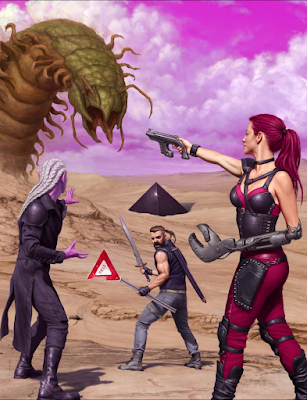
Cha’alt’s setting is a blasted post-apocalyptic wasteland following a war between the awakened Old Ones, and the planet’s highly advanced civilisation. Various city-states and barbaric outposts inhabit the remaining land mass, while interstellar opportunists have arrived to cart off the valuables, especially the remaining pockets of zoth, the literal lifeblood of the defeated Old Ones, and a main component of the super-valuable spice mela’anj. Of the great dungeon-complexes that have risen over Cha’alt, none are as formidable as the fabled Black Pyramid, a massive structure that has risen anew from beneath the sands. This is a high-energy setting with a crazy and enthusiastic anything-goes approach, from sandworms to space sluts, and from shameless Cthulhu flogging to monster cults. Gonzo games live or die by the way they cobble together their seemingly incompatible influences; the internal tension is part of the appeal, and being a little crazy never hurts.

The supplement’s first section is taken up by setting background and setting-specific miscellany – a grab-bag of stuff for your Cha’alt campaigns. If you want a random, goofy mutation chart, you will find it in the desert survival rules, while the description of the Domed City has a cyberware table to juice up your characters. This is a fun integration of rules and setting, and the section where the supplement is at its closest to the fabled Wilderlands of High Fantasy – a high point of creative, haphazard, play-friendly content. Factions with their typical representatives, and desert critters are described, although there are no random encounter charts (which would be one of the most important things to have in a sandbox setting), and the monster roster is rather limited with only seven new critters (there are several more scattered over the subsequent chapters). The same is the case for some of the supplemental material or random charts and rules, which are found hidden later in the book – a table of simple psionic abilities, an NPC motivation chart, random ability score arrays... bits and pieces that come up during play.
Here kitty kitty
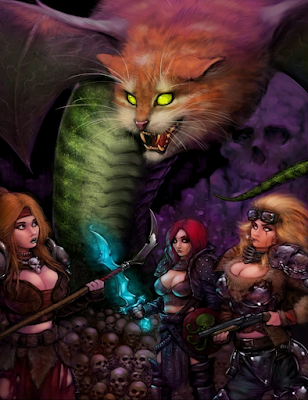
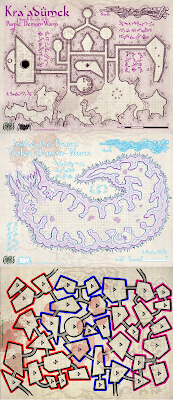
The core of Cha’alt is centred around four adventure sites: two smaller dungeons (Beneath Kra’adumek, 17 keyed areas; Inside the Frozen Violet Demon Worm, 23 keyed areas), a “home base” style location (Gamma Incel Cantina, 69 keyed NPCs), and a large, three-level “tentpole” dungeon (The Black Pyramid, 111 keyed locations). Unfortunately, it is the short intro scenario, Beneath Kra’adumek, that is the really good stuff, and the rest have a growing number of problems. But Beneath Kra’adumek is good, partly because it is designed as a real dungeon. There is a decent, meaningful layout combining caverns and passages; there are guarded sections to avoid or eliminate, prisoners to free, mysterious stuff to mess with, weird monsters (the centrepiece being the demon cat-snake) and duplicitous NPCs to kill, fool or befriend; and it has a sequence of simple, memorable setpiece encounters. Ways to poke at other dimensions and screw things up (including making 1/6 of Cha’alt’s population disappear forever). Fanatical demon-worm cultists absorbed in their evil activities. Cryogenic pods to awaken ancient pre-catastrophe sleepers. Individualised treasure. It is a dynamic scenario that could go a lot of ways due to the variety of NPC/monster/device interactions, and even feels like a goofy sort of Star Wars locale – great for an action-packed intrusion into the fortress-dungeon of an evil space cult, three “princesses” (well, big-boobed space sluts) included. This is top-notch, and unfortunately, as good as it gets.

Inside the Frozen Violet Demon Worm is a great concept – exploring the intestines of, well, you get the idea – but Cha’alt’s deeper flaws start to emerge. First is the degeneration of the maps. An arbitrary dungeon (Beneath Kra’adumek) offers good exploration potential, while the demon-worm’s interior is an enormous fleshy tunnel with a bunch off side-chambers in its folds. You approach the locations, you do the encounter. This is the Monty Haul dungeon in its original sense – a series of “doors” along a corridor to open for random stuff ranging from a young woman chained to a stone column crying out for help (concealed Ktha’alu spawn with some really god magical loot), a group of insectoids battling a flesh-sac detached from the slowly thawing worm, or an enormous stone head worshipped by savage brutalitarians (lazy Zardoz reference), a lost pirate ship, or a bunch of skeevy guys playing high-stakes poker around a scrap metal table. Why? Rule of cool, that’s why.
Retro, retro
stupid, retro utterly
freaking dumb
This is super-arbitrary, and unlike the cultist lair, has no good sense of place. Why don’t these encounters wander off a little? Why don’t they interact if they are right next to each other? What happens if the party runs deep into the worm, triggering them one by one (and how could the GM handle the logistical chaos of juggling 8-12 setpiece encounters)? It is a mess, with little to connect the random bits and pieces. It feels like a “ghost train” type deal from an amusement park, with dioramas of animatronic monsters leering at you from the sides. The structure is horrible, and whatever dynamism is present in the encounters is probably going to be wasted. They are still rather good on the individual level – the author’s skill for punchy, self-contained situations and setpieces lifts up the material. If these were spaced less tightly, and placed within a more interesting, better designed dungeon environment, this would be another good one.

Gamma Incel Cantina is the Mos Eisley cantina from Tatooine, but on Cha’alt. If you have an interest in gambling, whoring, illicit deals, information or odd jobs, this is a good place to visit if you know how to get in (it is behind a cloaking field). The presentation is questionable, but the content is good enough. Basically, you get a map, a brief description of the cantina’s main areas (from loos to gambling tables to its VIP lounge), then 69 (tee hee) NPCs keyed on the map in colour-coded groups to make things a little more accessible. This is, obviously, completely useless for anything other than hitting up 1d6 randos and interacting with them, and treating everyone else as a homogenous crowd. On the other hand, the paragraph-long NPC descriptions offer brief, fun profiles so hitting up those 1d6 randos is going to get you something. The list, appropriately enough for the author’s interests, starts with P’nis Queeg (“Pilot; just parked his starship; yellow skinned banana / penis headed alien with swollen ganglia. He’s holding a brand new plumbus.”), and includes people like Treena (“THOT, human; blonde hair, blue eyed space Muslim; smoking long, thin hookah; likes humiliation and spanking”), Halvern (“Sentient chartreuse vapor inside environmental suit; fake mustache painted on helmet visor; uncontrollable giggling – that’s why they call him “laughing gas.””) or Bolo (“Droid; bounty hunter; camouflage and rust-colored; spritzing WD-40 on plate of myna’ak wings; head of engineering on nearby space station.”) You get the idea. The sleazy truck stop/titty bar vibe is spot on, and it works decently as Cha’alt’s Keep to Cha’alt’s Borderlands.

The Very Naughty Tetrahedron

We now come to the main attraction: The Black Pyramid rises from the wastelands, descending into an underworld most mythical, or at least moderately horny. This is obviously the campaign lynchpin not just from the size, but all the side materials. We get a rumours chart, and random encounters complete with specific monsters (from the dreaded night clowns to hunter-killer droids, fruit folk, pizza delivery and bat-winged eyeballs) and unique NPC groups (lost Romans, alien looters, suspicious hooded guys of all sorts). A “what happened while you were away” chart! A “leaving the pyramid” chart (travel 1d30 years into the past/future and wipe most of the campaign – woo-hoo)! Six new gods! A “you dumbass slept in the pyramid” chart! And so on. So far so good.

"Have we reached rock bottom yet, guys?"
"Not yet! Everybody, dance!"
"My anus is bleeding!"
But then... yes, the problems of the book come back in force, and are multiplied fourfold. The maps are chaotic gibberish. Any semblance of structure or order (or even inspired chaos) goes out the window, and what we get is a bunch of randomly shaped and sized rooms connected by short, randomly patterned corridors (these seem to have no distinct function, or the reference just fails me) between random clusters of colour-coded rooms accessible with special crystal keys. This childish mess does not look like a pyramid – even a severely corrupted one – lacks meaningful height differences or even connecting stairs (what you think are three dungeon levels are actually a single flat plain), has no spatial order to accommodate orienteering or exploration, does not feature actual dungeon navigation challenges (even less so than the frozen demon-worm), and it is overall very repetitive in its formal structures. The room descriptions have no relation whatsoever to the room shapes and sizes. To make it short, the map is really, really terrible, lacking any redeeming qualities.

There is something about the encounters that was grating. Maybe my patience was wearing thin, or maybe it is truly repetitive, but one of the reasons this review is overdue by several months is that I just could not press on with it. It is just one pop culture reference setpiece after the other pop culture reference setpiece. Now... this can work if there is some other kind of connecting material to add variety (say, an interesting dungeon map to navigate, or challenging combat/exploration situations and a few clever traps), but it is missing them altogether. The lazy content also shows its limits. Sometimes, recognition still elicits the Sensible Chuckle, but that well soon runs dry, and you start to scrutinise these encounters with a more critical eye. And many of them do not cut it – they are often static, convoluted for the sake of telling a lame joke, or don’t offer much interesting interaction. And those lame jokes, they are getting lamer and more one-note. Here is a room housing anthropomorphic fruit (#13). Here is a stereotypical podcast guy doing an interview (#14). Here is the Carousel room from Logan’s Run (#15) – all right, this is OK. Here is a room with a clone of Rob Schneider trying to convince a young woman to pay him for sex (#16). Here is a room with a statue of Gonzo, of Sesame Street fame (#17). “Inspecting Gonzo's nose reveals a tiny catch underneath, at the base. Manipulating it opens a compartment located in his crotch. Inside is a battered trumpet. Playing Gonzo's trumpet summons a Buddhist monk (appearing in 1d4 rounds) who walks into the room and sets himself on fire, providing enough light and warmth for several minutes before it goes out and what's left of the monk is carried away like sand in the wind.” There was an opportunity with the Black Pyramid to present some kind of otherworldly, metal-inspired, high-energy dungeon. If you’ve got a black pyramid in your game, you kinda owe something to your readers. Well, Cha’alt’s Black Pyramid is not otherworldly; it sells out all its potential at one tired joke a pop. It is all so tiresome.

Here is another one for free

Zothferno

Your dungeon is offensive!
As the post may suggest, Cha’alt is not an easy thing to review. It is a giant collection of the good and the bad, mixed in with the happy medium of “questionable”, and it is not easy to separate the wheat from the chaff. At its best, it is high-energy gaming with a lot of personality, and a very specific flavour (space/Cthulhu sleaze). It would be a mistake to write it off on the basis of this content – like it or not, this is what it intends to do, and what it intends to be. Those who call it skeevy or sexist are only doing the author a favour, since this is what he wanted to do. To cite the late, great József Torgyán, head of Hungary’s Independent Smallholders, Agrarian Workers and Civic Party, “A lawyer with litigation, and a fine lady with a hard instrument, cannot be threatened.” But does Cha’alt succeed on its own terms?

As far as I am concerned, one of the supplement’s main draws is something that some may identify as a flaw – it is not a thoroughly polished product, but something that shows its origins as a bundle of the author’s home campaign notes. It preserves the enthusiasm, and does not reduce the material to a dry treatise. It invites questions and engagement. There is a definite sense of a dog-eared folder of faded printouts, scratch paper, and session notes behind the book. It is charming, and ironically, more conductive to actual use than many books that look more smooth, but are not presented with table use in mind. It is as accessible as a slightly cleaned up collection of GM notes, and a fun glimpse into a madman’s mind.

There is also something to be said about the modules’ ambitions. They are deeply flawed in multiple ways (as detailed above), but they are not gated by level and do not pull punches. You can easily meet enemies who are way more powerful than you are. You can also beat them up and take their high-tier loot or obtain powers beyond your meagre abilities. You can find yourself bargaining with major demons, inadvertently unleashing planetary devastation, or pull off major campaign-altering victories. Some of this is lolrandom stuff that depends too much on die rolls or (un)lucky encounters instead of player skill or meaningful choices that lead to logical consequences, but it is there nevertheless, and it can be glorious even in this flawed form. It is writ on a large scale, and allows the players to win big or lose big.

Third, it shows variety and imagination on the encounter level. Things on Cha’alt are unpredictable (to say the least), but they are always colourful, and feature fun interactivity – NPCs and plotlines sketched up willy-nilly with a few broad strokes, there are knobs to mess with (some of them blow up half the world, but that’s OK), and a lot of the material is hand-crafted, specific – although the magical treasure is also too plentiful; you can barely take a few steps without finding a javelin +1 or a freeze-ray. Many of the pop cultural references are lazy, but at least many of them make for a compelling set-piece.

Here is the problem, though. Cha’alt is cursed by a curious sort of laziness that’s apparent even if you consider this is a 200+ page hardback crammed with gameable content. It falls apart on the levels above the encounters, and has little discernible structure to it. Things are sometimes connected a little (albeit haphazardly), but mostly, it is just throwing things at a canvas to see if it sticks. Is there a pattern behind the random ideas, or is it just you? It is probably just you. The trick works in the comparatively small and tightly designed starter dungeon, but it increasingly becomes apparent Mr. Satanic is bluffing. The lack of structure and the utter scattershot randomness of the material makes it hard to apply player skill to the modules, to treat them as challenging, complex problems or even real places. This is where the diorama/animatronic monster issue comes back to take its revenge. The environment cannot be known and mastered because there is no environment, only an illusion of one. The amount of interaction obscures this problem, but never fully resolves it.

Your Dungeon is a Cancerous
Growth of Intertextuality and
Postmodernism. REPENT!
And it also suffers due to the sheer excess of pop culture citations. Any conceivable part of cult/geek media is digested and reconstructed in Cha’alt to form the majority of its encounters. While surely one of the greatest collections of genre and pop culture references, Cha’alt does little to integrate its disparate influences into a greater whole, or at least give them its own spin. The approach it takes is disappointingly literal, and often falls flat. When Anomalous Subsurface Environment draws from He-Man, it adapts the material to its setting, the Land of a Thousand Towers, and the result is always a great fit which transforms the spoofed material just enough to stay recognisable, yet add a new angle or a clever gameplay twist. Say, “Monsator, Lord of the Stalks” is obviously an homage to Evil Megacorporation Monsanto, but he is also a fully developed, compelling villain of a wizard who is interesting beyond the quirky reference. Monsator is also one idea among many, most of them original.

When Cha’alt does something similar, it mostly just plops down its direct references randomly, and tries to skirt by on the strength of star recognition. Sure, Mr. Satanic betrays an encyclopaedic knowledge of late 20th century cult stuff and esoterica, but a Videodrome reference next to a Logan’s Run reference next to a tiki bar next to a movie theatre showing Escape From New York does not start living together without some effort to make a coherent whole out of them. The city of “A’agrybah” is plainly Agrabah from Disney’s Aladdin, “just on Cha’alt” with some surface details like a spaceport and a human sacrifice tradition. Sure, there is supposed to be chaos and wild leaps of imagination, but that is just part of the work. Here, the other part is very often missing, and it is all just a post-modern mish-mash of citations upon citations. Is this because the author knows no better? Far from the truth! When he makes an effort to tie things together, as with the setting background, he succeeds fairly well. It just doesn’t happen often enough, or I guess well enough to bring out the sort of transformative quality which makes for a truly great gonzo setting.

Ultimately, these two central flaws are what makes Cha’alt only “good enough” and not actually “good” or “great” – they are omnipresent through the book, and cannot be easily fixed. There is something really good in the setting, and with better structure, the basic concept could excel. Where Cha’alt is good – the starter dungeon, many of the individual encounters, the no-nonsense campaign-friendly presentation – it is deservedly good. As it is, though, it is a deeply flawed book, although never without charm, or generously endowed space doxies, bless ‘em.

No playtesters are credited in this publication. It has apparently been very thoroughly tested, although often in a fairly peculiar manner, as text chat-based random pickup games over several of Mr. Satanis’ lunch breaks.

Rating: *** / *****

Thursday, 18 August 2022

[REVIEW] Colour of the Void

Colour of the Void
Colour of the Void (2022)

by Gizmo_the_Bugbear

Self-Published

“for use with any level adventurer because they’re all doomed anyway”

It is not fair. Mörk Borg modules are not noted for their high quality. Most barely rise above the level of crummy, and being “style over substance” is the least of their problems. I do not generally review them. Is it fair then to drag a random specimen into the limelight and savage it? No. I suppose not. But then random encounters are not fair. I bought Colour of the Void because it looked a cut above the norm – 24 pages seemed more substantial than usual, and something about the front cover looked promising. In fact, it is a lot like all the other Mörk Borg modules I have seen, with the same problems, so a general case can be made.

RUN

Let us start with the layout. Following the convention established in the rulebook, the module is a riot of colour splashes, arbitrary font selection, and scratchy artwork (some homemade, some publicly sourced). Yes, this is part of the design style. No, it does not make for good reading or reference, it is a massive waste of printer ink, and it is a way to skimp on the actual content while inflating the page count. Colour of the Void is not as bad here as other Mörk Borg offerings, but it is pretty bad all right. Some of it is meant to convey horror with its disintegrating texts, but, let’s be honest, this has been done a myriad times, it is a waste of space, and it does not in fact make the adventure better.

Where are your loops
now, MORTAL?!
The adventure itself follows a fairly standard structure in modern module design. The kidnapping of a village girl leads to a cave, which in turn leads to a larger tomb dungeon holding the body of a lost king and the girl, then stuff happens and there is a big final battle – scene-based rollercoaster design hammered into the location-based hole. If only there was a design philosophy that could do good location-based adventures… we might call it a design school, a fairly old one at that, but… nope. There are no decision points of note. It is as linear as it can get, and things are either decided for you, they don’t matter, or they offer a false dilemma (e.g. you could just not go on the mission; or you could go either way in a cavern, but only one of these paths leads forward). This is not a good recipe for an interactive game; it is the telling of a clichéd and tired story.

On the individual encounter level, things generally happen to the players. In a dark tunnel, “[t]he PC’s all lost one possession at random whilst stumbling through the tunnel [sic].” There are no stakes here. It is made clear that it happens whether the party has torches or not. Elsewhere, things happen based on die rolls – you can literally slip and die, as “The walls are thick with shards of sheer rock, vengeful in their nature.”, and that requires a DR12 agility check to avoiding 1d4 damage, ignoring armour. Player input is not really considered, or required in any of the encounters – they are passive observers who sometimes roll dice in combat or to see if they are harmed by a specific trap or effect.

This, my darling, is
the Zybourne Clock
There are occasional good bits. In the beginning, a random chart for the villagers giving you something to help with the mission – mostly useless things like “1d4 hours of water”, “bread”, or “a concerned handshake and thanks”. This is good colour, showing how badly outclassed these losers are. Sometimes, it is grimdark absurdity, which kind of fits Mörk Borg’s black metal sources. “Fingernails are embedded in the wall and b l o o d  d r i p s out of the room.” Shadowy corridors stretch on forever, and when you turn, you find you have not moved (or you are suddenly elsewhere). There is a pretty cool treasure room trap, where every single piece of loot taken out of the place suddenly becomes super-heavy. Not that you would be stupid enough to believe there are real treasure rooms in a game like Mörk Borg. And not that it is stated in the text that you cannot put down those pieces of treasure to just shrug and continue. This is what good technical writing would do, but we have long ago abandoned those pretences. But the core idea, there is something there.

What else? There is of course a boss battle set up with a cutscene, and followed by a fight sequence (the undead king has an “obliteration beam” that sounds rather neat, although it basically only does 1d6+2 points. There is a neat illustration, and another cutscene: “Upon his demise, the King’s atoms are absorbed into the ether forever. His tomb begins to collapse. The void stone is weakened and vulnerable.” Of course, the rollercoaster ride doesn’t end here - ghouls are awakened, you escape the collapsing tomb, but the town is attacked by an UNDEAD VOID PLAGUED ARMY (I can’t reproduce the blood-dripping font on this blog, sorry), led by the girl they wanted to save. Here, there is a decent doom clock mechanic, where every action to rally the townsfolk, ask for more information, and so on, advances the clock as the horde of undead draws closer, and you can conduct your second boss battle.

Artpink
And that is Mörk Borg’s module design problem. This coffee table book, lauded for its particular aesthetic and awarded every medal on Earth (perhaps almost as many as that apex of our age, Thirsty Sword Lesbians), somehow continues to encourage the production of these absolute duds, and this can no longer be handwaved away. There is certainly abundant chaff in the general old-school scene, but there is also abundant wheat – where are the great Mörk Borg offerings? Where is the bedrock of those which are at least halfway competent? What is there beyond the superficial draw of the yellow-black covers? There is nothing there because there is no strong design ethic behind Mörk Borg, and no craft in its GM guidance. Repeated attempts do not produce excellence, just more chaff. I bet they don't even keep strict time records. Divorced from the tried (although surely not universal) principles of old-school gaming, the game is an untethered edifice of straw, gone with the first strong wind. Colour of the Void is just a sad manifestation of its fundamental weakness.

No playtesters are credited in this publication.

Rating: * / *****

Friday, 5 August 2022

[REVIEW] Into the Great Rift

Into the Great Rift
[BEYONDE] Into the Great Rift (2022)

by Joseph Bloch

Published by BRW Games

Levels 5-7

Into the Great Rift is a compact, 18-page wilderness and dungeon adventure on the vanilla/utilitarian end of the scale, designed for AD&D (this of course means “Adventures Dark and Deep”, also by BRW Games), and presenting the first part of what promises to be an entire module series set in the Great Rift. This enormous, Grand Canyon-style depression is an untamed land of dust, shifting rubble and towering mesas, populated by monsters and bandit gangs, and overlooked by a silver mining town called Cleftwall – one imagines a little bit of Wild West in the middle of the setting. You could easily place the Great Rift in your own campaign world; and if that world were the World of Greyhawk, the map of the rift would neatly conform to the shape and size of the Rift Canyon in the Bandit Kingdoms, Cleftwall slotting into the place of Rift Crag. What an interesting coincidence!

The adventure site is more “place to visit” than “plot to follow”, always a refreshing thing. Quakes have opened up previously hidden cave entrances in the Rift, with promises of riches and mystery. Following a rumours chart with compelling entries and a very brief description of Cleftwall, the module is divided into two sections. The wilderness of the Great Rift is represented by a decent random encounter chart from prospectors and bandits to leucrota trying to lure in the foolhardy (some from the MM2, like margoyles and galeb-duhr), and a brief encounter key to 21 wilderness sites. This is a bit on the dry side, and more overview than detailed look – entries are often to the tune of “There are a number of worked-out mines at the base of the tor that are now home to various monsters”, or “The ruins of an ancient Phlen city built into the very walls of the canyon”, where something more specific and interesting could have been added. It is a promising base for your own imagination, but obviously requires some assembly – and in this case, as the Wilderlands shows us, a bit more specificity is what can set the imagination on fire.

The module’s main attraction lies in the New Caverns. The earthquake-opened cave system is a gridlike, three-level network of long corridors and generally small halls; not very impressive on a first look, but nicely spiced up with multiple entrances, level connections, and the odd multi-level cavern. It is an initially simple structure with more complexity than meets the eye. There is scarcely any empty space, however, which is a bit of a shame. The inhabitants consist of two intelligent factions; a derro outpost maintaining a slave mine and the depot for a flying ship (a nice touch of weirdness in what is a fairly standard “monster hotel” setup), and a gnoll tribe who have moved in to claim part of the tunnels as their own. Additionally, there are a few monsters drifting up from the underworld to fill up the space, including a spider lair, and a pair of ogre magi slavers intending to recapture “stolen” property from the derro.

This 49-room dungeon is kind of a mixed bag. It is at its worst when entries simply describe terrain instead of interaction potential. “The passage curves away lightly to the right, making it impossible to see into the cave more than 20 feet or so from the outside” this is mostly evident from the map. There are occasions of background colour which will never be discovered by the players, and deliberately so. The derro leader (savant) “wears a signet ring with the symbol of the Red College, but no one outside the Derro would know the significance; it otherwise appears as an ordinary ruby ring worth 1,000 g.p.” Everything about this ring, its significance, or the Red College will be hidden from the players’ prying eyes, so the detail might as well be omitted.

The humanoid lairs are better – they are guarded appropriately, there are multiple access points (although almost all are narrow corridors), and the opponents have access to special forces with interesting capabilities, like the derros’ enslaved hill giant, or the gnoll chief’s hunting hyenadons. This is fairly standard AD&D fare, but well executed. I can’t help but think the best parts are the oddities, especially in the further, more out of the way corners of the caverns – a colony of cave-dwelling land coral, a mysterious iron head who will speak enigmas, or a cavern of living crystals. These underworld mysteries are outstanding, and we can only hope there will be more of them in further parts of this series.

Into the Great Rift is a decent modular scenario. Straight, to the point, modular – a bit lacking in the oomph that makes something truly great, but it squeezes a lot of stuff into 18 pages (the entire dungeon takes only six), and much of that stuff is decent. If you are looking for utilitarian campaign materials, or something to expand on, this is nice. You could even place The Bone Place of Drelb into the Great Rift. Why not?

No playtesters are credited in this publication.

Rating: *** / *****

Thursday, 30 June 2022

[ZINE] Echoes From Fomalhaut #10 (NOW AVAILABLE!)

Guests of the Beggar King
I am pleased to announce the publication of the tenth issue of my fanzine, Echoes From Fomalhaut. This is a 52-page zine dedicated to adventures and GM-friendly campaign materials for Advanced old-school rules, with cover art by Cameron Hawkey, and illustrations by Vincentas Saladis, Graphite Prime, and Sean Stone.

Whew! This is the 10th anniversary issue, and it is still hard to believe this project has gotten this far – you gain a newfound appreciation for Lee Gold and people like her, who have been at it since the dawn of time. How do they do it? In any case, two pages of this issue are dedicated to tooting my horn with a catalogue of the zine’s articles (you can download this below).

From the declining empire of Kassadia, the zine presents The Temple of Polyphema, a dungeon adventure for levels 2–4. The shrine of the cyclopean goddess has been defiled by a band of marauding gnolls, while her followers, the pitiful goat-heads, are in deep trouble due to an old curse, and the gnolls’ ravenous appetite. This adventure, with 25 keyed areas, was originally written for an adventure collection that never happened (and the same one which had produced From Beneath the Glacier), and is presented here for your enjoyment.

In the Twelve Kingdoms, we enter the tiny kingdom of Caer Iselond, ruled by Thrisp Urlum, the Beggar King. Fallen on hard times and past his prime, the king nevertheless keeps a large court with a merry knightly order recruited from rogues and never-do-wells… Now, external dangers and intrigue within his halls cast a shadow on Caer Iselond... and only the Guests of the Beggar King can set things right! This article describes the castle, its people, and the mysterious passages that lie sealed beneath the bustling halls (24 keyed areas).

Near Caer Iselond lies the druid-haunted Vexwood, where these followers of nature have been known to burn sacrificial victims in an enormous wicker raven. Even here, one recluse stands out with his menacing eccentricity – and his domain is the Gorge of the Unmortal Hermit! 13 keyed areas are described in this wilderness scenario. Can the Hermit be defeated if he is truly unmortal? And what about the crystal eyes he is reputedly collecting? Only one way to find out (levels 2–5).

From the City of Vultures, two organisations are described with their peculiarities, leadership, goals, and noted locations. Oom the Many is the name of a great sorcerer who is legion – and death does not seem to have touched him. What lies beyond the grey-robed visage, and what is to be found in the House of Oom (14 keyed areas, level-independent)?

Unlike the secretive Oom, all know the name of Jeng, and most shudder when it is spoken: the harsh and secretive religion rules over the City of Vultures with its extensive spy network and army of fanatical nomads. Yet Jeng’s clergy hides many secrets, and both treasures and valuable knowledge are to be found in… The Temple of Jeng! (38 keyed areas, this one if for levels 5–9, and can be nasty even that way). This issue’s fold-out map displays the temple, Oom’s house, and more sites with The Tomb of Ali Shulwar (Echoes #07). Is everything connected? It seems so.

The print version of the fanzine is available from my Bigcartel store; the PDF edition will be published through DriveThruRPG with a few months’ delay. As always, customers who buy the print edition will receive the PDF version free of charge.

The Illustrious Index of Incline - Catalogue of Zine Articles (PDF)

Beneath the Temple of Jeng


Tuesday, 7 June 2022

[BEYONDE] Expedition to the Dungeons of Torda

Play report from the Dungeons of Torda, one of the more famous delves of Transylvania. Three levels, high verticality, questionable “non liner” elements. This will be picture heavy, so the rest beyond the intro will be hidden behind a <more> tag.

Torda (Romanian: Turda, German: Thorenburg) is a former salt mining town in the middle of Transylvania. Salt is wealth, salt is power; thus, the mines have been extremely important since the Romans, and became a significant source of wealth in mediaeval Hungary. The town was important enough to control all salt mining throughout Transylvania, becoming the seat of the Salt Chamber (later Salt Office), and hosting multiple national and regional diets. Here, in 1568, freedom of religion was declared for the first time in Europe, establishing the ground for the mostly peaceful co-existence of Roman Catholic, Lutheran, Calvinist, and Anti-Trinitarian (Unitarian) faiths, whose effects would indirectly also apply to Eastern Orthodoxy and Judaism. (The edict, while long-lasting, was neither perfect nor unlimited: Anabaptist refugees were welcomed with open arms, but the Székely Sabbatarians, who took religious innovation to the extent of converting to a form of Judaism, would face persecution, and remained an underground faith – their last remaining stronghold, Bözödújfalu, now lies in ruin beneath a water reservoir). But let's get back to the main adventure site.


Currently, the mines show a form representative of the late 19th and early 20th century, before extraction finally ceased in 1932. The main shaft, a few side-chambers, and two of the great conical mining chambers can be visited. This makes for a surprisingly easily delineated three-level structure: an Entrance Level (the Franz Joseph passage), a Mine Level (the Rudolf Mine), and a Subterranean Lake Level (the Therezia Mine). Two secret levels, "Anton" and "Joseph" are not open for ordinary explorers. There are not one, but two dungeon entrances, one from the village, and one from the hilltop above. The vertical dimension is enormous (the mines were worked from the top down), although the horizontal elements are sadly kind of an afterthought – properly jacquaysed it is not.

Let us begin our descent…

* * *