Thursday, 13 June 2024

[CAMPAIGN JOURNAL] News on the March! Episode I.


This blog has been quiet for a while – I haven’t been in the spirit of writing about games, although I have had a lot of fun running, playing and publishing them (on that matter, expect news reasonably soon). Perhaps the blogging drive shall return, but I’d rather not force it than do it badly. However, these short-form session reports I have been posting (mostly on Discord) have been fun to write, and may be of interest, so why not? Not a real full-feature campaign journal (there are sessions I didn’t post about), but hey.

18/03/2024

News from the Twelve Kingdoms! While trying to rescue noble prisoners from the dungeons of the City-Judge of Poicette, King Hjorl and his companions learned that they had been transported even deeper than the regular cells. Defeating a shadow guardian and opening a door, they found not a deep oubliette, but an entrance into the Gardens of Lady Haikainen, an enchanted forest illuminated by a starlit sky. Although they first lost their way due to careless mapping, they eventually found a ruined village, where a herd of sickly and crazed horses were ruled by Lianar the Centaur, an insane servant of the Lady. Nib, the half-orc Cleric-Thief, challenged Lianar to single combat, and was trampled to death by his horses along with a press-ganged headsman's apprentice. 

After burying Nib along with his cursed spear, they continued to a hedge maze inhabited by young green dragons. King Hjorl subdued one of the dragons, gaining a powerful mount... or so he thought. Just a little later, they encountered Minaro the Nomad (the replacement character), who has come to this forest through another gate, but got separated from his companion, Sir Vivensis the Storm-Bringer, in an ambush by forest-dwelling savages. Thus reinforced, they continued to the savages' campsite, but alas, they were already butchering the good knight's prize stallion, and roasting Sir Vivensis on a spit. Charging into battle, Hjorl's dragon mount, already weakened by the party's previous magic missiles, received multiple lucky hits from the savages, and was killed at once. "This beast was worth more than you!", cried King Hjorl, slaughtering the forest-dwellers with his sword of fire. Collecting the defeated opponents' heavy silver cauldron (a druidical artefact, probably), they continued to a secret back entrance to Lady Haikainen's castle...

Into the Odd Beneath the City

06/04/2024

News from the City-State of Glourm! It is rumoured that ruffians of a most detestable character have entered the mansion of Morsult the Merchant while he was visiting a nearby tavern located above the tomb chamber of Alcazar – and he brought Captain Froinx, the head of his house guard with him. Subduing the other guards, these thieves absconded with the magic sword kept in Morsult's throne room, the contents of his safe, and his valuable talking parrot! This bird was then delivered to Grentor Slagoth, a notability of Glourm, whom the beast had insulted from Morsult's window, and who then wrung its neck with his own gloved hands.

Renting a room in the exquisite cupola room of the Spheroid Fish (an upscale establishment with a view), the company then left to investigate a secret entrance in an old cistern, which they thought would lead them through underground connections towards Alcazar's burial chamber. An altar to the alien fungal deity Glyuathk'th was discovered, as well as a cyclopean stone face hiding a dolm-coloured gemstone. Many skeletons were fought as they animated on plucking the gemstone, and on the way back to the surface, an enormous spider with skeletal limbs and mind-controlling eyes attacked - only defeated at great risk, and with lots of luck. From its sepulchral chamber, a magical mirrored shield was retrieved. Alas, the dolm gemstone would not survive daylight, and shattered as the rays of the Sun hit it. The search for Alcazar continues in the depths of the city!

"Shut up! I map this way!"

25/05/2024

News from The Dungeon of 1000 Sins! Two expeditions were conducted to this LBB-only OD&D megadungeon run by iudex. The first delve beneath the city included four PCs and 7 hirelings. My character, Brosius the Conqueror (Fighting-Man 3) brought Brothellind the heavy footman and Brog the porter; Tarak (Cleric 3 of Law) brought Tax the porter; Melion (Elf 3) brought Arian the heavy footman, Brutus the heavy footman, Bruno the bowman and Fergas the porter (Melion was flush with starting money). Tenlizar (Cleric 3 of Law) came alone, for he only had money for chainmail, and little else. Our funds barely enough to outfit this force, we descended into the underworld from a wine cellar.

In the dungeons, a heavy curse soon fell on Melion after paying a strange old undertaker to carve a tombstone for him. While ambushing a group of cultists, six gargoyles were unleashed, who tore apart Tax and Brothellind - but the cultists' robes and golden masks were captured, giving us an effective disguise later on. A cursed scroll turned Tarak into 1000 cockroaches, and he was replaced by Brutus, promoted into a Fighting-Man. Poor Brog was shot by a goblin with a bow, the keeper of a chaotic altar. A dungeon store was looted and its proprietor killed after his trap hurt my PC. From a talking goldfish, we finally learned of the Triton's treasure, a secret sought by rival adventurers, and this now became our mission. We first sought it in an Aquarium, where Arian dived down for false coins, but grasped a poisonous coinfish, and drowned underwater. We finally retreived a magic scimitar from the place, and other minor treasure - but not the treasure's whereabouts.

From a wandering archeologist we killed with a poisoned playing card, we found further clues about the treasure's location, and after multiple encounters (including robbing a group of local aristocrats visiting the dungeons), we found the place in a larger chamber, where a gang of bandits were already trying to dig up the entrance. Under our disguise, we scared away these men, and descended into a deep sublevel. Here, we avoided four forms of terrible death, and eventually found generous ritual supplies of beaten gold, as well as gemstone chalices we could barely carry. With these, we returned to the surface, Brosius the Conqueror proving his incomparable mapping skills by leading the party back to the starting point. While some miscreants might believe Brosius made multiple major mapping mistakes, and mapped the dungeon on diagonals instead of on a 90 degree grid, this was foolish talk, and Brosius had a battleaxe to enforce his opinion!

For the next expedition, a larger company was assembled, a few potions were bought, and magic items were identified. Brosius the Conqueror - now also calling himself the Explorer - brought Broderic the heavy footman, Brolind the heavy footman, Browind the crossbowman, and Bronk the porter. Brutus, now a Fighting-Man (level 2), brought Hector the war dog and Fergas, now no longer a porter, but a heavy footman! Melion brought Bruno the bowman, Cassius the heavy footman, Nestor the heavy footman, and Priamos the porter. Finally, Temlizar, now a 4th level Cleric of Law, brought Achilles the war dog.

Alas, this small army fared less well than the initial group. We first started in the Casino of Death, where we wished to pick up rumours, but learned only that years of life could be wagered here for a lot of money... or a card game played with the sinister madman called the Fool. This was not to our liking! On the way out, however, we were ambushed by orcs, dozens and dozens of them. Brolind, Bronk and Bruno died under a hail of arrows, while the orcs' leaders drove their men with their whips against us. A second party used side passages to attack us from behind; and Cassius was likewise slain. We finally broke through this latter group with a hold person spell and fled, the orcs giving no pursuit. Thus diminished, we descended to the second dungeon level to grab what we could. A valuable (magic?) lamp was taken and a horn of blasting stolen from a group of dwarves manning (or dwarfing?) a giant machine. So far so good.

In another dungeon section, a demonic idol's small gemstone eyes were stolen through a stratagem I shall not detail. We found a narrow passage leading into magical darkness, and a place we thought was the lost tomb of a famous brewmaster and his precious trade secrets. Alas, we were misled. Our followers walked into the lair of Isolde, a talking, demoniac spider (the insane wife of a city councilor, no doubt metamorphosed into this horrid form). Here, Brutus, Priamos, and Brosius the Conqueror all succumbed to spider poison. The price was a cursed ring, a pouch of expensive gemstones, and a magic scroll. Alas, Brosius, hero of the Dungeon of 1000 Sins, met his end here. He was replaced by Broderic, who adopted the name Broderic the Revenger, putting his master to rest in a viking funeral as he burned out the spider nest. Decimated and low on resources, the party returned to the surface, eager to escape with their riches back to the city!

U L T R A R E A L
10/06/2024

News from the dimension of ULTRAREALITY! The expedition from the world of Fomalhaut sought knowledge in a derelict monastery of the sinister monks of the Path of Exultant Wisdom. Located on a plateau about to be destroyed by an active volcano, the company nevertheless ventured forth, fighting the monks in several pitched battles, finding them to be soulless automatons capable of many strange feats. Magic items and other treasures were won (and some very good ones missed), although the monastery's ultimate secrets remained undiscovered. Arkinos (Fighting-Man 3) was stabbed by a monk's poison needle, assimilated into some sort of hive-mind, and transformed into their unwitting pawn. He was finally put out of his misery by his own companions. Carrying their gains, the company retreated to their ship, the Viridian Star, and sailed away through the night seas of ULTRAREALITY while the ancient monastery was engulfed and destroyed by VOLCANIC FIRE.

The Empire has fallen. Millions must die.
13/06/2024

News from the fallen empire of Kassadia! A group of eight adventurers, drugged with wine in coastal taverns, found themselves in the dungeons under the villa of Basilius Antonius Proculus, degenerate patrician. To the delight of the revellers at his lavish party watching the events from above, Basilius Antonius exhorted his "guests" about the greatness of personal excellence, animal vitality, and a new age of barbarism, before letting loose the  wolves and lions on those below his villa. Trapped there with rival fighters, ferocious beasts, and deadly traps, the company nevertheless prevailed without PC casualties (although there were many "almosts"), winning some treasure, and escaping Basilius Antonius' cellars through a secret staircase. Wounded and low on resources, retreating into the dark forests outside the infamous villa, they swore they would meet again under different circumstances!

Friday, 26 January 2024

[MODULE] The Webs of Past and Present & Cloister of the Frog-God (NOW AVAILABLE!)

Can you have enough frog-themed modules?

I am pleased to announce the publication of two adventure modules, The Webs of Past and Present and Cloister of the Frog-God.

Buxom Elven Wenches
May Be Included
The Webs of Past and Present
is a 28-page dungeon module by Gabor Csomos for 4th to 5th level characters, with 39 keyed areas. The module features cover art by Graphite Prime, and interior illustrations by Ferenc Fabian, Cameron Hawkey, the Dead Victorians, and the Robot Overlords. It takes adventurers to the decaying elven pleasure-palace of Túr Eridenal, now a monster-haunted ruin still clinging to its past glories. Exploration-oriented gameplay in an open-ended environment is combined with complex puzzle-solving, a ticking clock, and evil flying elven heads. The booklet comes with a fold-out GM’s map of Túr Eridenal. This adventure was the winner of the 2021 No Artpunk Contest, a mighty accomplishment.

“A group of adventurers took a job they were unable to finish. They went into the ruins of Túr Eridenal, an abandoned elven palace of some kind, and never returned. The characters’ mission is to find out what happened to them, rescue the survivors, and – if possible – finish the job they started. Besides the predatory creature the adventurers were hunting, the ruins are overrun with all kinds of monsters, and corrupted by a sinister curse. There are survivors, however, whom the party may rescue if they are smart... even more than just some lost adventurers. All shall be caught in… The Webs of Past and Present!

* * *

Death Frog Doom
I am also pleased to announce the publication of Cloister of the Frog-God, a 40-page wilderness and dungeon module for 4th to 6th level characters, with 15 + 77 keyed areas and more frogs than you can shake a stick at. The module features cover art by Denis McCarthy (who also did a bunch of the interiors), and interior illustrations by Andrew Walter, Matthew Ray, Stefan Poag, the Dead Victorians, and the Robot Overlords. The module’s wilderness section describes the Marshlands, a labyrinth of waterways, strange denizens, and swamp monsters. However, it is the frog-cultists who truly rule the land from a half-ruined cloister complex, sitting on top of ancient catacombs that reach far down – and just as far back in time, before the coming of Man. The cloister is a large, interconnected dungeon environment with multiple access points, different sub-sections, and challenges to test both the cautious and the daring. The booklet comes with a fold-out GM’s map of the Marshlands, as well as the Cloister complex.

“The cloister has stood on a desolate ridge overlooking vast swamps since time immemorial. Dedicated to the great and terrible Tsathoggus, this edifice of evil was destroyed again and again through history, only to re-emerge from its slumber once the forces of Law grew lax and the terrible deeds of the frog-cultists became forgotten. Now a new order rises among the old walls, while older evils stir in stone grottoes and underground sanctuaries. Spies visit the settlements of the marshlands, and offerings make their way to the cloister where the monks hold their vigils as their ancestors have, guarding a nightmare that refuses to die.”

NOTE: This is a scenario whose two parts have been released before, and are now combined into a single adventure. The Cloister dungeons were published as a chapter in Frog God Games’ Rappan Athuk (and are reprinted with permission), while the Marshlands were published in Echoes From Fomalhaut #04. The current edition has been re-edited for greater accessibility.

* * *

The print versions of the modules are available from my Bigcartel store; the PDF edition will be published through DriveThruRPG with a few months’ delay. As always, customers who buy the print edition will receive the PDF version free of charge.

Sunday, 21 January 2024

[REVIEW] Benighted Betrothal

Benighted Betrothal (2023)

by Sandor Gebei

Published by the Melsonian Arts Council

Level 3

Dubbed “a viking soap opera”, this is a small sandbox adventure describing the general area of a small northern village beset by inner conflicts, ancient curses, and mysterious locales in the wilderness. A wedding is being planned to unite to rival viking clans, others (potentially including the player characters) are planning to disrupt it, and things are set up to go astray in a dozen interesting ways. The module is mainly a toolkit to run these calamities: the soap opera aspect comes from the complicated web of personal enmities, obligations, and relationships which make the situation so unstable.

This is a slim, small 40-page hardcover with generous production values and just as generous empty space. References and summaries are provided, stretched to take up multiple pages with illustrations. For instance, there is a one-page location summary with a facing player map, then the same map is reproduced again for the GM on two more pages with just about the same content. That, in turn, means, the written content is rather slim; I would estimate this is around the size of a 20-page pamphlet using conventional layout techniques and the usual amount of interior art. It is effectively written; words are not wasted, and the module should be easy to use in play. But in the end, it is still  lighter than it should properly be.

The focus of the module is on open-ended problem-solving, and you receive useful components for that. The tiny town of Gnupr is mainly presented not so much as a location (this section is a bullet-point list of items like “Longhouses – 20’×60’ longhouses; half wood, half turf”, or “Smithy – source of constant noise”) as a network of social relationships and hidden agendas. Common knowledge, rumours, key NPCs, and a table of hired swords are used as the moving parts of the sandbox. Written with brevity, they are rich with potential to instigate exploration and conflict. For instance, rumours may be things like “Even our mortal blood has magic. It opens portals, they say”, or “Have you noticed how Thorwald acts all weird ‘round Helvi?” An NPC, such as the bride’s mother, might be described as “Not young anymore but still beautiful. Does everything to stop the marriage between Ingrid and Varghöss due to the terrible truth that [they] are half-siblings. She will not share this information with anyone willingly”. This is good an effective, although the book’s empty space might have been used better for a default progression of events, the description of a few possible developments or plans that may come to pass, or other sorts of useful information (it might be a natural idea to steal the bride-price for a combination of personal gain and to prevent the marriage, but where it may be kept and what form it may take is not provided). You mainly get the raw building blocks and get to assemble them yourself, or use random rolls to do so.

The Very Tiny Sandbox
The module’s other section is focused on the surrounding wilderness. The emphasis here is on ancient, mythical secrets which are the source of Gnupr’s present troubles: undead infestation, witchery, a dragon, and more are involved. They draw on the stranger aspects of Nordic legends (or might have been made up by the author, but if so, the fit is excellent). However, the wilderness section is much more sketchy and underdeveloped. There is a chart of 12 random encounters which are usually more complex than a simple monster fight – more like open-ended situations to build on and integrate into the action. A group of manhunters are seeking a fugitive (related to multiple denizens in Gnupr), a group of kindly nomads are herding their goats, which walk on two legs at night and are breastfed by their women; a swarm of crows coalesce into an ominous seer. This is the stronger part. The five wilderness locations (four monster lairs and an enigma) are honestly not much. There are interesting NPC antagonists, including a young dragon and the hag behind some of the village conflicts, but they are small in both scope and number. The wilderness feels tiny. This is partly intentional, as part of an inwards-focused situation-based setup. Most links lead back to the central conflicts. But unrelated elements also serve a role; and they are not present. It is also the case that even the largest of the locations, the hag lair, is essentially a three-room dungeon with three paths each terminating in a cave. The rest are even more aspatial. Not everything needs to be a dungeon crawl, or a pointcrawl, or another sort of crawl, and yet…

Benighted Betrothal is a decent, functional scenario whose primary value lies in its intricate social conflicts, and presenting them in an open-ended way that makes it adaptable to different needs, accommodating different styles of player problem-solving. Where it is weaker is in two areas. The location-based components are underdeveloped, and the wilderness adventure sites are just minor lairs. Ultimately, it is nice, but you come away with the impression this is a case where more would have been more. The “tiny hardcover” format perhaps drives this home more than a more conservative presentation would have, but the issues are there.

This module credits its playtesters.

Rating: *** / *****

Wednesday, 27 December 2023

[REVIEW] Shrine of the Demon Goddess

There Goes the Neighbourhood

Shrine of the Demon Goddess (2023)

by Jonathan Becker

Self-Published

Levels 7–9

Bored with weird ingredients and stamp-sized portions? Jaded with molecular gastronomy? The nightingale tongue pâté and the jellyfish confit no longer do anything? Is it all fated to be filled with ennui? If so, you might try wholesome home cooking. It may not be fancy, but it is based on the tried and true, and the wisdom of generations. Shrine of Demon Goddess is that sort of module. The final stage in the three-part Storming the Forbidden City series run on Cauldron Con (which would probably give it the C3 module code), it is now freely available on the author’s blog as a free download. Let’s be clear: this is the PDF conversion of a very simple Word file, the first two parts of which (the first two tournament rounds) do not even have a map. The text is a simple series of bullet point entries without art or any further layout. The text is not even justified. We did not come for the production values.

Without a map for the first two scenarios, To Rescue a Prince and The House of Horan (which are also more bare-bones), we will only focus on the third. Shrine of Demon Goddess is an add-on to TSR’s Dwellers of the Forbidden City. Much of the ruined city was never detailed in the module, so Jonathan Becker took one of the random city blocks, and turned it into a scenario. The scope of the adventure is about one or two sessions of play (if the players decide to explore the whole of it), featuring a three-level dungeon with a total of 27 keyed areas. Each level follows Dwellers’ Meso-American theme, but each is subtly different: the surface area has a weirdly shaped five-sided pyramid temple; the first underground level is catacomb exploration and tomb-robbing; and the third is a cave system with setpiece encounters in the titular shrine. The levels are interconnected, making for about an expedition each – we mostly focused on the second, while a different playtest group hit the third.

We now come back to the home cooking analogy. There is nothing here that causes a complete surprise, or tries to dazzle you with wild ideas (Ship of Fate has you covered there), it is just solid, competent material, the sort of thing a skilled DM creates in a few evenings for a weekend game session. It all hangs together, and there is a pleasing smoothness to it all. The encounters are built on D&D standards, employed and combined skilfully, and adapted to the module theme. You infiltrate a compound that seems deserted, but suspiciously so. You explore a gridlike catacomb system, trying to find the “special” rooms. A subterranean chamber has four statues depicting three-headed eagles, three in a sad state, one pristine (if you immediately go “I chuck a stone at the mimic”, you are a better player than us). A hard-to-access room is “dominated by an ancient well, intricately carved with eagles and serpents” (observe the emerging theme, as well as the Mexican flag homage), inhabited by a pack of water weirds, and blocking a passage with treasures. It is all familiar concepts, but constructed well. The Forbidden City theme is heavily exploited; elements of decaying and dangerous architecture, Meso-American weirdness, and the feel of National Geographic-approved funerary complexes are gamified.

On Grid

The skill of the design also crops up in the structure and smaller details. The treasure distribution is built on the “large, well-defended treasure caches” idea instead of a more even trickle with the occasional spike (which tends to be closer to my approach). You are moving through the environment to hit one of the scores, and there is not much small-scale stuff. When you win, it is a big one, like 10,000 platinum with extra gems/jewelry and a few high-quality magic items. Likewise, the monster encounters are not just random assignments plopped down in rooms, they are placed in situations where they represent a challenge. A yuan-ti jailer is weak on his own in single combat, but has the ability to sneak up on the party and cause mayhem. The water weirds are blocking treasure, and are vulnerable to the Cleric’s spell… unless he is the first to get dragged underwater (as it happened with us). A cavern filled with 92 snakes in all sizes and varieties and blocking your path presents a conundrum – do we go around silently and risk an attack? Nuke them and waste a fireball, or even alert the rest of the complex? Do something else? This is a module filled with interesting choices and strong opponents, even for a level 7–9 party.

Shrine of Demon Goddess looks unassuming on a first look, but then establishes a strong, functional baseline, which it sticks to. It is well made. One reason you aren’t paying good money for modules like this is that they are not for sale, and what you get instead is fare that invariably tends to be higher concept but lower quality (often considerably so). A bunch of releases you see in the wild have the production values and wahoo ideas, and all they lack is skill. This module is just skill. You will find it useful if you ever need something Meso-American – if only standard stuff was exactly as good. The rating is a high ***; the award-winning GMing added the extra * in play.

This module does not credit its playtesters, but I hereby witness having played and survived it. We took losses and carried away fabulous treasures, as is proper.

Rating: *** / *****

Thursday, 21 December 2023

[REVIEW] Skalbak Sneer: The Stronghold of Snow

Skalbak Sneer
[REVIEW] Skalbak Sneer: The Stronghold of Snow (2023)

by J. Blasso-Gieseke

Published by 21st Centaury Games.

Levels 5–7

Hello, and welcome to part EIGHT of **THE RECONQUISTA**, wherein entries of the scandalous No Artpunk Contest II (banned on Reddit but the top seller in the artpunk category on itch.io) are subjected to RIGHTEOUS JUDGEMENT. As previously, the contest focuses on excellence in old-school gaming: creativity, craft, and table utility. It also returns to the original old school movement in that it assumes good practices can be learned, practiced and mastered; and there are, in fact, good and bad ways of playing. Like last year, these reviews will assume the participants have achieved a basic level competence, and are striving to go forward from that point. One adventure, No Art Punks by Peter Mullen, shall be excluded since Peter is contributing cover and interior art for my various publications. With that said and solemnly declared, Deus Vult! Let Destiny prevail!

* * *

Tomb of Horrors is one of those modules which, before it was inevitably reduced to a safe geek in-joke, had its black legend, a reputation for pitiless cruelty and character destruction. Skalbak Sneer is Tomb of Horrors for combat-centric scenarios, billed “a tactical deathtrap dungeon”, and living up to every letter of that promise. This is an adventure that, if run correctly, will make a bitter almost-TPK feel like well-earned victory, and could be properly titled Death Frost Doom if that was not already taken by the LotFP classic.

Skalbak Sneer is what you get when a clan of snow dwarves, given centuries of time and work, has dedicated its efforts to building the perfect, unassailable fortress on a frosty mountain peak, with multiple lines of defences to draw in, then grind down and destroy potential invaders. They have been at it for a long time, they have developed battle plans and contingencies, and they expect visitors. If they can stick to their plans, the invaders will die, or be driven off with heavy losses. If the invaders can find ways to break the pattern, they might win (the dwarves’ limited reconnaissance abilities may be an edge, and leveraging pre-adventure information gathering another). The dwarves are limited in numbers with 24 defenders including some named NPCs, but they have resources, trained monsters, and an environment designed to their advantages. It uses psychological tricks to lead besiegers into a doom loop which allows them to be whittled down and dealt a killing blow without actually breaching the fortresses’ vulnerable interior. If the players follow this subtle railroad, it will lead them into an ignominious end. Similar designs have been attempted previously. The 2e supermodule Dragon Mountain did it with kobolds, although it relied on gimmicks and unfair rulings to make it work. Skalbak Sneer plays fair, it just plays to win, and does so effectively.

Welcome to My Death Machine!
The module is basically a very tough tactical assault scenario set in a hostile environment, with dug-in opposition and formidable defences, Operation Overdwarf-style. Even the approach, a great winding stairway spiralling around the snowstorm-buffeted mountain peak, is a hostile place of natural hazards, and it gets worse from there. It is a hard scenario on both sides of the table. It will be tough for any party attempting it, but it also places heavy demands on the GM, who must understand how the snow dwarves’ deathtrap operates on multiple layers, then keep it in motion during play while adapting to the dynamics of play. You have fortifications, defenders, trained monsters, traps and other moving parts on top of each other, connected like a well-greased death machine. There is a lot of depth here on a complex map, which requires careful study. The presentation is very helpful – multiple colour-coded maps and alternate battle plans for alerted/surprised defenders are provided along with effective prose – but it is a lot. I don’t think it could be run practically on anything except a VTT.

In addition to the tactical play, the module has its strong, effective aesthetic. Much of the writing is very functional, with OSE-style barks like Switchback: Designed to force the party past the barred doors and vicious claws of the tundra troll, yeti, and polar bear.” or Spear-bolt holes: Allows Lieutenant Snull and the three Defenders in Attack Position 1 13 to attack through the walls.” Interspersed with this are bits of effective prose which give you an idea of a formidable, hostile place born of dwarven paranoia and madness, feeling more like a prepared grave for a death-obsessed clan than a place filled with life. It is cool, in multiple ways. “An arch of white icicles hang down like the fangs of some abominable hibernal beast. Beyond them, a yawning black gullet of Cimmerian darkness.” Or: “On each of the six sections of wall, a headless body, human, elf, orc, bugbear, hobgoblin and gnoll, hangs from chains in the shape of a Y. Between upraised arms, red stumps gape with frozen gore.” Or even: “A warm pipe running around the mountainside melts the surrounding snow. The musical sound of dripping water fills the air.” It is strong with expressive detail, Nibelungen-style tragic grandeur, and invocations of dwarven doom.

The rewards, if you gain them, are kingly. It is not sparse change, but enormous silver statues of stern dwarven warlords worth 10,000 gp each (and weighing 2,500 lbs too). The armoury of captured weapons, visible through arrow slits just beyond the entrance, is not just a few weapon racks: it is a room filled with a 3’ deep layer of war bounty from every conceivable destroyed invader, a grim warning to break the spirit of the attackers. The cooks and brewmasters, as much the masters of their craft as the garrison, shall die defending their precious trade secrets with their last breath. There is no quarter asked or given, only wintery death.

Skalbak Sneer is obviously not for everyone. It is not for players who aren’t heavily into tactical combat, formidable challenges, and being tested to the limits of their ability. The gulf between this module and the OSE fare you typically find on DrivethruRPG could not be wider. It is also focused on one particular thing, so if you don’t have an interest in it, it will feel fairly obsessive and one-note. That said, in its own genre, it is unmatched and perfect: a Masterpiece of Death.

This module does not credit its playtesters. This is a shame, because it would have been particularly interesting here to learn how they had fared during their assault.

Rating: ***** / *****

Thursday, 30 November 2023

[BEYONDE] Thief: The Black Parade [NOW AVAILABLE]


The Black Parade

“In THE BLACK PARADE you play the character of Hume, a hardened

criminal who was sent into exile as a punishment for his crimes.

The year is 833. You are now back in The City, a sprawling metro-

polis of soot-caked brick, greasy fumes and noisy machinery, with

many a sinister conspiracy whispered behind closed doors. Lost and

without a penny to your name, you are back to your life of thievery

and must find your old associate Dahlquist. Shadows and silence are

your allies. Light is your enemy. Stealth and cunning are your tools.

... And the riches of others are yours for the taking.”

 Regular readers of the blog may know I am a Thief: The Dark Project fan – indeed, it is my favourite computer game of all time, and one I have made a handful of fan missions for. Thief, today 25 years old, is a rich, complex and challenging stealth game that combines tight gameplay with excellent level design and top-notch mood. It is also a game which holds a lot of interest for old-school gaming: its roots lie in trying to simulate an AD&D-style thief on the computer, and there is much you can learn about dungeon design, open-ended scenarios, and even city adventures by playing it. A small but active level design community exists around the game (AD&D adventure designer Anthony Huso was one of the early greats in the scene), and there has been a steady flow of user-made fan missions over the years, from very simple thieving scenarios to full mission packs. However, not since T2X: Shadows of the Metal Age (2005) has a campaign approaching the scope and quality of the original Dark Project been attempted, let alone completed. (Your truly had tried and failed with The Crucible of Omens, a never-ever for The Dark Mod, a Doom3-based Thief spinoff.)

Until now.

Dark Mysteries

The Black Parade is a new, full, ten-mission campaign that has been released for the game’s 25th anniversary, built over seven years by some of the best level designers in the scene, and made freely available for download. Set slightly before the events of The Dark Project, TBP focuses on the adventures of Hume, a former convict, as he becomes entangled in a dark plot concocted by forces beyond his control, and must use stealth and guile to survive and come out alive from the ordeal. The dark depths of Thief’s nameless City, a corrupt industrial metropolis, serve as the story’s locations: dimly lit streets, crumbling mansions inhabited by the idle rich, haunted crypts and thieves’ dens populated by the dregs of society. I had the privilege of beta-testing the pack (there were several rounds of testing by both old hands and new players), and I can report it is very much worth the trip.

Skullduggery and Deceit
The Black Parade spares no expense in constructing this world: the ten missions you will play through are sprawling, complex, and rich with detail. These are all open-ended, exploration-heavy missions offering multiple ways of achieving your objectives, built by a team who get Thief’s gameplay loop, but also know how to make missions that, while difficult, are never unfair or needlessly obscure. (They are a step up from TDP, but that is to be expected.) They are rich in navigation-oriented challenges (verticality, waterways, obscure entrances and hidden byways), tense stealth situations (from dodging patrols and sometimes security systems to shadowing a lone figure through the City’s streets), and careful decision-making between stealth and exposure. The missions, although connected by a joint plot and a dedication to superb quality, are very varied in theme and approach: the hands of multiple authors with different design styles are visible, but so is the refinement that comes from teamwork. These are all interesting, high-quality missions, and there are two in the lineup I rank among the very best ever made.

Corrupted Splendour

But the excellence of The Black Parade goes beyond level design (although that is the most important element). The campaign comes with well-animated cutscenes between missions; numerous new voice lines, textures and objects; new AI types (including some once considered impossible) and game mechanics. Many previous fan missions have done one or a few of these; but very rarely all, and never at this level of quality. In all cases, the updates to The Dark Project extend the original game while remaining entirely faithful to its mood and style: at no point does something stick out like a sore thumb. Thief has always been heavy on the mood, and this campaign pack returns to that level of quality, while taking advantage of the technical advances which allow a 1999 game to transcend the limits of its antediluvian engine and quirky level editor (as the quote from one of the original devs, goes, “Once upon a time, not only would DromEd crash, but it would go out and kill your family afterwards”). In its consciously low-poly architecture and grainy textures – no ill-advised attempt has been to make this look like a mid-2000s experience – The Black Parade builds scenes of labyrinthine complexity and deep SOVL.

A Labyrinthine Plot

This is also one of those rare mods that takes writing seriously: the main story was meticulously plotted before the levels entered the building phase, and the levels were then filled with fragments of readable texts, environmental storytelling, AI conversations and the evolving objectives Hume will face during the course of the missions. Although the writing quality tends to be high in the Thief level design community, this is a standout even by those standards. While the cutscenes convey the main plot, much in gameplay is information you need to piece together on your own – from clues that will help you reach your objectives, avoid deadly hazards or find carefully hidden loot; to pieces which reveal more about the surrounding world in an unobtrusive way.

Strange Perspectives

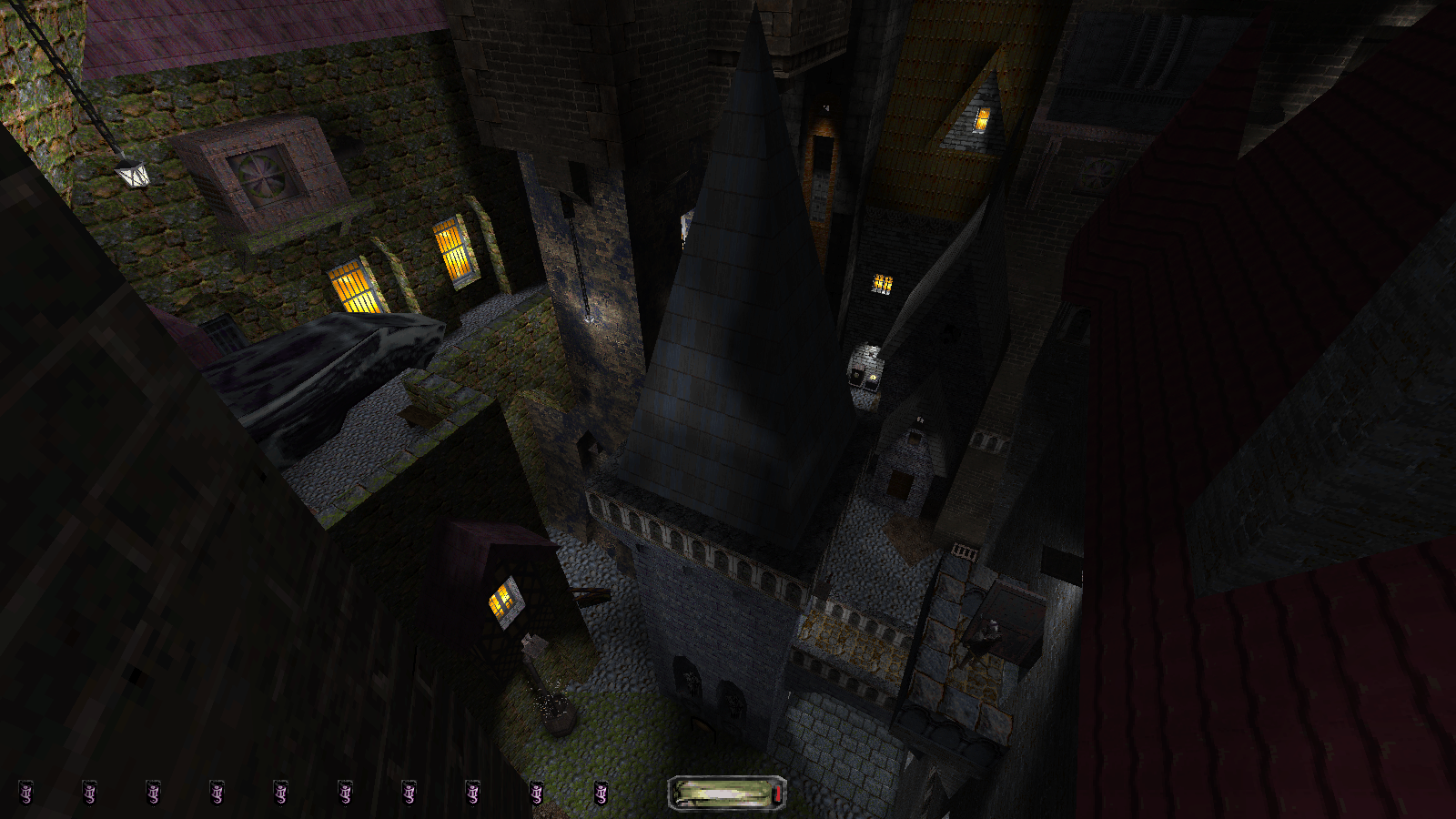
There is much more that could be written about The Black Parade, and I suspect it will be widely discussed in the following weeks and months. For now, though, this introduction should suffice. You can download the campaign here. A trailer, and a handful of screenshots by yours truly, follow.


Lost in the Catacombs

Back in a Smoke-Shrouded City

Venturing to Locales Long Forgotten

Pursued by Merciless Enemies

Sunday, 5 November 2023

[BLOG] The Sinister Secret of Schloß Hohenroda

The Cauldron Crew

It was already 19:30, a mere thirty minutes before I was supposed to GM my first session, and we were not yet in Hohenroda. We had come far and we had come fast on Hungarian State Railways, the Austrian Federal Railways, and finally Germany’s Autobahns, racking up a speeding ticket in the process while rain was beginning to fall in earnest, but we were just not there yet. The staff at the car rental agency were out for lunch at the checkout time, and would not show up for a nerve-wracking forty minutes, nor be accessible by phone. On our way North, we were caught in the congested traffic of München’s ring roads, and later rural Bavaria’s labyrinth of third-class roads. Stuck among barns and church steeples, we pressed on to the great Autobahns, heavy with traffic, and mired in cars due to a massive automobile accident. From a rest stop, we proceeded along an agricultural road, hoping the BMW’s state-of-the-art nav software would not lead us into an ambush by Bavaria’s backwoods cannibals (these, we would later learn, are organised and numerous beyond the Autobahn system). In the end, though, in Stygian darkness and incessant rain, the timber-framed houses of Hohenroda appeared in view, and, on a side-road, the central bulk and side-wings of an ominous structure: Schloß Hohenroda.

World's Least Surly Hungarians
We travelled to the uttermost fringes of civilisation to participate in the events of Cauldron Con 2023, organised by the secretive German game club only referred to as “the Nexus”. Indeed, many brethren had gathered at the venue from the far-flung corners of Germany, the mercantile lands of the Dutch, the sinking island of Hibernia (at the time of the convention, just barely above the waterline), the icy wastes of Finland, and the barbarous wilderness of Skåne. From across the sea came Jonathan Becker, a slayer of men. All these, and the Hungarian delegation of five, would spend the next two days gaming, drinking excellent beers, feasting on suckling pig roast and the Settembrini clan’s bio-apples, and meeting people we had mostly only interacted with virtually.

It is often easy to overlook the work behind good organisation when everything goes smoothly. But things were so tight that it became noticeable: all the background effort translated into an experience where everything went without a hitch, and we could focus on the actual gaming. For being a first-time event, people organising mini-conventions could do well to learn from Cauldron. A lot of the larger gaming events are flabby affairs with plenty of idling, questionable seminars, and filler content. This con was all killer, no filler, with sitting down and playing at its forefront. A concentrated dose of dice-rolling over two days with local signup and a focus on the action. In the end, not only was the time spent well, there was still enough slack in the system to sit down for discussion by dinner, a bottle beer, or the miniatures table.

I ended up running three sessions and playing in two more with old friends and recent acquaintances. Only brief descriptions are provided here:

The Mysterious Estate

I GMed Urmalk the Boundless, an expedition to the Pentastadion Necropolis to recover the abundant treasures of a decadent magnate. A series of surface mausoleums were plundered, including one of the most dangerous ones (another was wisely avoided once the risks were calculated). While the adventurers did not make it down into the underground catacombs, nor find a way into Urmalk’s tomb, they made off with decent treasure, and avoided a costly confrontation with a bandit gang by bribing them with a valuable piece of loot coated with contact poison. Devin, 4th-level Cleric (Caelin), died in an assassination attempt after the session, failing to secure a valuable shield he was tasked to recover from one of the tombs to settle a debt. (I mix things up a little by letting players draw from a deck of random items, missions and curses before session if they so please.)

The Convention's Winner Claims
the Cup of Demise Best Player Award
I also GMed Catacombs of the Pariahs, one of the dungeon complexes from the City of Vultures. Transported to the depth of the catacombs by the sorcerer Padog Miir, the adventurers had four hours to emerge alive from the labyrinth. An undead lord and his entourage of concubines were defeated, the tomb of a powerful magic-user looted, cultists fought, an enigmatic device of the ancients messed with (successful saving throws helped out here), and a band of pariahs press-ganged into the party’s service. The players made it back up to the upper level reasonably quickly, avoiding the dangerous depths visited in a much earlier playtest. Morrill, 4th-level Magic-User (Patrick) was strangled by an invisible apparition who snuck up on the party. The company emerged from the depths with moderate but adequate treasure, and a magic sword.

Dr. Becker Racks Up the Kills
I played in Storming the Forbidden City III, run by Jonathan Becker. This was a series of three self-contained adventures developing sites in the classic TSR module. Having suffered heavy casualties in the previous round in a humanoid lair assault, the Hungarian team was augmented with new reinforcements to seek the treasures of the yuan-ti in their most ancient pyramid-temple. The adventure started with careful reconnaissance (probably overly cautious for truly effective play, but the second round made the veterans cautious), and followed with dungeon-crawling beneath the pyramid. We saw one of the adventure’s three levels, and found one of the major treasure-caches, where got embroiled in a fight against a well of water weirds. The half-orc Cleric who could immediately dispatch them with purify food and water was the first to be dragged under, and while he could survive effectively with his helm of underwater action, this made the battle into a much more perilous affair. The adventure thus produced Cauldron Con’s signature casualty for Marcella, 7th-level Ranger (Max), who was drowned, revived, and subsequently fireballed by Chomy’s careless use of a wand of wonder. Another character, Thomas Peacock, a Thief-Bard, drowned ingloriously. Grabbing the bounty of the chamber and fending off the enormous giant spider that tagged along in the catacombs on the way back to ambush us from the rear, we emerged rich and victorious.

The Slyth Never Saw It Coming

I also played in Slyth Hive II, a high-level deathfest of a module by Prince of Nothing (now available on DriveThruRPG). This is kind of a scenario where you bring your best to fight the worst: the finest champions of multiple dimensions were called to face a world-ending menace. When your convention pregen is named Oberon, the Old Man of the Mountain, Jacques de Molay, Sir Giselher, Solomon the Magician, Brandoch Daha, or The Master of Summer, you’d better start paying attention (the most mighty of them all, the elusive “Kent”, was too powerful to handle by our group). Since this was a night session, we unfortunately had limited time to explore what is an enormous multi-level module, but we tore through two high-end setpiece battles, one with a horde of howling caveman in a cyclopean cavern passage, and a second with several hundred insectile slyth and their psionic overseers in a cavern littered with prehistoric bones. This is a tier of play where high and versatile player capabilities can be used individually or in combination, giving rise to unexpected hacks to regular AD&D procedures. We were somewhat constrained without a steady supply of mass killing powers that’d turn these confrontations into simple massacres, but ended up steamrolling the foe nevertheless with crowd control and targeted action. The session also featured gaming history’s laziest Djinn, whose expertise in avoiding having to do useful work impressed even this team of hardened adventurers.
An Expedition to Hohenwart
Finally, I ran The Saint in Hohenwart, a Helvéczia scenario, where the group was tasked with saving their friend, the young mercenary captain Konrad Göttlinger, from the influence of a strange and ominous saint in the high valley of Hohenwart. Travelling through a mountain wilderness, a grotesque recluse engaging in deviltry was captured, tried and lawfully executed by James Raggi; a duel was fought between two Italian clerics who turned out to be life-long mortal enemies (the affair was settled in a tense card game, eventually won with the devil’s assistance); and Konrad rescued from his predicament. Willem, 2nd-level Dutch Vagabond (David), an agent of the Dutch East Indies Company not at all modelled on Prince of Nothing, was dashed on the rocks of a waterfall after trying to climb a slippery rock surface with a rope, and assuring everyone he had abundant practice in these matters on the high seas.

The Battle for Safeton Rages On

It cannot be emphasised enough how well things can go if players are focused on getting things done, and having a common interest. There was a lot of creative play demonstrated over the sessions, from clever spell use to bold and smart decision-making, and sometimes just pure on-the-spot improvisation. It helped that Cauldron Con was deliberately targeted at a specific kind of experience, and set up to deliver on that promise. But there was also the energy brought by the players, who all gave their best over two days. It was good to see that the con spoke not only to the grognards among us, but also a younger cohort; some recently acquainted with old-school gaming, and some entirely new to it, who came to Hohenroda to check out what this all meant. It was all focused, with a good fighting spirit and high cheer, and that’s the best thing.

The Revievers' Conclave Meets... Again!
Beyond the games, the convention also hosted a surprise star guest in the person of Mr. Bryce Lynch, reviewer extraordinaire. It has been a long four years since our first meeting in Athens, Ohio, so when we heard Bryce was in the general area, steps were taken to arrange what was, truly, a random encounter. Unfortunately, Bryce was on a tight schedule – he was travelling “to take care of family business”, and the way he stressed the phrase, we decided not to probe further – so most people at the con missed him due to ongoing sessions, but it was an excellent opportunity to catch up on things and shoot the breeze for half an hour or so. It may be too early to reveal details about Bryce’s new OSRIC module line, but we can all be sure it will be a “No Regerts”. Tentative plans of a Crusade to get rid of the sub-par creators littering the “OSR” with irrelevant junk were outlined, and we can promise with some confidence that the response to this particular “problem” will be highly effective, even if it has to rely on Mr. Lynch’s “business associates”. Unfortunately, Bryce had to leave early in his black BMW, so the fine details are still to be elaborated.

Extra-Fabulous Collectibles

Finally, Cauldron Con featured an auction of riches from the community: treasures from 1980s German comic books to uncommon old-school publications went to lucky buyers, some after an energetic bidding war. Settembrini proved a skilled auctioneer at introducing the titles and their context, and generous lucre was gained by the sellers, as well as various charity organisations. On the final day, an award ceremony was also held: hand-engraved copper cauldrons went to the convention’s best player, most effective looter, the player who died most (“the Cup of Demise”), and the best GM – the mighty Jonathan Becker, who will no doubt fill it with the skulls of his enemies back in the U.S. of A. And that was Cauldron Con 2023. With the pace and energy, it felt a day short, although that may be asking for too much from the hard-working hosts. There was just a lot crammed into it, and there were things you’d inevitably miss – an ongoing multi-day Chainmail battle to determine the fate of empires in the German old-school scene’s shared Greyhawk campaign, an OD&D hex-crawl, the classily named Don’t Fuck the Priest, The Smorgasbord of Adventure, and many more. As always, you can’t come away with everything, but it felt like coming away with a lot. We also saw a pizza vending machine, which proves, once and for all, that greatness is still within mankind’s reach. 2024 sounds like a nice number. Appetites were whetted. Spielen wir AD&D!

An Assortment of Excellence
Until then, stay tuned for part II of the convention report, where we will present the Handshake Firmness Evaluation Chart. Strict records have been kept!

Vorsprung Durch Technik:
The Pizza Vending Machine