|
The City-State of Pentastadion
(as depicted in a 1932 university yearbook) |
“OK, but what actually is Fomalhaut?” is not a question I get asked specifically, but it is one which seems to deserve an answer due to other questions about the setting which come up – “Is Erillion part of Fomalhaut?”, “Are all the campaigns in Echoes from Fomalhaut set in the same world?”, “Do you have a blog post that’s like a guide to your settings?” – and which come back to this question.
Over
time, I may have contributed to the confusion by not clarifying the matter in
an accessible post, and just assuming all this would be self-explanatory. To compound
the problem, I named this blog “Beyond Fomalhaut”, and my zine “Echoes
From Fomalhaut”. These choices were intentional, since at the time, I was
not actually running a game in the Fomalhaut setting, so the names were
hints this would be something different (the “beyond”), it would just have some
vague stylistic similarities to it (the “echoes”). Both were initially aimed at
a small circle of friends I have known since the mid-2000s who would presumably
know this, but rapidly grew beyond that scope to draw new readers who
presumably wouldn’t. The original setting guide was published in Fight On
#03 in 2008, and that wasn’t yesterday either (more time has passed since
that time than between OD&D and 2e). To add insult to injury, when I
started publishing materials for the Isle of Erillion, I didn’t have a good
name for the broader setting, and didn’t really need any, so a lot of people
just rationally assumed it would be the titular Fomalhaut. A few years later,
the mixup persists and grows, and well, much of it is my fault. It also happens
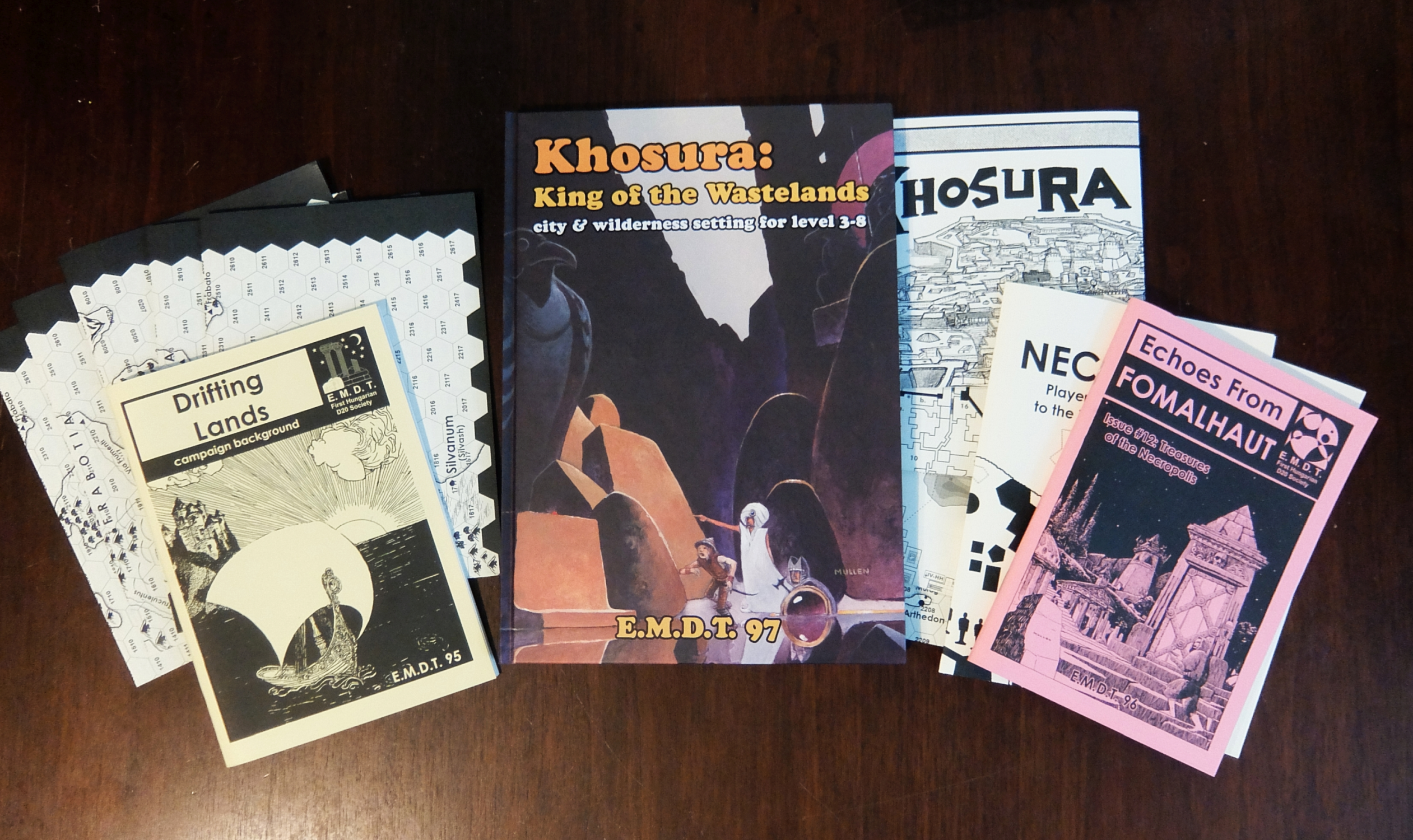
to be that I have published a hardcover last year that described a corner of
Fomalhaut (Khosura), and am planning a players’ setting guide for early
next year, making it a good opportunity to clarify things.
So
here it is: a post about what isn’t Fomalhaut, what is Fomalhaut, and
what makes Fomalhaut distinct from “just old-school D&D”.
 |
We Will Speak of this No More
(an Unholy Khosura/Erillion Hybrid by Grützi) |
Drifting
Lands: What Isn’t Fomalhaut
Let’s
start with the simple part. The Isle of Erillion, the Twelve Kingdoms, and Kassadia
are unrelated to Fomalhaut. All of these places are regions of the Drifting
Lands, a more traditional adventure fantasy setting which is more or less
in line with the implied setting of the AD&D rulebooks. Of these, Erillion is
sort of standard Gygaxian high fantasy (and would fit neatly into Greyhawk somewhere
east of the Great Kingdom and north of the Lendore Isles); the Twelve Kingdoms
is a northern archipelago divided among tiny rival kingdoms (mainly inspired by
Jack Vance's Lyonesse and Mike Singleton's Lords of Midnight); and the fallen
Empire of Kassadia is a mixture of late Roman and mediaeval Italian influences about
a land where the local equivalent of the Roman Empire never fell, just decayed
into competing polities still nominally linked by shared culture and tradition.
Other regions in the settings are sketched out but unexplored, since we have
not had adventures there.
The
Drifting Lands just assume that all of the common assumptions about AD&D’s
implied setting are valid, and if something is there in the three rulebooks, you
could also find it here. (Conversely, I have never had much of an interest in
expansions like the UA, although our campaigns have adapted some stuff from T.
Foster’s much better Heroic Legendarium.) The Drifting Lands is more
humanocentric than canonical AD&D tends to be; it is slightly lower on the
power curve (it doesn’t get too deep into the high-level end of AD&D, and
assumes a lower level of magical treasure); and it has a slightly stronger
sense of fantasy realpolitik than most AD&D materials (assuming its
internal conflicts mostly stem from human-level ambitions vis-à-vis a battle of
cosmic forces and alignments – to be fair, Greyhawk comes fairly close in these
sensibilities). These are differences of degree, but not of kind. It also
explains why I didn’t worry too much about defining the setting beyond the
regional level, since materials written for it are plug-and-play, and easily
adapted to most old-school campaigns.
 |
Now This Is More Like It
(Updated Overview Map) |
What
Fomalhaut Is
Fomalhaut
is a different setting: a coherent sword & sorcery take on the D&D
baseline, with strong sword & planet elements. While the Drifting Lands are
defined by their adherence to the AD&D canon, Fomalhaut is defined
by its distinction from modern RPG fantasy – it highlights that which is
specific and peculiar about old-school D&D, eliminates the “elfie-welfie”
(my phrase from 2006), and makes a setting out of it. At the time of
its creation in 2006 (apparently, right before Christmas), it was inspired
by the rediscovery of the Judges Guild materials, particularly Wilderlands
of High Fantasy; the exploration of “Appendix N” books; a growing interest
in OD&D; and the stranger aspects of old-school play. Thus, Fomalhaut is
still D&D through-and-through, but it focuses on the game where it connects
to earlier traditions of pulp fantasy. This is not old-school gaming as it was,
since it was always a mixture of influences, but old-school gaming as it could at
least theoretically be – self-consciously sword & sorcery while keeping the
structures of play as they are.
 |
Not Quite Fomalhaut,
But Close Enough |
Fomalhaut’s
TL;DR pitch is “Mediterranean city-states in a world built atop the ruins of an
earlier, more advanced age, surrounded by a vast wilderness dotted with strange
enclaves, fallen (or all-too-successful) utopias, and pockets of weirdness.”
Its main sources of inspiration in tone are Leigh Brackett (the
Skaith
trilogy in particular), Jack Vance (more
Planet of Adventure and
even
Demon Princes than the Cugel stories), Clark Ashton Smith (mostly Hyperborea
and Zothique), H.P. Lovecraft (
Dream-Quest, but not Cthulhu), Harold
Lamb’s historical pulps, various swords & sandals movies like Harryhausen’s
Sindbad films, and Alex Raymond’s
Flash Gordon comics (the original,
crazy 1930s strips, of which the 1980 movie is a worthy adaptation). To sum up
from the intro of the forthcoming gazetteer: “This is a setting of bold sword
& sorcery, where the Techno-Hellenic age fell in destructive interstellar
wars, and was succeeded by one of iron and bronze. Here, the descendants of Man
have fractured into a myriad strange societies in a changed world, some
warlike, some reclusive, and some surprisingly civilised. Philosophy, religion,
and cultural variety are rife with exception and local colour. But ‘in every
age, in every place, the deeds of men remain the same’ – and for all its
strangeness, this setting, and the adventures you can find therein, should be
immediately recognisable to fans of sword & sorcery.”
One
major difference with strong implications down the line is that where D&D’s
implied setting is mostly mediaeval (with Old West and modern influences),
Fomalhaut draws its aesthetics and social settings from Ancient Greece and the
surrounding Mediterranean and Near Eastern civilisations. It is thus a setting
with vast seas and lots of seafaring; mainlands covered with wilderness and
lots of barren wastelands; and small pockets of civilisation dominated by
commercial city-states (leaning into the points of light concept). It
assumes fantasy polytheism a bit beyond D&D’s understanding, and a set of
limited petty gods with massive character flaws. It also adds a layer of
weirdness, which informs its ideas of the fantastic: lost high technology,
crashed UFOs, ideas plundered from pseudo-archaeology, the kind of strange
magic you may find in 1930s pulps, and all kinds of odd thought experiments (“but
what if… someone tried to set up an ecological utopia in a sword & sorcery
setting around the wreckage of a flying saucer?”). The setting also assumes
NPCs and PCs who are shrewd, pragmatic, and often a little morally dubious by
modern standards – more Odysseus and Conan than Robin Hood and Frodo. Conversely,
it is not a grimdark setting: it is intended to be violent and morally complex,
but not nasty or cynical. It is about as edgy as a mid-century hardboiled story
– that is, “somewhat” but not beyond good taste. If Leigh Brackett would write
it, it would fit Fomalhaut.
Above
all, Fomalhaut leans into the idea of the hex-crawl, as expressed most
purely in Wilderlands of High Fantasy: the setting is meant to be a
sandbox where wilderness exploration and sea-faring are important pillars of
play. (Although our City of Vultures campaigns were mostly city-centric, and
our ongoing online game is more site-based.) It stretches over nine hex maps,
two of which have been published so far (one in Echoes #08, and one in Khosura),
and altogether three of which have seen extensive play since 2007 (not counting
connected otherworlds, of which there were some).
 |
The Tridentos
(Regional Hex Map ca. 2006, Players' Version) |
Setting
specifics
(This section is excerpted from
the forthcoming players’ gazetteer.)
Campaigns on the world of
Fomalhaut generally conform to the rules and style of play found in old-school
systems, but by default (as we have played our campaigns), they feature some
departures as well. The following is not immutable dogma, and may be altered or
disregarded at the Gamemaster’s discretion, but it makes for a cohesive, sword
& sorcery-flavoured take on the old-school playstyle that has worked out
fine in our games.
Humanocentrism: Only human
descendants of old Terra are found on the world of Fomalhaut. The likes of
dwarves, elves, gnomes or halflings are entirely absent, unless they are
brought in through a magic portal, found in cryogenic storage, summoned by a
magic-user, etc. During character generations, players may select from Terrans
(general humans) and other human sub-groups. Likewise, Fomalhaut does not have
goblinoids (orcs, goblins, ogres, most giants) or dragons, but features an
abundance of degenerate cavemen, a few mutants, dinosaurs, and rarely,
high-tech killing machines. In many cases, the GM can simply substitute
appropriate results on random encounter tables (e.g. cavemen or ape-men for
orcs, or dinosaurs for dragons). [The original setting concept had gnolls, but
they were subsequently removed. Our first campaign also featured a dragon
despite my sincere promises that “there are no dragons on Fomalhaut”.
Fortunately, the dragon was killed by the characters, so there are no dragons
on Fomalhaut. You can trust me.]
Class range: Not all classes fit
campaigns on Fomalhaut. Fighters, clerics, thieves, magic-users and
illusionists are excellent; others may be adopted on a case-by-case basis. In a
campaign played with Seven Voyages of Zylarthen, fighting-men, thieves
(SVoZ’s excellent variant) and magic-users were sufficient, and clerics were
not particularly missed.
 |
You Will Worship the Benevolent
Giant Slug God of Hedonism
And You Will Be Happy
(NO EDGED WEAPONS
OR SALT ALLOWED!) |
Petty gods: Fomalhaut’s gods are
not impersonal cosmic forces, but powerful and arbitrary individuals. Few
consider them a reliable moral compass, and those who do are often dangerous
fanatics. But most average denizens, and even priests and other followers see
them in a practical light, resulting in a more transactional relationship.
However, player character may easily come into contact with the gods from the
outset, who can act as both patrons and antagonists in the course of play.Power range: It is suggested to
start campaigns at level 3 (or an XP value where most classes are at that
point) where characters are hardy and capable enough to face the world’s
challenges. No campaigns in the setting have reached levels far beyond name
level (12-13 was the highest), and that is more or less where the setting
itself caps out. Magic has also been limited in our campaigns, with no spells
available beyond level 5, and no magic items beyond +3 (mostly in keeping with
OD&D’s original range, which was similar). Magic items were generally more
scarce. All this results a world of sword & sorcery that is slightly
lower-powered than the old-school default, but where characters can also expect
the same restraint from the setting itself.
XP for squandering: Treasure-based
experience is awarded not for winning treasure, but squandering it in
hedonistic excess (at the same rate of 1 XP/gp). Squandering may mean expensive
drugs, lavish entertainment, fancy clothing, sponsoring gladiatorial games, or
anything that has no direct or indirect gameplay benefit. Therefore, money
spent to curry favour with the rich and powerful, direct sacrifices to the
gods, or bribes to achieve some concrete aim do not count, but investments in
larger personal projects (including the construction of temples and
strongholds) do. Alms to orphans and widows, or money spent on other acts of
senseless altruism also qualify, since these actions are ultimately just as
ineffective and meaningless as vapid debauchery. No training rules apply, as
characters are assumed to be competent enough to learn during their adventures.
Hellenism and barbarism: The cultures,
attitudes and development level of the setting reflect humanity during late
antiquity instead of a truly mediaeval milieu. This is not just an age of
barbarism, but also one of sophistication and sometimes decadence; of bold
ideas and advanced commerce in a violent world. This is not a grim and dark
milieu, but one with wide conceptual horizons. Magic and fantastic elements are
not pervasive, but they do shape the possibilities and mindset of Fomalhaut’s
societies, and the powerful use them on a par for the course basis. The legacy
of the lost Techno-Hellenic age also means the setting may be more modern in
its thinking than it could first appear, and both the players and some NPCs may
be behaving like modern men dropped into pre-modern societies. Of course,
applying modern ideologies or utopian philosophies to the basic layer of
fantastic “realism” also introduces an inherent tension, with many
possibilities for conflict and failure. This element is excellent fodder for
ongoing campaigns.
High technology: The clash of a sword
& sorcery setting and advanced technology is a prominent feature of
adventures on Fomalhaut, which feature a strong sword & planet element.
Devices from the world’s ancient history do not turn up often in the daily life
of an average person, but they are a lot less rare in the hidden corners of the
wilderlands, the deep levels of dungeon complexes, or in the possession of
NPCs. By outwards appearance, the devices and architectural remains of the old
Terran civilisation generally follow neoclassical, art deco, and high modernist
/ brutalist influences.
Foreign planes and strange
worlds: Boundaries
are thin between the plane of Fomalhaut and other dimensions. Adventurers who
lose their way may easily find themselves in another world, or be dragged into
strange settings by hostile forces, from which they must escape with their own
might. It is left open to interpretation whether these worlds are truly
different planes, foreign planets, a form of time travel, dream-worlds, or all
of these.
Exoticism and colour: As conceived,
Fomalhaut strives to be a world of colourful, mosaic-like cultural variety;
eccentric and sometimes outré local customs; with a helping of fanciful
thought-experiments and surrealism. This is also a setting where wild
ideas may be tried in some corner of the world to see how they unfold to their
logical conclusions, which is how many of the specific details of this
gazetteer came to be.
Keep it adventurous: Ultimately, this is a
setting for classic adventure gaming with the usual old-school rulesets, not an
exercise in world-building for its own sake, or an attempt to come up with the
most bizarre world imaginable. Where a lot of Fomalhaut is colourful, the
adventures therein should be immediately familiar. It is a broad canvas to have
adventures with a specific flavour, and the needs of the game always come
first.
 |
The Sea of Emerald Idols
(as Depicted on a 1988 SF Magazine Cover) |
What Is Out There and What Is
Yet To Come
At the present time, two main bodies
of work for Fomalhaut are available in up-to-date editions: Khosura, King of
the Wastelands (a regional sandbox setting which has a bit of everything –
city, dungeons, wilderness, and more), and various pieces of The City of Vultures
campaign that have been published in Echoes From Fomalhaut. There have been
a few others, and there were earlier materials elsewhere (mainly in Fight On!
and Knockspell, although many of these have been republished).
Hex-crawl materials:
- Khosura, King of the Wastelands:
Includes
the writeup of the wilderness setting surrounding the city-state of Khosura, encompassing
the south-eastern quadrant of the Batrakasz.
- Thasan: A hex-crawl treatment
of the western half of this region, centred around the City of Vultures and
extending to the Sea of Kroitos. Published in Echoes #08.
Adventure modules and campaign
materials from the EMDT catalogue:
- The Lost Valley of Kishar (levels
6–8): Wilderness
adventure set in a small valley populated by strange wildlife.
- Trail of the Sea Demon (levels 3–5):
Three
interconnected city adventures involving a mysterious cult.
- The Nocturnal Table: Although more broadly
usable, the nighttime encounters in this book were originally developed for the
City of Vultures.
- People of the Great Wheel: A doomsday sect worshipping
an enormous, rolling stone wheel. Published in Echoes #03.
- Terror on Tridentfish Island
(levels 3–5): Former
island resort gone to ruin. Blood, death, and tourism! Published in Echoes #03.
- The Technological Table: Various high-tech
devices from Fomalhaut. Published in Echoes #04.
- Arfel: City-State of the Charnel
God: A
smaller city-state close to the City of Vultures, ruled by the followers of
Ozolba, the zombie god. Published in Echoes #04.
- The Enchantment of Vashundara
(levels 3–4 ): A
small extraplanar adventure set in the giant-sized palace of the eponymous
hero-god. Published in Echoes #05.
- The City of Vultures: A primer to the
city-state, with its customs, conspiracies, gods, and places of note. Published
in Echoes #06.
- The Gallery of Rising Tombs
(levels 4–6+): One
of the major dungeon complexes beneath the City of Vultures. It goes deep and
gets progressively more dangerous. Published in Echoes #06.
- The Hecatomb of Morthevole
(levels 1–4): Mini-dungeon
beneath the City of Vultures. Published in Echoes #07.
- The Tomb of Ali Shulwar (levels 4–6+):
Another
larger dungeon complex beneath the City of Vultures. Published in Echoes #07.
- The White Hand: One of the minor conspiracies
in the City of Vultures. Published in Echoes #07.
- Oom the Many: A more prominent
conspiracy in the City of Vultures. Published in Echoes #10.
- The Temple of Jeng: The city’s most powerful
religion, including their heavily fortified temple. Published in Echoes #10.
- Urmalk the Boundless (levels
3–5): The
necropolis of Pentastadion, a place of burial since time immemorial. Published
in Echoes #12.
- Catacombs of the Pariahs (levels
3–7): Yet
another large dungeon complex beneath the City of Vultures. Published in Echoes
#12.
- Tower of the Thief (levels 3–5):
A mini-adventure
describing an abandoned tower inhabited by a master thief. Published in Echoes
#12.
Earlier adventure modules, some
to be revised, and excluding those that have already been:
- Black Blood (levels 3–5): A dark prophecy, a
scared serving girl, and a nobleman’s villa where things have gone very-very
wrong. The opening adventure to our first campaign. Published in Fight On! #05.
- Pentastadion: Large city-state, one
of the setting’s main maritime powers. Published in Fight On! #05.
- The City-State of Dusal Dagodli:
A
very small, eccentric city-state inhabited by various philosophical schools.
High Vancian. Published in Fight On! #12.
- Isles on an Emerald Sea (levels
5–10): A
series of island scenarios, often fairly broad-strokes in their presentation. Published
in Knockspell #01, #02, #04 and #06. I would like to update these, and add some
material that saw play, but not publication.
- Systema Tartarobasis (levels 4–6): A larger adventure in a fallen technological utopia. Available here. [A minor note: the module introduction describes Fomalhaut's history as 8000-years long. This was subsequently shortened to a more sensible 4000 years.]
- In the Name of the Principle
(levels 5–7): Tournament
scenario set in a prosperous city-state known for its Autumn mysteries. A bit
over-the-top compered to the setting baseline, but possibly the best thing I
have written, so no regerts. Available here.
This is where things stand. My next
project is A Voyage to Fomalhaut,
which will serve as the updated and expanded players’ setting gazetteer to
replace the one that appeared in Fight On! #03, and should hopefully see
release in February. I would like to release more material in the future,
especially from our online campaign, which has produced a lot of stuff over
three years of play. Even more importantly, I really wish to do a Fomalhaut
boxed set with all the hex maps (counting player versions, that would be 18 of
them, which is a bit scary to think of), and hex descriptions for the three
major explored regions. This will need some work.
Until then, in the spirit of
Christmas, here is a preview of A Voyage to Fomalhaut. Since my first post
ever on Fomalhaut was a writeup of the deities, this will also be about
half of the same chapter – now updated and expanded, with art by the late and great
Virginia Frances Sterrett, the Antique Alumni, and yours truly.
A Voyage to Fomalhaut – Preview (2.3MB)
 |
| Onwards! |