Showing posts with label muh layout. Show all posts

Sunday, 27 August 2023

[REVIEW] The Arcane Font of Hranadd-Zul

The Arcane Font
of Hranadd-Zuul

[REVIEW] The Arcane Font of Hranadd-Zul (2023)

by Daedalus

Self-published

Levels 2–4 “plus henchmen”

Hello, and welcome to part SIX of **THE RECONQUISTA**, wherein entries of the scandalous No Artpunk Contest II (banned on Reddit but the top seller in the artpunk category on itch.io) are subjected to RIGHTEOUS JUDGEMENT. As previously, the contest focuses on excellence in old-school gaming: creativity, craft, and table utility. It also returns to the original old school movement in that it assumes good practices can be learned, practiced and mastered; and there are, in fact, good and bad ways of playing. Like last year, these reviews will assume the participants have achieved a basic level competence, and are striving to go forward from that point. One adventure, No Art Punks by Peter Mullen, shall be excluded since Peter is contributing cover and interior art for my various publications. With that said and solemnly declared, Deus Vult! Let Destiny prevail!

* * *

A shrine known for a font that can grant magical powers for a price has become the focus of multiple competing groups. A magic-user, looking for the font’s energies, has been captivated by an evil plant monster, and serves it loyally. A band of grimlocks want to destroy the plant to worship the font as a manifestation of their god. A drow swordswoman has escaped here with a macguffin, and is pursued by a humanoid band who want her dead and the macguffin for themselves. The plant monster wants to enthrall and feed on more victims. This adventure uses a Dyson Logos map for a small dungeon adventure with 25 keyed areas, and lets loose the PCs among the factions.

Designed to be
messed with
The result is a sort of compendium of dungeon design good practices – a good mixture of encounter types, dungeon factions, non-linearity, monster tactics and a sense of wonder are all present. The locale is effective as a derelict place of mystery, with the statues of mysterious goddesses, scavengers which have moved in, and enigmatic puzzles you can mess with. This element of exploration and interaction is the adventure’s strongest point; whether it is messing with two magical mirrors that allow remote observation of key locales, stealing votive coins from the shrine of a death goddess, or exploring a laboratory setpiece, fun possibilities are presented and explored. It is not just single-function stuff – there are deeper layers of interaction and multiple possibilities to explore. There are enough environmental clues to help you along, but experimentation is tempting. You find a dead body, followed by a killer trap, and if you fall for it, it is richly deserved. The combat encounters offer good variety – there is a battle on a bridge spanning a larger cavern with a swarm of spiders dropping down from the ceiling that should warm every GM’s heart, a large grimlock gathering you can crash, or moving NPCs who are all different in their approach and threat type.

The faction conflict is central to the adventure, and it is impressively developed. There are opposing forces active in the area, they are on the move, and some of them also have bases to fall back to. This is quite outstanding, although as it tends to be, the dungeon is too small for this scope of intrigue. It is a grand play on a small stage – to work properly, it would need a place that would be three or more times as large, with generous empty space between the keyed areas.

Discovering the Ruined e-Thot Room
User-friendly presentation is just as prominent in The Arcane Font of Hranadd-Zul, and every trick from the book is on display. Room entries use multiple-level bullet-point formatting, underlining, cross-referencing, the works. NPC motivations are explained, terrain features described exactly, there is a table breaking down XP and treasure, and even a “what happens after the adventure” page. Paradoxically, this becomes the module’s largest flaw and the main obstacle to actually using it. Things are over-explained in the text – describing the presence of mundane doors where the map would suffice, or dwelling on insignificant dungeon clutter, or the motivations of a mimic and a carrion crawler (it is what you expect). Underlined keywords are too frequent, and don’t draw our eyes to the relevant bits. The effect of presenting the entire text in two-level bullet pontese is more disorienting than helpful – a lot of it would have worked better as plain text, with the bullet points reserved for relevant material. The point is not that these layout practices aren’t useful, but that their role should be supportive, not overwhelming. Here, it is overwhelming.

All things considered, this is a decent adventure, but it would be a better one if it had a larger sscope, and especially if it wasn’t trying to be so helpful. There are strong elements in the factions, the exploration, and the generally well-written text, but in the end, we return to the eternal wisdom: less is sometimes more. Would I use the adventure as it is? No. Would I be interested in a new one that fixed its issues but kept its good points? Definitely.

No playtesters are credited in this module.

Rating: *** / *****

Monday, 26 June 2023

[REVIEW] Tomb of the Twice-Crowned King

Twice the Heads,
Twice the Fun!
Tomb of the Twice-Crowned King (2023)

by Hawk

Self-published

Levels 8–10

Hello, and welcome to part THREE of **THE RECONQUISTA**, wherein entries of the scandalous No Artpunk Contest II (banned on Reddit but the top seller in the artpunk category on itch.io) are subjected to RIGHTEOUS JUDGEMENT. As previously, the contest focuses on excellence in old-school gaming: creativity, craft, and table utility. It also returns to the original old school movement in that it assumes good practices can be learned, practiced and mastered; and there are, in fact, good and bad ways of playing. Like last year, these reviews will assume the participants have achieved a basic level competence, and are striving to go forward from that point. One adventure, No Art Punks by Peter Mullen, shall be excluded since Peter is contributing cover and interior art for my various publications. With that said and solemnly declared, Deus Vult! Let Destiny prevail!

* * *

Tomb of the Twice-Crowned King takes you into the resting place of a murderous warlord who put his own servants and family to death to guard him in his unlife, which is definitely the thing to do if you live on a metal album cover. The scenario looks deceptively small at a first glance, but it turns out to be a lot larger than it seems. The scenario’s main value lies in how it is built into a carefully honed killing field where interlocking encounters present a deadly gauntlet over 31 keyed areas. A spirit of good competitive fun permeates the work – this is high-skill, high-stakes funhouse AD&D from an author who has mastered this particular game style, and developed the skills to present it effectively in written form.

The level range is getting respectable: this is clearly an adventure designed for capable parties with commensurate resources and solid player experience. Not every encounter has a clear solution, but the module trusts your players to use their capabilities to circumvent them on their own terms.  The module excels particularly at the baited trap encounter. The entrance is guarded by two bronze statues wielding massive hammers, which prove stubbornly inanimate right until the moment when all hell is let loose in the tomb, upon which they begin demolishing the bridge leading to the entrance, and set up a guard for escaping PCs. 10 mummies in another room do not react for 4 rounds, just enough to put the players’ mind at ease before springing into action. The titular crowns are out in the open in the tomb’s main hall, just within reach... you know you want to grab it, just to see what happens if you do. This is a nasty mousetrap of a module, where getting in is a lot easier than getting out. It is also a piggy bank of the really good stuff that makes it very tempting.

The skilful design extends to combat setups – both standard and souped-up monsters (e.g. a vampire with a nine lives stealer sword) are used to great effect. While tombs are mostly static locations, this one does a reasonably good job keeping things lively by presenting effective defences and throwing curveballs at the players (such as one group of hill giant skeletons trying to push PCs into a pit filled with ghasts under the cover of continual darkness, and another bunch throwing giant-sized pots of flaming oil from ledges above a rope bridge). Some of the higher-end guardians hunt intruders effectively until they can strike for maximum effect. These tactical setups and defensive schemes make for effective and deadly combinations – but at this level, you should have enough resources to crack them. Traps are likewise clever, like a statue with gemstone eyes that shoots disintegrating beams, and whose eyes explode if removed; or a room of stepping stones leading through a pit of slime that turns its victims into ghasts or wights – with some stepping stones rigged to just give way and sink if stepped on. These are killer encounters, but they are also killer encounters of the “I should have known!” variety. After a while, good play gives you an instinct for these things – a tingling sense in the back of your head. Tomb of the Twice-Crowned King rewards the use of this sense.

Finally, it is the small things that spice it up further. Minor descriptive detail is used to add a little extra even to the basics – random wights approach “screeching and screaming madly (no surprise)”, while ghasts “whisper words of death as they prowl”. A room of sarcophagi has a bunch of fun “sarcophagus contents” results like “Male and female skeletons embracing”, “Putrid tomb air is released: save vs. poison or contract random disease”, or “Mass of maggots eating corpse, underneath is M-U scroll”. This is decent extra mileage for what are mostly one- or two-line additions.

The presentation is rock solid. Everything is there on six pages, except one of those pages is dedicated to Hawk’s expressive rendition of the Twice-Crowned King, and ¾ of another is occupied by the map, so all that text occupies 4.25 pages of real estate. No space or word is wasted, but you do not feel short-charged in the end. It is all there and all effectively conveyed, from strategically placed stat boxes to room entries which are as long as they need to be, and not a line longer. While dense with text, this is, in fact, an example of what good layout should aspire to – a compact, play-friendly, effective presentation that puts all you need at your fingertips, but gets out of the way once that is accomplished. It is simple, elegant, and polished to perfection.

Tomb of the Twice-Crowned King rises high above the average, competent tomb-robbing scenario with its tight design and touches of individuality: it is a great example of doing great things with vanilla AD&D. It has charisma, an infectious sense of wild fun, and a strong understanding of what makes high-level, module-oriented play tick. Like a finely honed blade of the purest Japanese steel, it cuts through tanks and bad players alike, and brings a smile to your face when you hold it in your hands. High energy.

No playtesters are credited in this publication.

Rating: ***** / *****

Tuesday, 13 June 2023

[REVIEW] DNGN #1

DNGN #1
DNGN #1 (2022)

by Vasili Kaliman

Published by Singing Flame

Levels 1 and up

The Terminator is a marvel of design and engineering, a sleek technological terror moving with superhuman precision. Its body is surgical steel, its eyes penetrating optical cameras, its blood high-grade machine oil. It hunts and kills according to the precise programming with which the machine overlords had imbued it. The Terminator is very efficient, but is it good for us? The jury is still out on that one.

Anyway, DNGN #1 is a weird science-fantasy megadungeon published as a risographed zine; the whole thing is printed in pleasing red and blue ink, with 10 really neat full-page illustrations that could be used as an illustration booklet, and even a comic strip! The initial issue covers ten levels and a bonus side-adventure (same author using a skullfungus map). This is a zine which follows all the layout and writing trends championed over the last few years, and used particularly in various Old School Essentials releases. The text is terse, using bullet points to convey information exactly and briefly. Monster names are not only bolded, but highlighted in red. Dungeon maps are annotated with extra room information on floor type and illumination, simple dungeon dressing tables, and so on. Each of the ten levels in this issue uses a page for the maps, and the facing page for the room descriptions.

Here lies the problem, though. As a result of this ruthless and sleek efficiency, what we get is not necessarily what we were looking for in an adventure. How can ten levels of a megadungeon  fit into a 40-page zine (that is, 20 pages of that 40-page zine, since the art and the comic take up the rest)? Well, we have to adjust our expectations for a megadungeon. These dungeon levels have around 8-10 keyed rooms on the average. It is also not like they are 8-10 keyed rooms in a network of corridors and empty rooms (which would be the Castle Greyhawk model). It is really all there is to it.

Puny meatlings! This is, in fact, my final form!

The maps are on the simplistic side, mostly a few basic geometric shapes strung together. Levels connect to one another through one or two stairways, but they follow in succession, without side-levels or the possibility of choosing between a risky deeper delve or a safer expedition close to the surface. Secret rooms are found, but the discovery of cleverly concealed hidden sections, larger room complexes, themed sections, staging areas, and the stuff that makes megadungeon campaigns exciting are all missing. Pit traps, slopes, stairs within levels, water, collapsed terrain, level-spanning rooms – not present either (although there are two cavern levels). It is notable how much of a difference a good map makes. If the whole zine was dedicated to mapping out a single, sprawling dungeon level with decent map design and all sorts of interesting exploration choices, it would solve a lot of the scope/content issues. Here, you just cannot explore too much, since there is so little to explore, and your ability to make meaningful choices is likewise limited by the constrained environment. This is, simply put, not a megadungeon in any shape or form that meets the commonly accepted criteria. Even as a dungeon dungeon, it is smallish and very linear. It all fits on neatly arranged page pairs. It is geometrically perfect, no exceptions. Is that really a feature here? Does it help create a dungeon that is fascinating to a group of players, drawing them back again and again to go further and see more?

The room keys are a step better. A technological/cosmic weirdness theme connects the dungeon, from star god altars worshipped by duergars to vampires slumbering in a glass tank to magnetic statues wearing cybernetic armour and animating if the weapons captured by their magnetic powers are removed. Here, you can see good ideas and well-designed encounters, even if they are mostly simple. You can assemble a good dungeon from a handful of simple, good ideas. However, the strict double-page format serves as a barrier to what can be done. If there is a dungeon room that actually does something interesting an complex (like the magnetic statue room), there are inevitably a few more that amount to “empty”, “here is a bizarre item”, or “they are here and they attack”, because that’s what you have layout budget for (“7F > EMPTY ROOM. Completely empty.”). Does that make the adventure better? Are we better off following this super-efficient and scientifically perfected formatting? Is it to our benefit? Some designers – and this takes a keen skill and sharpened practice – can produce terse, enigmatic room entries which stimulate the imagination in just a few lines, and help the GM imagine the rest. There is an almost oracular quality to these entries, seen in Bob Bledsaw’s Tegel Manor or Michael Curtis’s Stonehell, since they tell much more than they actually speak, and can be interpreted very differently by different GMs. In these cases, minimalism works. But it does not work for everyone (for example, Gary Gygax developed a different style with different strengths), and it does not work reliably here. Sometimes the author gets it right, but he clearly has not mastered the format. Which is no surprise, since it is actually hard to get minimalism right.

Mechanical Skelebro
Offers a Helpful Hint
The room mixture is a mishmash. Instead of concentrated mini-themes emerging from dungeon areas, it is just all random – a room inhabited by an illusionist berating 1d6+2 zombie servants lies next to a room of tapestries, which lies next to a room with three sarcophagi containing mummies, which lies next to a room with bandits, which lies next to a room of stalactites you can lick for 1 Hp of healing. The room-by-room entries can be good, but the big picture is incoherent – not by the standards of conventional realism, but even by the standards of a dungeon with a funhouse slant. The monster count is really low in both the room entries and the random encounter chart. You could see it is 1d6+2 zombies or 4 bandits or 3 mummies. You don’t really see OD&D’s hordes of lower-level opponents that come at you in an onslaught, to overwhelm the weak or get chopped into pieces by the strong. On the plus side, you can meet some really tough stuff that would require the characters to think before engaging, and run if they meet something they can’t handle. There is a purple worm right on level 2, hiding within a mass of tangled vines in a side room. That’s quite fun, although I suspect this module would have a high TPK potential if actually run.

And that’s the deal with DNGN #1. It shows strengths in some room entries, but it is a dungeon where the whole is much less than the sum of its parts. More than that, it shows, very clearly, how meme layout and graphic design fetishism have misled old-school designers. This zine uses a format which actively works against delivering a substantial, interesting adventure, and is particularly ill-suited for presenting a megadungeon. Old-school gaming’s efficiency movement has produced a perfected end product which does not work. And here is where we return to the Terminator analogy. It turns out we defeated the Terminator and kicked its shiny metal ass. We survived its initial attack, we outwitted its mechanical perfection, we learned its programmed tricks, and we crushed it under a hydraulic press. If it comes back, we will do it again. And that is because we are human. That is because we have something more than the machines have. We will prevail.

No playtesters are credited in this module.

Rating: ** / *****

Sunday, 14 May 2023

[REVIEW] Vault of the Mad Baron

Vault of the Mad Baron
[REVIEW] Vault of the Mad Baron (2022)

by Christian Toft Madsen

Published by CTM Publishing

Levels 3–5

A hollow Earth with a populated interior is a great setting for adventure stories, and a good way to place even stranger things under your fantasy world. From Verne, Doyle and Obruchev to Burroughs and Lovecraft, as well as the highly underrated weirdo children’s science fantasy series, Sunken Worlds (a.k.a. Spartakus and the Sun Beneath the Sea), it has been occupied by dinosaurs, UFOs, cavemen, nazis, punk pirates, dancing yellow pangolins, and intelligent lizardmen. This module is the second in a three-part series exploring the “Inner World”, two of which have been published so far. Journey to the Inside Out (itself an outstanding module I read but have so far failed to review) was a lost world setting with cavemen lorded over by a technologically advanced alien race, Vault of the Mad Baron is a bustling mediaeval city, and the forthcoming Labyrinth of the Dreaming Machine is going to be post-apocalyptic. The three modules are set in the same place, except separated by millennia (with time travel possibly linking them). For instance, the main dungeon of the first module is revisited here in a way that leaves most of the physical space intact, while showing how the place has been affected by the passage of time and repurposed by its new inhabitants.

Vault of the Mad Baron has a more conventional setting than Journey to the Inside Out, being set in Bergfried, a Late Mediaeval / Early Modern port city ruled by a hereditary monarchy founded by Northman conquerors, as well as a monotheistic church, the nobility, the guilds, and a rising criminal underclass. The pulp elements of Journey are still present, but fairly well hidden underneath the thick layers of a normal fantastic mediaeval society that reacts to these elements – a mysterious plague caused by messing with things that ought to have been left buried – in a fairly realistic way a fantastic mediaeval society would. Corruption, intrigue, the lust for power and revenge come to the fore as the plague spreads and things start falling apart, heading towards some sort of resolution between Bergfried’s competing factions.

This is the module’s basic premise: it presents a complex, interconnected sandbox setting in a large city with an eye towards realism, then throws curveballs when the characters start to dig deeper and events in the city escalate. It is sort of a low-magic and relatively low-level sort of D&D; light on monsters and treasure (perhaps a bit too low, especially on the latter), and high on realpolitik and competing factions. You could easily run it without the hollow earth premise if you wanted. The module notes it “contains topics which may be unpleasant to embrace in a fun pastime activity such as colonial aspects, abuse, murder, drug substances, poverty, diseases”, which is a bit like saying a candy jar contains candy, or a fantasy story features swords. Luckily, the module delivers on the good stuff in spades, without it being either preachy or puerile.

Vault of the Good Layout
The first impressive thing about the module is its scope, and its efficiency in delivering it. This is a 60-page book that would probably be a 240-page volume in lesser hands. “So what is in the sandbox?” “Everything.” “Everything?” “Everything.” The quantity of material crammed in is exemplary, containing everything you could conceivably need to run adventures in the city, with a gazetteer-style writeup, several random tables to facilitate play therein, detailed writeups of its six factions, their main NPCs and mapped headquarters, plus a large two-level dungeon system with a total of 80 keyed areas. “Good layout” has largely become a counterproductive obsession in this corner of the hobby, but that is not the case here. This is, in fact, good information design and good layout. A ton of information is presented, but it is being made accessible in the same breath. Page spreads are laid out to facilitate ease of use, with a plethora of random tables and charts next to the main text. The text is economic, and things are meticulously cross-referenced.

This efficiency is a necessity. As sandbox settings go, this one is heavily interconnected. The keywords are complexity, complexity, and more complexity. Everything relates to something, leads to something else, or is in conflict with a third thing. There are many moving parts, but the book does an admirable job of keeping them within the GM’s reach. There are occasional hiccups with table coding: is that Table BG, Table EG, or Table G1? It is not always completely straightforward to find where they are, and let me tell you, there are a lot of tables – it is hard to find a page spread without one, or five. However, this is the worst thing I can say about the module’s presentation. It is mostly just very solidly made.

Vault of the Shady Factions
The second thing that impresses about Vault of the Mad Baron is its handling of political intrigue. The rival factions are presented with their agendas, key objectives, things they want done in the city’s power struggles, and the people who run them. All of them crave power over Bergfried, but they do so in different ways – from the rising power of the Iron Guild and the doctrinal conservatism of the Church to the mystery cult of Dagon and the Baron’s grievously wronged wife who is plotting her revenge. This is not the railroady sort of political intrigue. Rather, you are handed the game board, you are handed the playing pieces with their capabilities and motivations, and let it play out in game as the players throw a wrench into the machinery. The city is a conglomerate of interlocking systems, and you can disrupt and destroy these systems through your actions.

In addition to the detailed static setting, a dynamic element is introduced through a simple but useful progression chart handling the advancement of NPC agendas – all based on how things get resolved through faction intrigue and player agency. Bergfried is a powder keg ready to blow, and there are serious opportunities for tipping the balance – with an element of moral dilemma. The city’s mighty and powerful all have something to hide, and are all eager not to have the skeletons in their closets disturbed. And disturb them you can: the headquarters of these organisations are written up as mini-dungeons (usually with about 30 locations each) ripe for stealthy and determined infiltrators. The cloak-and-dagger aspect is well done in both the physical and intangible sense, even if the room descriptions are mostly one- or two-line notes. As one-page dungeons go, they are the better sort.

Vault of the Vault

The Bergfried Dungeons form the module’s centrepiece. The two levels (three if we count the castle above them) are more detailed than the preceding city sites, using bullet point-based presentation with terse, matter-of-fact descriptions. The room entries are nothing to write home about – they serve their purpose, but you will not find entries that make you go “Wow, I should have thought about this one.” It is more of a low-key and realistic affair of prisons, workshops, guard rooms, cultist/bandit lairs and abandoned sections, without much in the way of “specials”. Realism takes precedence over whimsy. However, the dungeon system is ultimately saved by its interconnected nature, and even its size. This is an appropriately large place to explore, containing enough mysteries and dark secrets to uncover – all of which links back to things going on in the city. As a nice touch that will be mostly lost on those who do not have Journey to the Inside Out (an error you should redress when you can), the upper dungeon level is identical to the one in the previous module, and contains several callbacks to Bergfried’s prehistory. While the upper level is largely abandoned with the occasional guard outpost and NPC/monster lair, the challenge of the lower level involves four distinct areas, two of which are occupied and run in a systematic fashion by the Baron’s men, with guard schedules, checkpoints, and defensive systems. We also find the module’s weirdest things crammed in here, deep beneath the surface – and there is a large contrast indeed. It makes for a pleasant sense of discovery if the players come this far.

In summary, Vault of the Mad Baron is an exemplary adventure in both content and presentation. It lies slightly outside the standard D&D paradigm – it is a more-or-less realistic, low-magic Late Mediaeval setting with an underlying element of science fantasy, focused on a combination of cloak-and-dagger intrigue and dungeon infiltration instead of reckless adventuring. It lowballs its treasure values (something I am also guilty of, although not to this extent), so not that much character advancement will take place here, but that can be altered if you wish, and the NPCs largely play by the same rules. The tone is serious and tends towards the darker side; shades of grey and hard decisions all around. If you are looking for something after you are done with Hole in the Oak, this may not be the perfect sequel. You could say it is a bit like a LotFP adventure not written by edgy children. This is a module which inhabits its niche effortlessly: if you are interested in the premise, you will be happy with what you are getting. It is a large-scale, high-effort scenario that does “everything”, and does it very well. It comes with GM and player maps for VTT use. Oddly enough, there is even a trailer.

This module credits its playtesters, and that is, also, as it should be.

Rating: ***** / *****

Friday, 14 October 2022

[REVIEW] Wyvern Songs

Wyvern Songs
Wyvern Songs (2022)

by Brad Kerr

Published by Swordlords Publishing

Lowish levels (1, 2-4, 3-5, 5-6)

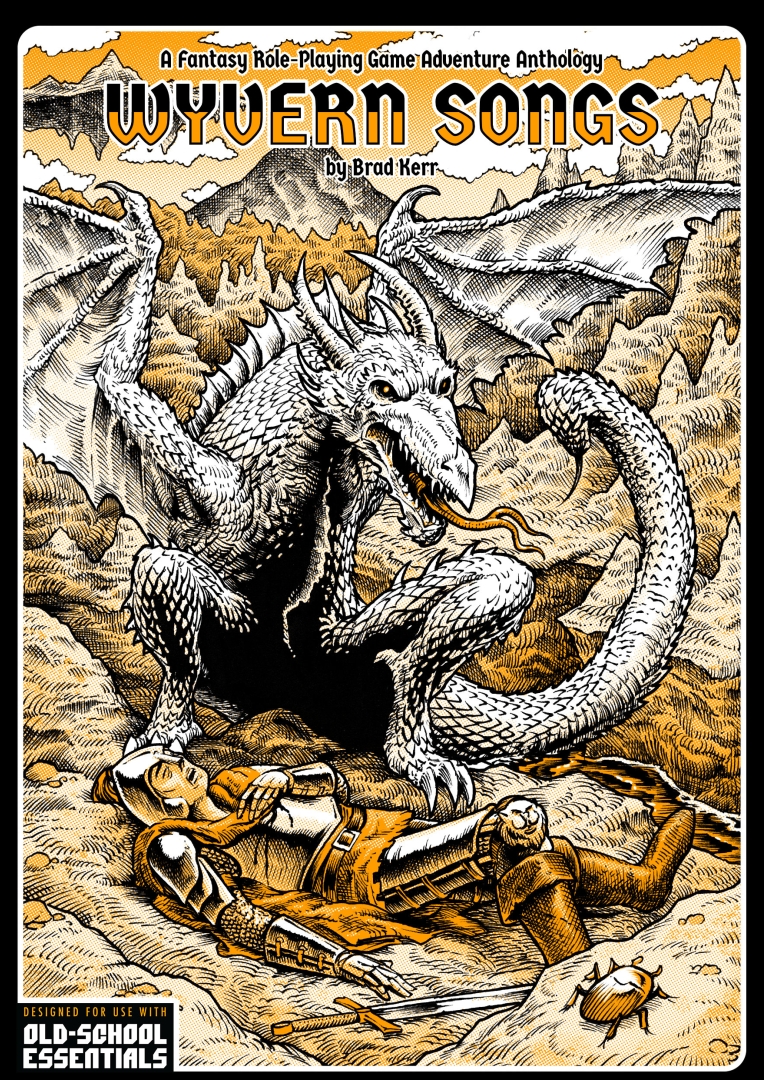
Following in the footsteps of the surreal, deadly garden of Hideous Daylight and the aptly named (slightly cramped) Temple of 1000 Swords, this is an anthology of four mini-modules which can also be linked and placed in a loosely outlined mini-setting. The book – a very tidy, elegant publication in its hardcover edition – combines a whimsical imagination with strong accessibility. Many OSE modules don’t quite hit the mark, mainly due to their authors’ lack of experience or the adventures’ overly small scope, but Wyvern Songs uses the format to its fullest without getting hamstrung by its limitations. Here, it all works. 

The tone recalls things like Fever-Dreaming Marlinko, Jeff Rients’ stuff, and psychedelic childrens’ cartoons (for some reason, Jamie and the Magic Torch comes to my mind), and this is very clearly telegraphed by the art. It is the polar opposite of Appendix N, featuring none of the doom and gloom that has characterised most of modern old-school gaming, nor the “mediaeval quasi-realism” of earlier eras. This is fullbright whimsy filled with quirky characters and highly fantastic, often anachronistic ideas, and leans on these themes more strongly than Hideous Daylight did. It feels modern, not old – a little twitterish and cutesy, just a little high on the sugar, but not disturbingly so. Of course, theme is not all. What is important is function: and these adventures deliver places and situations with a high interaction potential, where interesting choices may be made and interesting consequences may result. These are true funhouses where you can push your luck, come up with creative schemes, leverage NPCs for your gain, or mess with one of the many “levers” (sometimes literally, sometimes figuratively) to see what happens.

Of the scenarios, The Sinister Secret of Peacock Point (level 1) is a short, 25-area dungeon set in a thieves’ guild beneath an old lighthouse, overrun by the Skitterlord, a critter right out of a horror movie. This is the most conventional dungeon delve in the book, and a fitting setting to hone your dungeon-fu (appropriately enough, it also features in-game practice ranges used by the former inhabitants). The balance between the prowling horror and the sense of discovery drives the action and creates the main source of tension. There are loose ends and opportunities for expansion – what happens when you try to pawn off the stolen valuables? Or when some of the thieves who didn’t perish in their lair come back? It all segues into new adventures. **** seems right for this one.

Not depicted: Oompa-Loompas

Fabien’s Atelier (levels 2-4) is a puzzle-centric “wizard’s home” locale that was first mentioned in Hideous Daylight, and may be smoothly combined with it to create a more complex double feature. It is also the most anachronistic; the style of the floating dwelling is a lot more swanky 1960s lava lamp hangout/Jetsons flying saucer than, say, a grim basalt tower with gargoyles and stained glass windows. The central idea is puzzle-solving and exploration on a ticking clock, as the place is going haywire and shall crash into the ground below unless something is done. This also makes it a tougher challenge – with no time to retreat and recuperate, it will be difficult for weaker parties. The puzzles are fairly organic, although sometimes off the wall (the main solution to enter a specific room is to take a key-shaped door off its hinges and shrink it to fit a keycard slot; another requires catching a talking toucan with a key-shaped beak). Fortunately, there are workarounds, a sufficiently robust set of stuff to make mischief with (and come up with a truly original combination), and a few handy tips on nudging the characters forward if they are stalled. A ***, but a highish one.

The volume’s unquestionable highlight is The Singing Stones, a 23-location pointcrawl adventure set in an arid valley of musical rocks. Taken alone, this is close to five-star material. A central mystery is presented (the rescue of a lost prince who has gone wyvern-hunting, a task which requires solving two very significant challenges), but the real deal is found in the open-ended environment where truly complex adventures with side-plots and player-driven action can freely emerge without becoming an incoherent mess. The valley is populated with oddball characters, strange natural wonders, and has multiple things going on that may unfold and develop as the action proceeds. Most places have a surface idea and opportunities to go deeper if the characters care. Bullet points are being put to good use. The physical place as outlined is perhaps too large for the suggested six-mile hex (I would stretch it out to about four), but it is just the right size for a rich wilderness adventure. Add inventive random encounters and a rival adventuring party, and The Singing Stones is a definite winner, so we will call it a *****.

Lesbian gnome merchants!

The final adventure, The Dreaming Caldera, is a showdown with the followers of a newly emerging chaos god in a volcano lair where the god is being physically assembled by all sorts of chaotic creatures drawn here by their dreams. I honestly did not feel this one. It is not so much wildly imaginative Brad Kerr, and more Brad Kerr acting as a cover band of himself. The same kind of basic building blocks, just without the fireworks. There are still good features – a massive underground chicken farm in the middle of the dungeon with dire chickens; incompetent monsters being idiots while reconstructing their god; a rival and envious chaos god making the party an offer – but as a whole, it is somehow less free-flowing, and not as clearly outstanding as the anhology’s high points. This is a decent ***.

Wyvern Songs’ writing is smooth, effective stuff. It uses bolding and bullet points effectively (and, curiously, in a different way in each individual mini-module), and gets its point across without becoming too dry or too sparse. There are numerous quality of life features in the book – mini-maps on almost every spread (this does take up slightly more real state than ideal), short ideas on how to handle the consequences of likely PC actions, or how to expand and build on the adventures once things are wrapped up. There are even small touches like colour-coding the four adventures (neatly separating them for easier referencing), and listing their potential play times with an eye for one-shot suitability. Some of the monster stats refer back to the OSE books and are not listed in the publiction. This is a puzzling omission; not because you can’t just look them up, but for what happens when you have to manage multiple monster types working in concert or against each other. A few extra pages wouldn’t have hurt, and since the anthology packs a lot of material between its covers, it would have still been a modest-sized volume.

Charms U
The elegant presentation and the scope of the modules in Wyvern Songs would make them a good choice for novice gamemasters and players. No system mastery required, but creativity is rewarded and the experience is not bowdlerised – there are plenty of opportunities to die in entertaining and instructive ways, and there are other interesting failure conditions. Most of all, this is an adventure where you can try interesting things that lead to interesting consequences, and in various ways, they are all open-ended. There are certain limitations due to the scope of the individual adventures (again, The Singing Stones excepted) but taken as its own thing, this is the good stuff. If you like engaging with plots of pure whimsy in open-ended environments, messing with eccentric NPCs (who essentially tend to behave like modern Internet people), and coming up with non-standard solutions to non-standard problems, this is a sure bet.

This module credits its playtesters, as well as a bunch of other people who have helped with the project, surely the gold standard of giving credit as it is due.

Rating: **** / *****

Sunday, 10 April 2022

[REVIEW] City of the Red Pox

City of the Red Pox
City of the Red Pox (2021)

by Benjamin Wenham

Published by Dark Forest Press

TROIKA! level

Hello, and welcome to **ZINEMASSACRE*2021**! Last year, Kickstarter ran Zinequest 3, their third zine writing promotion campaign. This venture seemed to be ill-starred, as not only did many of the projects suffer from delays and disappearing authors (a.k.a. “the old cut and run”), but this may actually be the last significant venture under the name for reasons which are both funny and disappointing. These reviews will focus on the zines I funded AND which actually got released – let’s see how it goes.


* * *

The City of the Red Pox is a 36-page zine for the Troika! system, presenting the beginnings of a city setting ravaged by a deadly disease, and under attack by horrors from another reality. It comes in a lavishly illustrated booklet on high-duty colour paper, and looks generally fancy. Following the logic of such things, the zine’s layout is breezy, with generous empty space, large fonts, ample spacing and all the various tricks of the trade. That is to say, it does not contain as many letters as you might expect; in truth, it contains surprisingly few. Since no further issues have been published, this first issue thus has to be the basis of the review.

Favoured enemy: Dense, two-column text

The Serene Republic of Antar is basically fantasy Venice, one of the great settings for baroque skullduggery. It is currently enmeshed in chaos as a consequence of the plague, the breakdown of order, and extra-dimensional threats which do not receive much attention in this volume. This may even remind you of the great Dishonored and the city of Dunwall, which would not be far off either. In lieu of a traditional gazetteer or world guide, we mainly get “background through flavoured game rules”. Six Troika! backgrounds (character builds) are offered, a macabre lot which I genuinely like. You can be a Charonite Guilder (a gondolier who transports the rich and the dead alike), a Widow of the Veil (a teller of ill fortunes), or my favourite, a Once Trusted Butcher (these pig-masked freaks are family confidantes in matters both gastronomic and criminal). Then, there are twelve enemies, from cops to the damned, plague doctors, river wasps, the mysterious Stone Watchers (sphinxes that whisper secrets, and work for the State), and “the King’s Boatmen” – clad in “tattered, pale yellow robes”, and a sign that the one seeing them is marked for death. A more mixed bag, and does not offer much, but the pick is decent and moody – these are usually minor antagonists.

The best thing in the zine, no kidding!

A third section provides an introduction to the city, as well as sample NPCs with a selection of adventure hooks. This is, unfortunately, already past the halfway mark, so the material is not just meagre due to deft but wasteful layout tricks eating up those 36 pages, it is just a very shallow catch. You see some shiny ideas which would be great to elaborate on, but they remain as these little decent sparks, like the “funeral trade” of transporting bodies to and from Antar, or an NPC looking for the perfect glass coffin for the preserved corpse of his beloved. But a lot of it is stating the obvious without making it interesting and useful in a hypothetical game. Finally, we get six spells, not bad for two pages.

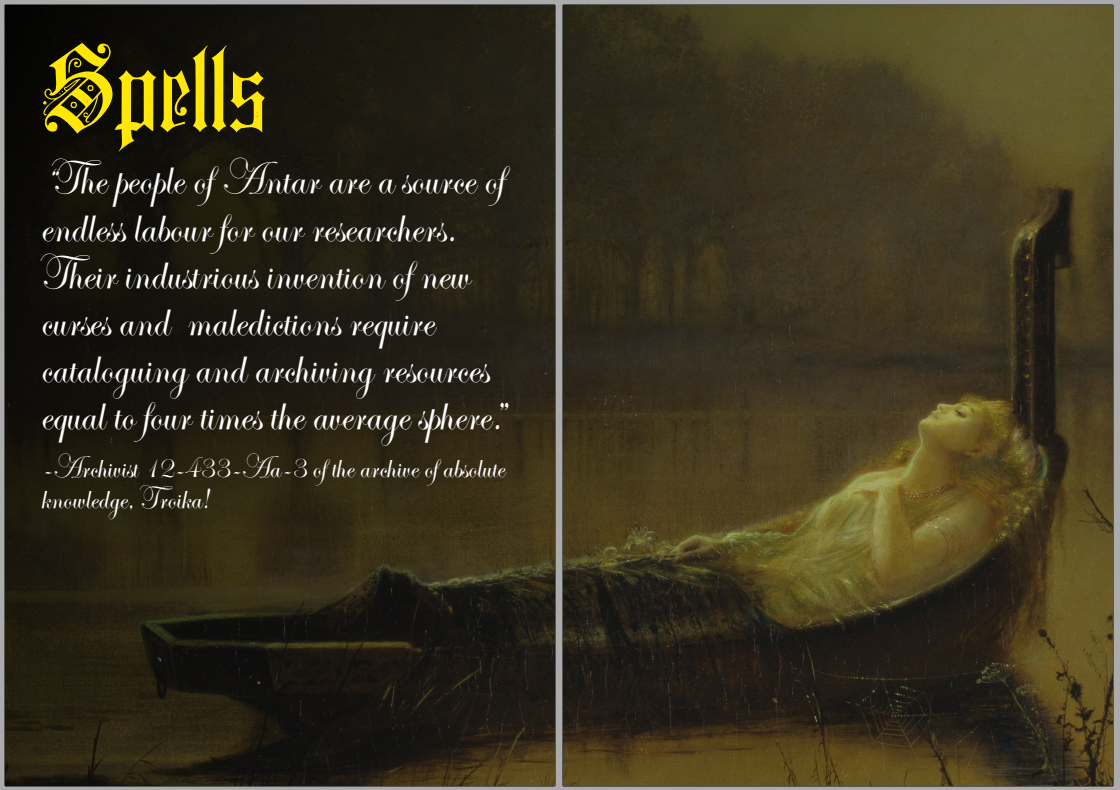
Then you get six spells on two very empty pages

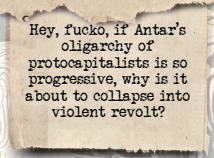
City of the Red Pox also features what I assume to be the author’s anarchist politics. Well, fiction is a way to convey your ideas and pillory your opponents, so a little editorialising does not hurt. Unfortunately, nothing useful is being done with this aspect, except to hammer it home through the equivalent of marginal notes that the State, verily, is Bad; unjust hierarchies are inherent in Capital, and that All Cops Are Bastards. This is in a sense authentically zine-like (in that it reminds you of the Deep Thoughts & Poetry section of the authentic punk zines you may find in the wild), but it is all Tell without Show, and on the level of gems like “Hey, fucko, if Antar’s oligarchy of protocapitalists is so progressive, why is it about to collapse into violent revolt?” (Solution: because the Author made it so.) It is all so tiresome.

Fuckos: rekt

One Zinequest earlier, Visitor’s Guide to the Rainy City demonstrated how much excellent content can fit into a modest little volume, and how to convey the feel of a teeming, decaying metropolis during what may be its final weeks. City of the Red Pox does no such thing, because it barely does anything before calling it a day. The few genuinely nice ideas do not come together to form something great. It has a great premise, but the execution is lacking, and the material is too thin to be genuinely engaging and useful.

No playtesters are credited in this publication

Rating: ** / *****

Wednesday, 9 March 2022

[BEYONDE] The Book of Gaub (2021)

The Book of Gaub
The Book of Gaub (2021)

edited by Paolo Greco, with contributions by Charlie Ferguson-Avery, Evoro, The Furtive Goblin, Isaak Hill, John Gregory, Rowan A., Paolo Greco, and Jack Shear

Published by Lost Pages

This is not a review of a creepy spellbook-supplement-thing: I lack the familiarity with modern occult horror games, especially those which inhabit the more obscure corners of old-school gaming, to write a proper one. While The Book of Gaub uses “OSR” style statistics, it is for all intents and purposes outside the scope of D&D-inspired gaming as most of us understand it: therefore, the following post will be more recommendation than proper criticism. Essentially, The Book of Gaub is a grimoire of stuff for horror games set in the 20th century, accompanied by several “micro-fictions”, or small pieces of flavour text. The tone and content mainly recall the antiquarian horror stories of M. R. James (although with more blood and guts), the grotesques of Franz Kafka, and some of the more recent horror writers; it avoids associations with the Mythos, although you could use it as a basis for a good Call of Cthulhu campaign to replace tiresome Old Squidface.

Who is the mysterious Gaub? Not even this book tells us; we only get to know him by way of a creepy hand with seven spindly, crooked fingers (including one that “does not, will not, and has not existed. Ever”). These charmingly named fingers (“The Finger Under the Floorboards”, “The Finger Gnawed to the Bone”, etc.) are associated with 49 spells, a handful of creatures, occult items, and magical phenomena. Mr. Gaub has certainly been around, and you can find his handywork in many unwholesome events. The setting around the hand of Gaub is a modern world of gloom, of deformities and medical horrors, of abandoned houses and sickening, miasmatic urban environments, of sadistic authority figures and reclusive malformities.

No Pain, No Gain
Most spells in The Book of Gaub are specific enough and weird enough to carry the premise of a whole adventure; and since each is accompanied by a small vignette of a story, many of them come with a basic idea sufficient for an adventure hook or at least element. Herein, we find spells such as “Perdivagrant” (all of them have strange, fanciful names), a spell that leads a lost company back to a known starting point, while travelling through strange and unsettling landscapes; “Pamphagous”, which evokes an insatiable hunger in the target that will probably lead to horrible consequences; “Orgiophant”, which results in a terrible proliferation of extra limbs on the hapless victim; or “Lichoscope”, a reanimation spell that only preserves the animated corpse while the caster keeps looking at it (much to the horror of the intellect now once again inhabiting it). As seen above, the spells become useful in specific situations you often need to set up carefully beforehand (not unlike the magic of Helvéczia), and many of them are closer to plot devices than direct utility magic. But on their own, they are creepy and highly imaginative. (Props to the authors and the editor for the consistent tone and unity of vision.)

The book is more than a simple grimoire. Each of the different fingers have associated occult paraphernalia: “a doll made of hundreds of burnt matches bound together” (will snuff out fires, but requires the owner to start fires or it will go and make one of its own); “a dull stethoscope that does not work” (but it will scream if used on an injured or diseased area); or “a ring of 2d6 skeleton keys” which will cause doors locked with them to disappear and leave behind a barren wall. There is a table for 100 magical catastrophes (which might result in the stars taking an unpleasant interest in the caster, a being of luminous beauty visiting during his or her next rest, or a premonition of being followed by something).

I was particularly impressed by the imaginative selection of monsters: the Corner Beast (whose glimpse you might just catch out of the corner of your eye, and whose presence is not registered by careless bystanders even if it kills), the Squeak (an enormous conglomerate of dead rodents resembling a rat king, eager to devour everyone in a house and identified by “too many mouse holes”), or the Dear Reader (this book-shaped monster not only reads YOU, it trades secrets in exchange for other secrets and blood). The monsters come with minimal stats, but useful descriptions describing not only their abilities, but their wants, the omens that betray their presence, and their use in occult stuff (for example, the Squeak can be fashioned into a handkerchief which can imbue liquids it is dipped into with potent, deadly rat poison). Finally, a collection of adventure hooks is also offered – maybe a bit hit or miss, but where they hit, they hit.

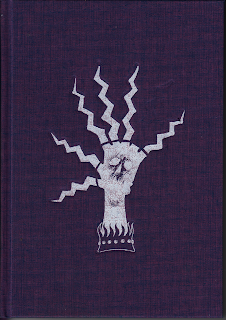
The Book of Gaub looks the part of an occult folio you might find in the seedier kind of bookstore, bound in sickening lilac cloth depicting The Hand as a creepy white impression, and supplemented with a bookmark. The paper is nice and the layout is quite elegant, a deliberate echo of the Arts & Crafts movement. Things are indexed and easy to reference. There are numerous illustrations of sickly and scurrying things, many of them reminiscent of Scrap Princess’ better work (although without the nightmarish intensity). Not only is the book pleasant to carry and read, but you can also use it as a prop of… itself. If I am allowed a parting shot: handy!

A Shrieking, Skittering Little Bundle of Love

Wednesday, 24 November 2021

[REVIEW] In the Shadow of Tower Silveraxe

In the Shadow of
Tower Silveraxe
In the Shadow of Tower Silveraxe (2021)

by Jacob Fleming

Published by Gelatinous Cubism Press

Low- to mid-level

In a sense, the mini-sandbox is one of the holy grails of old-school gaming. The idea of a home base, a wilderness with minor points of interest, and a dungeon or three to top it off is the clearest expression of a home campaign. From Hommlet to Herth, and from Bone Hill to The Forsaken Wilderness, the pattern has been unbroken, even if relatively few published modules give you the whole sandbox, toys included. (The Vault of Larin Karr, for mid-level PCs, is the best example in print that I know of.) This is one genre which is easier to build piecemeal at home by the game table than prepare in a publication-ready format.

In the Shadow of Tower Silveraxe, a 60-page, zine-format module for Old-School Essentials, is a fully realised mini-setting describing the locales of the Gemthrone Wilderness, a mountainous territory arranged around a central valley occupied by a particularly dense and dangerous old-growth forest named The Labyrinth of Shadows. Dwarven settlements and ruins ring the central valley, connected by well-mapped trails; the Labyrinth is trackless and inhabited by the most dangerous monsters. In addition to wilderness exploration procedures, the module provides a description of five settlements (including the town of Karn Buldahr) and nine dungeons of various sizes (from 5-6-room lairs to a main feature with five levels and 33 areas total). The power curve goes from beginning-level to some fairly deadly stuff – maybe 4th to 5th level or so. Rumours, mysterious glyphs, treasure maps, the remains of an advanced ancient civilisation, and local politics complicate the picture, and create a layer of connections to bring it all together.

Hiking Trip, But With Hobgoblins
Tower Silveraxe follows the trends in vogue in the modern old-school gaming scene. It is heavily focused on tight editing and effective presentation. Every page spread is laid out in a precise way that eliminates the need for page flipping: all the maps and key you need are there before you. The dungeon maps are precise and clean affairs, with local random encounter charts tucked into a corner. I was particularly impressed with the wilderness cartography, which takes the form of an elegant hiking map with contour lines, trail distances, and points of interest. This format has lots of potential, and I hope people will do more with it in the future. (Minor nitpick: my inner textbook editor is screaming in rage at sight of the page numbering, which puts odd numbers on the left and even on the right. How dare you.)

Here we come to the Achilles heel of the module. Following trends in vogue in the modern old-school gaming scene, Tower Silveraxe has sacrificed interest for accessibility. It is well-rounded, impeccably made, nicely interconnected, but the content is just sort of mediocre. One could call it vanilla, but the term is misleading. For instance, the original TSR modules were often quite vanilla, but even so, they always had interesting twists like the orc/carrion crawler caverns/weird shrine under Steading of the Hill Giant Chief, or the pool room and the whole “retired adventurers’ home base” aspect of In Search of the Unknown. Unfortunately, this is the “generic, flavourless” sort of vanilla that works with standard tropes and does not really improve on them, or use them innovatively.

A lot of the module text is remarkably facile. Consider Karn Buldahr, the dwarven town. There are 14 keyed locations, very few of which actually add anything beyond the baseline. The Traveller’s Inn is “a modest inn, just outside the western gate, (…) welcoming to all travellers, even in the early hours of the night.” The Stables are “Owned and run by Kreel Coalbraid. Only mules and carts are available to purchase.” The guards are stout. The General Store & Outfitters sells adventuring gear. The Crafters Quarter is “where nearly all skilled crafters conduct their trade.” There is very little here that could not be improvised on the basis of “Dwarftown. Population: dwarves”. Karn Buldahr occupies an uncomfortable middle ground between minimalism, which does not give you much, but occupies little place, and an actual in-depth treatment which elaborates on the basic concepts until they transcend a generic quality. Here lies the trap of the format: it is all on a spread of two facing pages, which either stifled the author’s creativity, or made him stretch a thin concept beyond its sensible limits. In fact, Karn Buldahr does have things of interest which deserve notice: a theatre putting on modernist plays everyone goes to but nobody confesses to not understanding (the Quirk differentiating the place from other dwarven towns), the local tradition of The Airing of Grievances (the Detail which drives home the dwarven connection), and a magic-user looking for crystals (the Adventure Hook). There are four decent rumours. This is good stuff, surrounded by several paragraphs of eh and meh.

Similar problems affect the nine mini-dungeons. The size is all right for something you find in a wilderness (although Bone Hill would beg to differ), and the concepts – looted tomb, abandoned mine, haunted tower, cave shrine, etc. – are good, with decent variety. It is, again, the encounters which suffer. They are very rote, very standard dungeon encounters of the monster/treasure/trap variety, missing a sense of wonder or deeper challenge that would make people start to pay attention. The treasure is usually coins contained in chests and such, and generic +1 items. The monsters are usually small groups of standard critters. You don’t get the “oh crap, 45 goblins! How do we solve this one?” kind of encounter here.

The encounters end up remarkably shallow. Many details in the key add nothing to the information already found on the map:

“Large room with six huge stone pillars. 2 doors – one south and another goes east on the north end of the room.”

“There is a tunnel to the north and a door to on the south wall. The room is empty.”

Seemingly interesting details do not, in fact, add to the interaction potential of the module, and are left as undeveloped cyphers:

“This room contains many shelves of books. A library for the elf stewards.

>> Books: All journals and logs written by the elves throughout the centuries.

>> Treasure: 3 spell scrolls (shield, knock, and hold portal)

“The stairs descend to a large room with four large statues of figures with heads bowed. At the end of the room is a sturdy iron door.”

Touch the Eye.
Touch the Eeeeye!
If you read that last one, your spidey sense is probably telling you this is going to be a great “deeper level” setpiece with a portcullis trap, animated statues, poison gas, flooding, or monsters attacking from behind secret doors. But nothing really happens, and the imagery is left unexploited. Of course, not every such room needs to be a deathtrap. Red herrings play an important role in messing with the players and either deplete their resources or lull them into a false sense of security before the iron door mimic eats them for lunch. Too bad this is a pattern that repeats through Tower Silveraxe, and most similar opportunities are also missed. There are a few exceptions: good foreshadowing down in the main dungeon, which offers progressive hints of a large, dangerous monster’s presence; a cyclopean idol with an obviously telegraphed but still oh-so-fun poison gas trap; or mysteries which span multiple adventure sites. However, the majority of encounters in the adventure are very plain, and the payoff of finding something really unique and off the wall is not present. This is a shame, because the setup is virtually crying out for it.

In the Shadow of Tower Silveraxe is, therefore, a module with excellent structure and relatively weak content. I would not want to savage it – there is obvious craft in how it is put together – but I cannot help but believe the “layout-correctness” has not helped this one, and that it does not live up to its own implicit promise. Your players would probably have a reasonably good time playing it; it does not make any egregious mistakes, and just letting the players loose in the sandbox often produces a spark that sets even middling material aflame. This is what it is: solid, functional, but falling way short of excellence. Potential for improvement? Yes. Room for improvement? Yes, and lots of it.

No playtesters are credited in this publication.

Rating: *** / *****