Showing posts with label the pillory. Show all posts

Sunday, 17 September 2023

[REVIEW] Into the Caves of the Pestilent Abomination

Into the Caves of the
Pestilent Abomination
Into the Caves of the Pestilent Abomination (2023)

by Marcelo P. Augusto

Published by Giallo Games

Levels 1–2

The idyllic rural community beset by a monstrous menace is one of the main plots in fantasy games, and the premise of a myriad low-level adventures, so much so that it probably beats “undead-haunted crypt of a local notability” and “Keep on the Borderlands” to the top spot. The majority of them are low-complexity affairs, with a straightforward setup and a mini-dungeon at the end. Into the Caves of the Pestilent Abomination is a typical representative of the genre, and suffers from its typical issues, including a misunderstanding of what makes an adventure.

Where the rural idyll is concerned, the module lays it on thick: “The small community of Woodsmen Village lived in tranquility, without anything or anyone bothering its peaceful residents. Days come and go while the gardens sprout succulent and showy greens. Shepherds quietly follow their flocks of sheep to the nearby hills, and poultry farmers happily inspect the beautiful eggs their fat hens daily laid. (sic)” Woodsmen Village, mainly noted for the Fussy Lark tavern and the magical throwing axe of a dwarf hero who has once helped the place, is troubled by a problem. A traveling priest who has settled near the village has gradually grown wild and transformed into a stinking, decrepit abomination, scaring the local folk and eventually moving on to killing the livestock. All this is told through an overly long backstory, which is then followed by a disproportionately simplistic adventure. The paragraph you have just read would have sufficed for an introduction conveying the same ideas the module spends four pages elaborating.

Ceci n'est pas une d'une
exploration hexadécimale.
The adventure proper has a wilderness segment in this idyllic little land, which serves no purpose whatsoever. There is a hex map with nine keyed areas, but these are not functional encounters of interest to the adventurers. Rather, the locations mentioned in the backstory are put on the map, from the dwarf hero’s serene lakeside tomb (a nice touch: flowers and tobacco are deposited near the grave as a local tradition), to the location where a local kid once saw the Pestilent Abomination, the place where the torn off sheep’s head was found, and the other place where the mule carcass was discovered. These places are not encounters per se, since nothing really happens at them, nor do they offer useful information to finding the Abomination’s lair. As the module helpfully tells us, “It’s possible that the adventurers try to investigate the area, but they won’t find any clues about the recent incidents at the village.” The only function of the wilderness is to bump into random encounters, except they are mostly not functional encounters either, being local wildlife like deer, a snake, an eagle, shepherds and sheep, a mountain goat, 1d4 wolves, and travelling dwarves. This is mainly just set dressing before the adventure – but there is no adventure in these outdoors.

The actual adventure begins on page 12, where the module starts to describe the nearby swamp. Some of the encounters here are actual monsters and hazards (like a depth change), although this is basically just mucking around until you arbitrarily find a trail to the Caves of the Pestilent Abomination. The best part of the adventure is found here; an encounter with “the Swamp Predator”, “a bizarre cross between a crab and a spider”, which attacks from beneath the murky water of the lake before the cave entrance. This is simple but well done; an interesting monster with an effective setup.

The caves feature seven keyed areas (13 if we generously count sub-areas), and follows a linear path with three side-branches. There are the beginnings of interesting locales here. A half-flooded cave glittering with rough citrines and populated by giant salamanders (the adventure’s only treasures of note, worth a total of about 180 gp) is pretty cool. A completely flooded cave with a submerged quicksand pool is a good challenge of problem-solving and equipment use. The descriptions are sometimes effective, let down by parts of the key describing things which are evident from the map. In the final room, the adventure ends up as a bait-and-switch: you do not actually get to encounter the original Pestilent Abomination, as he has died a while ago and been replaced by a troll which has taken his place. This development is probably realistic, but disappointing. The shepherds and farmers of Woodsmen Village would probably see the troll as a fearsome monster of whispered legend. For the actual people playing this adventure, it is just a troll. It also nullifies the priest plotline the module had spent so much ink setting up. There is no treasure except a cursed necklace which transforms you into the Pestilent Abomination, and has an overlong backstory of its own.

Into the Caves of the Pestilent Abomination is just an example of a general trend that has beset old-school adventure design, and it is perhaps not fair to single it out for criticism. It is one of many, and its sins are of the age which had birthed it. There are ways out, but they must be shown so people can walk them. Good adventure design is not that hard, and old-school gaming has much to offer in this respect. But regrettably, this is still really bad. The lesson is thus: sometimes, horrors are hidden around idyllic communities, and we must put them to the sword for the sake of peace and quiet.

This module credits its playtesters properly.

Rating: * / *****

Tuesday, 13 June 2023

[REVIEW] DNGN #1

DNGN #1
DNGN #1 (2022)

by Vasili Kaliman

Published by Singing Flame

Levels 1 and up

The Terminator is a marvel of design and engineering, a sleek technological terror moving with superhuman precision. Its body is surgical steel, its eyes penetrating optical cameras, its blood high-grade machine oil. It hunts and kills according to the precise programming with which the machine overlords had imbued it. The Terminator is very efficient, but is it good for us? The jury is still out on that one.

Anyway, DNGN #1 is a weird science-fantasy megadungeon published as a risographed zine; the whole thing is printed in pleasing red and blue ink, with 10 really neat full-page illustrations that could be used as an illustration booklet, and even a comic strip! The initial issue covers ten levels and a bonus side-adventure (same author using a skullfungus map). This is a zine which follows all the layout and writing trends championed over the last few years, and used particularly in various Old School Essentials releases. The text is terse, using bullet points to convey information exactly and briefly. Monster names are not only bolded, but highlighted in red. Dungeon maps are annotated with extra room information on floor type and illumination, simple dungeon dressing tables, and so on. Each of the ten levels in this issue uses a page for the maps, and the facing page for the room descriptions.

Here lies the problem, though. As a result of this ruthless and sleek efficiency, what we get is not necessarily what we were looking for in an adventure. How can ten levels of a megadungeon  fit into a 40-page zine (that is, 20 pages of that 40-page zine, since the art and the comic take up the rest)? Well, we have to adjust our expectations for a megadungeon. These dungeon levels have around 8-10 keyed rooms on the average. It is also not like they are 8-10 keyed rooms in a network of corridors and empty rooms (which would be the Castle Greyhawk model). It is really all there is to it.

Puny meatlings! This is, in fact, my final form!

The maps are on the simplistic side, mostly a few basic geometric shapes strung together. Levels connect to one another through one or two stairways, but they follow in succession, without side-levels or the possibility of choosing between a risky deeper delve or a safer expedition close to the surface. Secret rooms are found, but the discovery of cleverly concealed hidden sections, larger room complexes, themed sections, staging areas, and the stuff that makes megadungeon campaigns exciting are all missing. Pit traps, slopes, stairs within levels, water, collapsed terrain, level-spanning rooms – not present either (although there are two cavern levels). It is notable how much of a difference a good map makes. If the whole zine was dedicated to mapping out a single, sprawling dungeon level with decent map design and all sorts of interesting exploration choices, it would solve a lot of the scope/content issues. Here, you just cannot explore too much, since there is so little to explore, and your ability to make meaningful choices is likewise limited by the constrained environment. This is, simply put, not a megadungeon in any shape or form that meets the commonly accepted criteria. Even as a dungeon dungeon, it is smallish and very linear. It all fits on neatly arranged page pairs. It is geometrically perfect, no exceptions. Is that really a feature here? Does it help create a dungeon that is fascinating to a group of players, drawing them back again and again to go further and see more?

The room keys are a step better. A technological/cosmic weirdness theme connects the dungeon, from star god altars worshipped by duergars to vampires slumbering in a glass tank to magnetic statues wearing cybernetic armour and animating if the weapons captured by their magnetic powers are removed. Here, you can see good ideas and well-designed encounters, even if they are mostly simple. You can assemble a good dungeon from a handful of simple, good ideas. However, the strict double-page format serves as a barrier to what can be done. If there is a dungeon room that actually does something interesting an complex (like the magnetic statue room), there are inevitably a few more that amount to “empty”, “here is a bizarre item”, or “they are here and they attack”, because that’s what you have layout budget for (“7F > EMPTY ROOM. Completely empty.”). Does that make the adventure better? Are we better off following this super-efficient and scientifically perfected formatting? Is it to our benefit? Some designers – and this takes a keen skill and sharpened practice – can produce terse, enigmatic room entries which stimulate the imagination in just a few lines, and help the GM imagine the rest. There is an almost oracular quality to these entries, seen in Bob Bledsaw’s Tegel Manor or Michael Curtis’s Stonehell, since they tell much more than they actually speak, and can be interpreted very differently by different GMs. In these cases, minimalism works. But it does not work for everyone (for example, Gary Gygax developed a different style with different strengths), and it does not work reliably here. Sometimes the author gets it right, but he clearly has not mastered the format. Which is no surprise, since it is actually hard to get minimalism right.

Mechanical Skelebro
Offers a Helpful Hint
The room mixture is a mishmash. Instead of concentrated mini-themes emerging from dungeon areas, it is just all random – a room inhabited by an illusionist berating 1d6+2 zombie servants lies next to a room of tapestries, which lies next to a room with three sarcophagi containing mummies, which lies next to a room with bandits, which lies next to a room of stalactites you can lick for 1 Hp of healing. The room-by-room entries can be good, but the big picture is incoherent – not by the standards of conventional realism, but even by the standards of a dungeon with a funhouse slant. The monster count is really low in both the room entries and the random encounter chart. You could see it is 1d6+2 zombies or 4 bandits or 3 mummies. You don’t really see OD&D’s hordes of lower-level opponents that come at you in an onslaught, to overwhelm the weak or get chopped into pieces by the strong. On the plus side, you can meet some really tough stuff that would require the characters to think before engaging, and run if they meet something they can’t handle. There is a purple worm right on level 2, hiding within a mass of tangled vines in a side room. That’s quite fun, although I suspect this module would have a high TPK potential if actually run.

And that’s the deal with DNGN #1. It shows strengths in some room entries, but it is a dungeon where the whole is much less than the sum of its parts. More than that, it shows, very clearly, how meme layout and graphic design fetishism have misled old-school designers. This zine uses a format which actively works against delivering a substantial, interesting adventure, and is particularly ill-suited for presenting a megadungeon. Old-school gaming’s efficiency movement has produced a perfected end product which does not work. And here is where we return to the Terminator analogy. It turns out we defeated the Terminator and kicked its shiny metal ass. We survived its initial attack, we outwitted its mechanical perfection, we learned its programmed tricks, and we crushed it under a hydraulic press. If it comes back, we will do it again. And that is because we are human. That is because we have something more than the machines have. We will prevail.

No playtesters are credited in this module.

Rating: ** / *****

Thursday, 13 April 2023

[REVIEW] Expedition to Darkfell Keep

Expedition to Darkfell Keep
(white borders original)
Expedition to Darkfell Keep (2023)

by Joseph Mohr

Published by Old School Role Playing

Levels 1–3 (I’d assume)

Darkfell Keep (from the noble lineage of Shadowbad, Felldark, and so on) is a ruined keep in a dangerous forest wih a dungeon under it. Orcs, goblins, raiders and bandits have been spotted in the area. Heroes are called for. It is the bland stereotype of a beginning basic D&D adventure, a fifth-generation photocopy of Keep on the Borderlands and In Search of the Unknown without Keep’s solid craft, complexity and curveballs, or Quest’s magic pools and adventurer home base premise. It has the typical vestigial sections which do not add anything to the game, but are somehow required to be included. A rumours table with bland entries like “Other adventurers have gone to explore the keep. Many of them never returned alive.” A half-page wilderness section that’s basically a random encounter chart with entries like “Kobolds (1-6)” or “Gnolls (1-4)”, and a “Sounds in the forest” table that would be an interesting concept if more was done with it. But there is no actual wilderness section in the adventure; there is nothing to explore in the Darkfell, not even a trail to follow to the dungeon, or an estimate of how much it takes to get there (thus the instruction to check for random encounters twice daily makes no sense). It serves no function except take up space. We could start right at the dungeon entrance.

The dungeon uses a Dyson Logos map with 30 keyed areas spread out across a surface section and three small dungeon levels. Not a bad scope for a smaller adventure. However, the encounters themselves are nothing to write home about. A lot of time is spent restating the obvious about basic architectural features. The rest is a crash course of basic dungeon encounters: promising-looking corpses drawing the characters into a monster attack, generic storerooms and barracks, simple mechanical and environmental traps, and the world’s least surprising pressure plate puzzle (you have to place weights on it to open a secure door). The adventure is entirely static, a place of scavengers and the odd group of undead, so much so that unlike the wilderness, no random encounters are provided. The combats are usually with small, isolated monster groups that rarely pose an interesting challenge, and monetary treasure is a trickle of mostly low-value items (although magic items are awarded very generously, so if those can be sold, it gets a lot better).

There are some bits that stand out: a portcullis trap separating the party right next to a combat encounter, or a fairly standard “cobwebbed room” encounter with the obligatory corpses and obligatory giant spider, except this is a proper, cunning D&D spider with an evil intelligence which cannot be flamed out so easily. Creative hiding places for loot are used. Some of the descriptive detail on the ruined environment makes a good effort to spin them into functional encounters. Right around the start, you have a hazardous section of stairs which can result in a broken neck for a beginning character, and you’ve even got a dead goblin sprawled out at the bottom – infested with rot grubs! That’s precisely how intro dungeon encounters should look like: killer, not filler. Unfortunately, a lot is filler.

It is really quite remarkable how shoddily this module is put together from cover to the badly implemented OGL section. This is not the charm of early DTP or something hand-crafted and a little rough around the edges. It is just lazy editing, the bad sort of public domain artwork, and a Dyson Logos map stretched out in a weird way and never fixed despite the glaringly obvious error. Great content could make you forget any of this, but that’s not present here. There are occasional brighter spots, but this module is not really suitable for anyone. The basic dungeoneering building blocks you can find in it are a rearrangement of ideas found in better adventures. The sense of wonder is also missing. If you are a beginner, you deserve a dungeon at least as good as (say) Gatehouse on Cormac’s Crag. Starter modules should never be half-hearted; they should go all in and give you the best. If you are an experienced player, you could play this on autopilot and it’d just be a distorted echo of things you have already seen and solved, so it would not give you much. It is not the worst, but it is plainly dissatisfying.

Ironically, despite claims of thorough playtesting on the product line, no playtesters are actually credited in this module.

Rating: ** / *****

Thursday, 9 February 2023

[REVIEW] Winter in Bugtown

Currently Smoking:
Pill Bug Pipeweed
Winter in Bugtown (2022)

by J. Colussy-Estes

Published by Noisms Games

Low levels

Enjoy being lost In the Hall of the Third Blue Wizard? If so, this new zine/anthology edited and published by David McGrogan might be of interest. The following reviews will focus on the adventures in the recently published first issue. As the call for papers (appropriate, as the book looks and feels like a scholarly journal) specified, submissions would be expected to be between 2000 and 10,000 words, and they tend to be on the brief side. This is both an opportunity and a hazard. Constraints can encourage efficient writing, but they may also limit the scope and complexity of an adventure. It is a fine balance to walk. Appropriately, some of these reviews will also be on the short side. It is a fine balance to walk.

* * *

Winter in Bugtown is a scenario describing an underground city of whimsical bug people, half Derinkuyu and half ant farm. Under the surface world of a podunk fantasy setting lie tunnel systems of jaded insect aristocrats, giant pill bug racing, a hive of brain bees, and a dormant swarm of undead locusts kept at bay – so far, most of the time – by the machinations of mothman necromancers. This is as high-concept as it gets, and the question that comes up with these things is always “Creative idea, but does it work?” As it tends to be with these projects, it doesn’t. That’s the summary.

However, to defeat the bug, we must first understand the bug. What makes modules like this stumble? Being an undisciplined thought experiment with little concern for functionality is the main reason. The scenario is not a working adventure: it is a very broad-strokes, high-level overview of one with a few random tables to recreate the underground city of Ghir Oom. This worked fairly well in The Cerulean Valley, where similar elements were used in the construction of a small sandbox setting, with a very good understanding of how to help run a mini-campaign in it. Winter in Bugtown is neither proper setting nor proper module, but a hybrid which does not play to the strengths of either, while being too much of both.

Six-Zone Dungeon

Ghir Oom lies below a dungeon below a ruined temple, which receives a four-line overview and a table of hints that lead further below, but the dungeon is otherwise left undescribed – as are the nearby Duskfire Woods, for which the scenario offers a table of eight adventure hooks without useful resolution. The bug city proper consists of six loosely sketched zones, all of which are surrounded by tunnels and sub-complexes of things that don’t receive useful attention either. Some of this is mitigated by semi-useful random tables: there is one for weird finds which run the gamut from spider dolls to a maggot mask that does 2d6 Hp damage as it affixes itself to the face. The “What Can I do With This Dead Bug?” has tasting notes for texture and flavour (if you really wish to eat the bugs), salvageable bits, and valuable body parts (if you really wish to get rich selling bug ovaries/testes).

There are ideas which play well on disgust and the natural human loathing for bugs, such as a maggot nursery of docile surface creatures serving as a host to a new generation of giant wasp maggots, or a gross hive of brain bees. The mothman necromancers are properly creepy and mysterious, with a “dungeon under the dungeon under the dungeon” trick that always works well. This is well done. However, you can’t paper over the fact that this is a slightly souped-up six-zone dungeon, where you can’t actually do much. The conflicts being described are sufficiently specific to strike a spark, but it turns out the bug people, for all their oddball whimsy, don’t actually have interesting conflicts going on. Plipple, a mantis shepherd child, is bored, and likes to spend time in the mantis nursery. Fellefe, a mothwoman necromancer, is compensated for maintaining the warm light of the bug marketplace, but tires of the responsibility. Narqua, another mothwoman necromancer, is fed rotting fruits by a zombie goblin, and keeps a zombie raven she calls “Baby” and strokes mindlessly while speaking. It turns out the bug city is just modern Seattle, which makes this more of a horror scenario than you might first think.

The aesthetics are way past the shark-jumping point. In the 2000s dungeonpunk era, it would be a half-fiend wereshark wielding a spiked chain – no, TWO spiked chains! Here, it is encounters like “A palanquin carrying a group of four mothmen passes by, carried on the backs of four zombie bears. Fine spidersilks hide the faces of those inside.”, and “Bing Fifty-One – Mitefolk locust trainer who smokes a pipe and is missing a middle arm.” When you already have a basic premise with a bug city and mothman necromancers, you need to be careful not to push it from highly weird into the ridiculous, lest it become a circus freakshow. Well, that did not work out so well here. Worse, it is a banal circus freakshow. The whimsy becomes grating, and ends up twee and powerless, a safe and pastel-coloured fantasy.

The problems mount as you go into the details. Not only does the general framework not work, many of the individual bits and pieces don’t work either. You can see this in random encounters with a “captured adventuring party, stripped and caged, starving”, who inexplicably and suicidally “take the first opportunity to attack and steal their rescuers’ belongings” if freed. Why would they ever do this, considering the encounter is assigned to an area far underground, where there are hordes of bug people between these rescued fools and the safety of the surface world? The adventurers are not described beyond the superficial idea kernel. We don’t know their capabilities, numbers, or any other distinguishing characteristic which may help us run the encounter, as stupid as it is. On another occasion, an encounter which can occur in any region of Ghir Oom (1:6 probability) sprays the party with pheromones which makes all encountered insects and insectoids attack violently on sight, completely upending the social/interaction element of the scenario in one swoop that the players may never even realise the reasons for. We also get stuff like a “mothman necromancer seen in the near distance”, who raises an arm, points and vanishes, placing a curse on a random party member which can only be lifted by killing this specific mothman. That is not how D&D, and specifically old-school D&D works: we have combat rules and PC abilities to determine whether the event can actually happen this way, and remove curse spells that can counteract similar afflictions. This is a nitpick, but it reveals the underlying problem: this is not adventure gaming, but attempts at crafting “story” at the expense of player agency. The encounters are a mess. The zone descriptions are a mess. The aesthetics are a mess. It is all a mess.

Winter in Bugtown is a perfect example of a module where the ideas are all it can offer, and the execution is a disappointment. The wild stuff – the parts that are imaginative in their own way – is not really so remarkable when there is an entire design movement doing the same kind of stuff, and the novelty wears off. You start to lose interest in the eccentric flourishes and the quirky oddball bugmen, and come away disappointed because there is no solid structure underneath. More than that, the deeper you look into the module, the sloppier it gets and the more practical issues emerge. If this was an orcs-in-a-hole dungeon, its deficiencies would be plain to see. As is, the veneer of colourful paint serves as a temporary distraction. However, the substance remains weak: this is just a mishmash of underdeveloped high-fructose ideas in a confused structure that’s neither setting nor module, and does not work as either.

No playtesters are credited in this adventure.

Rating: * / *****

You will be eaten by the bugs,
and you will be happy.


Wednesday, 26 October 2022

[BLOG] OSR Module O5: 2e is Still Not Old-School

“The point is the culture that drove 2E. It wasn't a

Zeb Cook anomaly, he was just a prominent

individual steeped in the overall boring-as-hell

“hail m'lady” culture, overdosed on sage,

nag champa, and witchy bush.” – EOTB

“Why so mean?” , asks the man inviting the whole world into the big tent until the noise within swells to an unpleasant cacophony, rubbish accumulates, the venue gets thrashed, tentpoles are removed from their place by loud people who don’t believe tents need them, and the whole edifice collapses on the ugly spectacle. Many such cases. After the Artpunk Foe, let us now turn our attention to the sinister menace of second edition.

* * *

Terrible.
When something takes off and becomes successful, you will invariably get a lot of interest, and a lot of people who will want to get involved. Success is infectious. The people who got involved invite other people who are also interested, and they in turn also invite yet more people who are vaguely into the thing, maybe, but they are a lot more into being part of a big crowd. However, the defining boundaries of what made that specific thing so interesting in the first place also become blurry. Definitions are drawn up and debated, edge cases are tested, and you get a sort of fuzzy boundary between “this is the thing” and “this is not the thing”. It is helpful not to overdefine. If you try to make an airtight case, you will miss out on a lot of good fringe stuff that’s not exactly the thing, but it is actually very good. Purity policing is blind. It will not see Encounter Critical as an inspiring text of the old-school, even though EC preceded OSRIC, and inspired many of the ideas that define the modern old-school movement way more than a lot of second-rate TSR modules did.

You also get cognitive blind spots where your definition shall lead you astray. For example, parts of the old-school crowd are so wedded to B/X purism and its procedure-based gameplay (“the gameplay loop”) that that they end up ignoring AD&D, and with it the actual defining tradition of the classical era; as well as neglecting OD&D, the wild primordial soup of runaway creativity that gave us the strange thought experiments that are now worth examining and reconstructing. In comparison, Moldvay/Cook is good but you will eventually run into its limitations if you don’t use AD&D’s case law to interpret it; and BECMI is a bland game that hacks away the rough edges so successfully that nothing interesting is left. BECMI is the SKUB of D&D. And then there is 2e.

In recent years, you can see a common approach to define “OSR” by viewing it as a single continuum which was broken when Wizards of the Coast overhauled the D&D system, and released the 3e books. As long as you are on the “TSR” side of the divide, you are OSR. There are persuasive arguments which support this position, at least on the surface level. There is mechanical compatibility. People can get tribal over OSE vs. B/X vs. S&W vs. LL (they are the same darn thing), but once you take a deep breath, you can convert materials on the fly among these systems with minimal effort. Even in a worst case scenario, the gaps will never be insurmountable. Game concepts are recognisable across the board. The vocabulary is common. There is personal continuity through the TSR years (although the endpoints have barely any connection at all – David Sutherland, Skip Williams and Jim Ward were the main people who were there from the beginning to the end). There is also a web of references that form the D&D “lore” (this is a magical Renfaire glitter pony of a term I am using only to express my utter disdain for it), exemplified by things like the drow, beholders, the planar system, or the hand of Vecna.

The Worst Encounter Ever
However, this is precisely the point where we lose the clarity of our vision, and with it the ability to distinguish ourselves and argue for the things we actually hold dear. Even though there are a myriad links between old-school D&D and 2nd edition, these links exist to be severed, and the test of the TRV OSR Taliban is a sure hand and keen eye while bringing down the blade. Justly so! Old-school gaming came not to praise 2e but to bury it; it quite clearly got established by guys who hated 2e’s guts as much or even more than they did 3e’s. More than this antipathy, old-school gaming is a deliberate rejection of the 2e legacy, a style and school of thought which set itself up as its polar opposite in aesthetics, focus, design principles, and GMing style. Its advocates saw 2e as a corrupted, bland, corporate husk of the original D&D spirit, and thought it was like a swig of clear spring water when they could finally get back to what they saw as the buried genius of those creative origins. This is why it is named old-school after all: from the vantage point of 2022, all TSR D&D might seem old, but for those in the early and mid-2000s, the 2e era was still kind of a fresh wound, and in no way was it considered worth preserving.

Now this probably does sound a bit extreme. “The OSR Taliban” was not a term of endearment. Some of the debates surrounding the emergence of old-school gaming were ugly, bitter, and acrimonious. But clarity is often like that. You don’t challenge common wisdom without creative conflict. You can’t play “right” without also identifying “wrong”. In the end, old-school gaming has thrived on this wedge issue. It shone light on a neglected approach to play, it established its distinctive identity, and gained bountiful creative energies in the process. These energies still drive it, although much of the momentum has naturally become exhausted over time, or become unfocused.

Let us now make a brief attempt to explain where the points of disagreement lie. There are a lot of details which are incidental, or which have little significance on their own, but work their way through small, subtle shifts that add up. Instead, let us try to look into the heart of the thing: two visions of (A)D&D which look very close from a distance, but are very far apart on a more careful look. These are not detailed comparisons; rather, they try to capture the respective essence of the two, and why these are not interchangeable.

* * *

For all their continuity and rough compatibility, AD&D and AD&D 2nd edition are far enough from each other to be different games. They rest on different literary traditions, their rules serve different purposes, they place emphasis on different sorts of adventures, and they play fairly differently. You can easily see this by their online communities, which generally do not mix or even communicate much.

1st edition AD&D is a single man's vision about a broad, campaign-level implementation of D&D. Its stylistic quirks and idiosyncrasies make it a personal work, even if he did, in fact, get help from a tight, handpicked design team who had helped him refine his ideas. Gary Gygax had peculiar tastes in fantasy, even in his generation: he had little interest in Tolkien and other sorts of epic fantasy, and instead liked violent sword & sorcery pulps and books on historical warfare. His main sources of inspiration were Jack Vance, Robert E. Howard, and Fritz Leiber, although he had even more eclectic tastes, and an uncanny ability to adapt ideas into the game, from 50s SF blob monsters and flying saucers to Japanese plastic toys.

Wenches n' Renfaire Dorks
The resulting game assumes a grittier sort of world with tough, often shady heroes, corrupt civilisation, and rugged frontiers where laws are stern and might makes right; underground empires inhabited by ancient and malevolent civilisations, and supernatural powers – demon lords, devil princes, gods and goddesses – playing chess with their mortal pawns (in a very Ffahrd & Mouser way!) There is a lot of strangeness around the edges, too. The rules integrate these assumptions into their fabric, from character types with dubious morality (assassins, a focused illusionist class), or an ethical code focused on the swift dispensation of frontier justice (giant-killing rangers, monks, paladins). The game's most important rule declares that advancement is mostly found in loot and plunder, gained by hook or crook. Characters then have to train to advance in levels, seeking out various masters, or competing in class-centric hierarchies (you will only become Top Druid if you first defeat one of the previous top Druids). There are lots of quirks and edge cases. Some of this is not “codified law” D&D but “case law” D&D where commentaries and edge cases are used to help you understand the finer design, not to be memorised and employed in all their detail (that way lies ADDICT).

The mechanics are often baroque in their totality, but they can be scaled well (this feature is one that is shared by 2nd edition). The game comes with a badly edited and rambling but supremely useful Dungeon Masters Guide which offers solid and wise advice on constructing adventures, and setting up a complex, interconnected campaign that's more than the sum of its parts. In its first years, it was also served by a very solid collection of adventures, which were very thoroughly playtested, and still serve as the most consistently good collection of scenarios for any RPG (early Warhammer Fantasy and CoC come close in their own niches). These modules are slightly different from the campaign-oriented vision of the core books: they are good, but they are often convention scenarios with standalone premises and higher deadliness for competitive scoring.

A Paladin in Art Hell

The ideal of the 1st edition campaign is not as tightly structured as some interpretations of B/X, but it does have an implied arc. From frontier localities threatened by dark forces, characters grow in stature to embark on lengthier and more complex adventures, until they can establish domains, embark on extraplanar journeys, or descend into the depths of the earth. There are adventure hooks and modules along the way, but the main drive comes from the players, and the endeavours they choose to undertake. This picture is perhaps too optimistic (there was always plenty of bad practice around), but this is the campaign format advocated by the rulebooks. It is the main way the game was meant to be played, even if many people didn’t. If you follow the instructions on the tin, you will get a good game.

* * *

2nd edition AD&D is a different beast, an attempt to create a new, accessible set of rulebooks in place of a game that became overburdened with unwieldy and dubious optional rules and character options. It was created by a committee, although, to its credit, a committee of experienced game designers who were all old AD&D hands. 2nd edition plays safe while trying to reconcile mutually contradictory demands: to consolidate a decade's worth of new materials and popular house rules; to deflect parental and religious criticism from the game and establish it as a family-friendly brand; and to serve as a springboard for several new novel and product lines. It is the kind of compromise that people can accept, but generates little enthusiasm.

Puns
2nd edition AD&D's literary roots lie in heroic high fantasy, the popular trilogies, quadrilogies, pentalogies, etc. of the 1970s and 1980s, without the seedier pulps. Best-selling AD&D-branded novels set in Dragonlance or the Forgotten Realms were as much a part of this background as things like The Belgariad, Shannara, The Chronicles of Prydain, The Chronicles of Thomas Covenant, and so on. This sort of fantasy tends to draw clearer lines between light and darkness, focuses on heroic destinies, doing the good thing, heroic protagonists and comic relief side characters, typically united against some gathering dark force through a long quest that integrates a bunch of adventures. Its implied world is a fundamentally calm, green kingdom of RenFaire aesthetics, and fundamentally good, or at most mischiveous people, beset by the forces of Evil. This is the baseline mode of 2nd edition, with significant later departures, but dominant throughout the edition cycle. The rulebooks also make references to historical or mythical heroic figures from Robin Hood to Charlemagne, but this line doesn’t really go anywhere, and the authors don’t do anything interesting with it.

2nd edition is a "cleaned up" edition, on three levels. First, it whitewashes the moral ambiguity, earnest violence, and weirdness of the earlier game, to focus on more straightforwardly heroic character types. It is squeakier, cleaner, and yes, a little milquetoast. Assassins and half-orcs are right out in the core books (yes, they are brought back in those crappy expansion books that came later, and which only Complete Weenies used). It also reduces the specificity of the game rules: the Illusionist and Druid classes, which had had their distinct rules and spell lists, are folded into the general Wizard/Cleric character type, where they no longer stand out. The Ranger and Bard also lose a lot of their flavour. This is not to the game's benefit. The third aspect of cleanup, on the other hand, is beneficial: 2nd edition is easier to grok, has more coherent mechanics, a rudimentary but functional skill system, and a combat system that moves from attack tables to THAC0, a badly explained but ultimately quite easy formula. Crucially, though, the Main Rule is muddled: the bulk of experience is now awarded for “story awards” (or whatever they are called), with some for monsters (this has continuity with 1st edition) and some for class-specific stuff. Much less laser-like precision.

A M'lady
2nd edition has cleaner rules, but, at the same time, somewhat less interesting ones. The weakest part of the core game, however, is the Dungeon Master's Guide (now with an apostrophe). This book, simply put, does not teach the beginning Dungeon Master anything particularly useful. You don't really get concrete advice about developing your adventures, campaign worlds, or even much about running the game. The first edition's massive and packed appendices are not present, nor is its storehouse of good advice. At the table, the DMG's role was mostly as a magic item reference. It is not a good guidebook to run the game, develop adventures, or manage grand campaigns, and its advice is unhelpful for the beginner. (I am speaking from painful experience here: I learned more about adventure/setting design from Fighting Fantasy and Titan than the DMG.)

Bad Stuff
This is really quite unfortunate, because while the DMG is lacking, the adventures for the general AD&D product line – the ones you would presumably buy after getting into the game – are not very good either, so they do not establish a solid practical example. At this time, TSR did not do much, if any in-house testing, and outsourced much of its adventure design to wannabe novelists (fruity people angling for their TSR novel deal who created linear, story-heavy junk without substantial player agency), the RPGA's organised play sections (mainly rules lawyers and turboautists who could rattle off Official TSR Rulings with a bookkeeper’s consummate skill, but tended to lack even basic creativity and imagination), and Dungeon Magazine (fan content, the best of the lot but still mediocre). Accordingly, it doesn't have much of a module legacy. Who plays classic 2nd edition adventures anymore? What are these classics even? Hell if I know.

And that is the main difference: the playing culture surrounding 2nd edition is not simply a diluted version of 1st edition’s, but a hotbed of bad practice which will harm your games. Massively overwritten encounters, dungeons reduced to flat and boring hack and slash and “cabinet contents” design, blatant railroading, contrived attempts at forcing AD&D into game styles it can’t support well, combined with an unhealthy proliferation of character snowflakery: it is all there. You can run good games with the 2nd edition rules (we did), but you cannot become deeply immersed in 2nd edition fandom without coming away with bad playing or GMing habits (we did).

To its credit, 2nd edition, while it suffered from a horrible bloat of barely (if at all) playtested of filler supplements in its day, does have two strands of creative legacy that are worth noting. First is a sequence of campaign worlds, which, while not free from the sins of the age (bloat, sanitisation), are obviously labours of love in a way the core game really wasn't. People who remember the likes of Al-Quadim, Ravenloft, or (the best of them all) Dark Sun remember 2nd edition much more fondly than those who wanted to play “just AD&D, thanks”. The support material sucked just as much, but some of those worlds are pretty gud. (Planescape is not even AD&D, but some weirdo thing for weirdos. The less we speak about it the better.) Second, the second edition era produced a whole bunch of really good AD&D-based computer games. This success story begun with 1st edition-based games (the Gold Box series), but continued well into the 1990s, and included a whole lotta classics that still stand up today. Not all of them were great (Dungeon Hack and that one stronghold building game were godawful, and Baldur's Gate 1 is a colossal MEH), but the likes of Eye of the Beholder and Shattered Lands have stood the test of time very well.

The Quintessential 2e Experience

So that's the REALLY TL;DR take. In the end, it would be quite easy to run a good game with the 2nd edition rules (I have been in many), but if you have access to 1st edition, it just makes more sense to go with that one, and maybe adapt THAC0 and a handful of rules that you like.

Sure, call 2e “OSR”, what do I care. But it is not, and will never be part of actual old-school D&D. It is therefore * * O F F I C I A L L Y * * cast out into the outer darkness; and in that place there will be weeping and gnashing of teeth. 

Undersigned,

Dr. Melan, Ordo Praedicatorum & Congr. Romanae & Universalis Inquisitionis.

What the hell?!

Postscript: The New 2e and What to Do About It

Is there a purpose to this “guy between thirty and death rants about old stuff” post other than grouching and historical reminiscence? Perhaps. Actually, yes there is. There very much is. It looks like 2e is coming back, and it is now even run by another fat, woke upper-class lady like the last time.

It increasingly looks like D&D One will be shaped by very similar driving forces to 2nd edition: to consolidate a decade's worth of new materials and popular house rules; to deflect increasingly shrill political criticism from the game and establish it as a neutered corporate brand for safe and easy consoomption; and to serve as a springboard for broader monetisation as a “geek culture” property. You might easily think “surely, this will be as bad as 2nd edition”, and you would be wrong. By my inquisitorial authority, I hereby predict that it will be worse than 2nd edition in every aspect. perhaps three times as bad?

In our time, the real enemy is not so much Artpunk, which has spun off old-school gaming and really become something else. This statement should not be taken as automatic disparagement. What is called Artpunk can be done well, if done by talented and resourceful people. Even if it doesn’t create something good, at least it has a soul. However, nothing can fix the game equivalent of Corporate Memphis. Sixth edition, or what is called “One D&D”, will be a commercial juggernaut and a creative disaster. It will be the rebirth of that specific, 2e-style of corrupt blandness that outraged the OSR Taliban so much, and got them so annoyed they ended up getting off their behinds and actually doing something worthwhile.

Here is a threat that is also an opportunity. There is creative energy in butthurt, and setting up TRV old-school gaming as a bottom-up alternative to corporate D&D is a rare gift whose potential should not be neglected. This section of the hobby should of course be open to dissatisfied players who find their way here, but it should distinguish itself as a clear alternative. The best way to do so is by making a compelling argument for the old-school way, and cultivating excellence in game materials, sensible playing advice, and of course through lots of actual practice. Then, and only then, that which had once lived, and now slumbers with the occasional grunt and growl, shall live once more and rampage anew across the land.

Friday, 2 September 2022

[REVIEW] Cha’alt

Cha'alt
Cha’alt (2019)

by Venger Satanis

Published by Kort’thalis Publishing

Low to mid levels

* * *

Knee-Deep in the Zoth 

Gonzo science fantasy has a high pedigree in old-school gaming. Wild genre-mixing has been with us since the campaigns of Dave Arneson and Gary Gygax, the publications of Bob Bledsaw and David Hargrave, and has more recently produced such gems as Encounter Critical (2004, predating the earliest retro-clones) and the great, unfinished Anomalous Subsurface Environment. For something affectionately referred to as “retro stupid” (Jeff Rients), this odd platypus-like mutt of gaming history has produced some remarkably excellent materials, and the expectations have thus been set rather high. So we come to Cha’alt. The book has often been dismissed as a vulgar display of bad taste, the product of some fringe weirdo with bad opinions, or juvenile fetish material not worth playing attention to. It has a small but dedicated cult following who swear it has merit. More often than one might think, these small cultish groups are right, and everyone else is dead wrong. Sometimes, they are just deluded. And thus, we are here.

Cha’alt is a lavishly produced, colourful, 216-page hardcover printed on heavy-duty, slick paper, with gold leaf embossing on the cover, and a psychedelic dust jacket depicting something from a 1970s album cover. There is a generous amount of colour illustrations and photos from Deviantart, most of them in tremendously bad taste, from “photorealistic” fetish art to generic and soulless colour pieces. As far as I am concerned, the art budget is wasted, but production values do not really concern this blog, so we shall move on.

While layout is not packed (white space and squiggly “magical glyphs” are abundant), there is a surprising amount of material in the book. Where a significant portion of old-school gaming has succumbed to the idea of minimalism, this is a rich, extensive campaign book mostly focused on directly playable material. This is a pleasant surprise: say what you will about the subject matter and the execution, the book has its heart in the right place. It is not an exercise in creating avant-garde literature, but giving you a rich grab-bag of stuff you can run out of the book. More than that, it is actual, honest functional writing that balances the setting’s peculiar flavour with the idea that information should be accessible, easily understood, and of help to the tired GM. It does not go into the weirdo formal experiments of presentation which have become fashionable in recent years, but while the text will not win any writing awards, it is competently edited, and does its job efficiently and unobtrusively. There is even a functional, well-built appenix! In the realm of ease of use, Cha’alt scores above much of the gaming field.

* * *

The Shores of Cha’alt
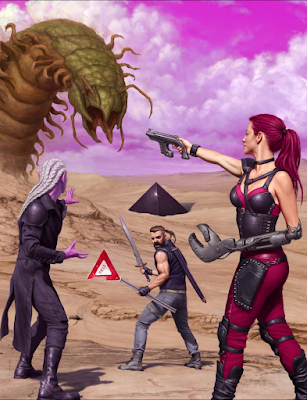
Retro stupid rides again
Cha’alt’s setting is a blasted post-apocalyptic wasteland following a war between the awakened Old Ones, and the planet’s highly advanced civilisation. Various city-states and barbaric outposts inhabit the remaining land mass, while interstellar opportunists have arrived to cart off the valuables, especially the remaining pockets of zoth, the literal lifeblood of the defeated Old Ones, and a main component of the super-valuable spice mela’anj. Of the great dungeon-complexes that have risen over Cha’alt, none are as formidable as the fabled Black Pyramid, a massive structure that has risen anew from beneath the sands. This is a high-energy setting with a crazy and enthusiastic anything-goes approach, from sandworms to space sluts, and from shameless Cthulhu flogging to monster cults. Gonzo games live or die by the way they cobble together their seemingly incompatible influences; the internal tension is part of the appeal, and being a little crazy never hurts.

The supplement’s first section is taken up by setting background and setting-specific miscellany – a grab-bag of stuff for your Cha’alt campaigns. If you want a random, goofy mutation chart, you will find it in the desert survival rules, while the description of the Domed City has a cyberware table to juice up your characters. This is a fun integration of rules and setting, and the section where the supplement is at its closest to the fabled Wilderlands of High Fantasy – a high point of creative, haphazard, play-friendly content. Factions with their typical representatives, and desert critters are described, although there are no random encounter charts (which would be one of the most important things to have in a sandbox setting), and the monster roster is rather limited with only seven new critters (there are several more scattered over the subsequent chapters). The same is the case for some of the supplemental material or random charts and rules, which are found hidden later in the book – a table of simple psionic abilities, an NPC motivation chart, random ability score arrays... bits and pieces that come up during play.
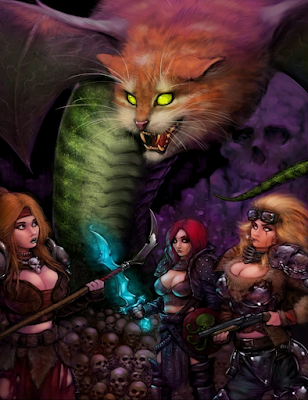
Here kitty kitty
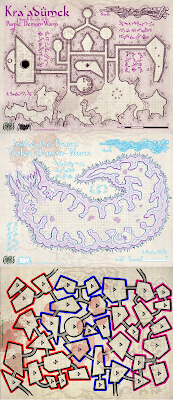
The core of Cha’alt is centred around four adventure sites: two smaller dungeons (Beneath Kra’adumek, 17 keyed areas; Inside the Frozen Violet Demon Worm, 23 keyed areas), a “home base” style location (Gamma Incel Cantina, 69 keyed NPCs), and a large, three-level “tentpole” dungeon (The Black Pyramid, 111 keyed locations). Unfortunately, it is the short intro scenario, Beneath Kra’adumek, that is the really good stuff, and the rest have a growing number of problems. But Beneath Kra’adumek is good, partly because it is designed as a real dungeon. There is a decent, meaningful layout combining caverns and passages; there are guarded sections to avoid or eliminate, prisoners to free, mysterious stuff to mess with, weird monsters (the centrepiece being the demon cat-snake) and duplicitous NPCs to kill, fool or befriend; and it has a sequence of simple, memorable setpiece encounters. Ways to poke at other dimensions and screw things up (including making 1/6 of Cha’alt’s population disappear forever). Fanatical demon-worm cultists absorbed in their evil activities. Cryogenic pods to awaken ancient pre-catastrophe sleepers. Individualised treasure. It is a dynamic scenario that could go a lot of ways due to the variety of NPC/monster/device interactions, and even feels like a goofy sort of Star Wars locale – great for an action-packed intrusion into the fortress-dungeon of an evil space cult, three “princesses” (well, big-boobed space sluts) included. This is top-notch, and unfortunately, as good as it gets.

Inside the Frozen Violet Demon Worm is a great concept – exploring the intestines of, well, you get the idea – but Cha’alt’s deeper flaws start to emerge. First is the degeneration of the maps. An arbitrary dungeon (Beneath Kra’adumek) offers good exploration potential, while the demon-worm’s interior is an enormous fleshy tunnel with a bunch off side-chambers in its folds. You approach the locations, you do the encounter. This is the Monty Haul dungeon in its original sense – a series of “doors” along a corridor to open for random stuff ranging from a young woman chained to a stone column crying out for help (concealed Ktha’alu spawn with some really god magical loot), a group of insectoids battling a flesh-sac detached from the slowly thawing worm, or an enormous stone head worshipped by savage brutalitarians (lazy Zardoz reference), a lost pirate ship, or a bunch of skeevy guys playing high-stakes poker around a scrap metal table. Why? Rule of cool, that’s why.
Retro, retro
stupid, retro utterly
freaking dumb
This is super-arbitrary, and unlike the cultist lair, has no good sense of place. Why don’t these encounters wander off a little? Why don’t they interact if they are right next to each other? What happens if the party runs deep into the worm, triggering them one by one (and how could the GM handle the logistical chaos of juggling 8-12 setpiece encounters)? It is a mess, with little to connect the random bits and pieces. It feels like a “ghost train” type deal from an amusement park, with dioramas of animatronic monsters leering at you from the sides. The structure is horrible, and whatever dynamism is present in the encounters is probably going to be wasted. They are still rather good on the individual level – the author’s skill for punchy, self-contained situations and setpieces lifts up the material. If these were spaced less tightly, and placed within a more interesting, better designed dungeon environment, this would be another good one.

Gamma Incel Cantina is the Mos Eisley cantina from Tatooine, but on Cha’alt. If you have an interest in gambling, whoring, illicit deals, information or odd jobs, this is a good place to visit if you know how to get in (it is behind a cloaking field). The presentation is questionable, but the content is good enough. Basically, you get a map, a brief description of the cantina’s main areas (from loos to gambling tables to its VIP lounge), then 69 (tee hee) NPCs keyed on the map in colour-coded groups to make things a little more accessible. This is, obviously, completely useless for anything other than hitting up 1d6 randos and interacting with them, and treating everyone else as a homogenous crowd. On the other hand, the paragraph-long NPC descriptions offer brief, fun profiles so hitting up those 1d6 randos is going to get you something. The list, appropriately enough for the author’s interests, starts with P’nis Queeg (“Pilot; just parked his starship; yellow skinned banana / penis headed alien with swollen ganglia. He’s holding a brand new plumbus.”), and includes people like Treena (“THOT, human; blonde hair, blue eyed space Muslim; smoking long, thin hookah; likes humiliation and spanking”), Halvern (“Sentient chartreuse vapor inside environmental suit; fake mustache painted on helmet visor; uncontrollable giggling – that’s why they call him “laughing gas.””) or Bolo (“Droid; bounty hunter; camouflage and rust-colored; spritzing WD-40 on plate of myna’ak wings; head of engineering on nearby space station.”) You get the idea. The sleazy truck stop/titty bar vibe is spot on, and it works decently as Cha’alt’s Keep to Cha’alt’s Borderlands.

The Very Naughty Tetrahedron

We now come to the main attraction: The Black Pyramid rises from the wastelands, descending into an underworld most mythical, or at least moderately horny. This is obviously the campaign lynchpin not just from the size, but all the side materials. We get a rumours chart, and random encounters complete with specific monsters (from the dreaded night clowns to hunter-killer droids, fruit folk, pizza delivery and bat-winged eyeballs) and unique NPC groups (lost Romans, alien looters, suspicious hooded guys of all sorts). A “what happened while you were away” chart! A “leaving the pyramid” chart (travel 1d30 years into the past/future and wipe most of the campaign – woo-hoo)! Six new gods! A “you dumbass slept in the pyramid” chart! And so on. So far so good.

"Have we reached rock bottom yet, guys?"
"Not yet! Everybody, dance!"
"My anus is bleeding!"
But then... yes, the problems of the book come back in force, and are multiplied fourfold. The maps are chaotic gibberish. Any semblance of structure or order (or even inspired chaos) goes out the window, and what we get is a bunch of randomly shaped and sized rooms connected by short, randomly patterned corridors (these seem to have no distinct function, or the reference just fails me) between random clusters of colour-coded rooms accessible with special crystal keys. This childish mess does not look like a pyramid – even a severely corrupted one – lacks meaningful height differences or even connecting stairs (what you think are three dungeon levels are actually a single flat plain), has no spatial order to accommodate orienteering or exploration, does not feature actual dungeon navigation challenges (even less so than the frozen demon-worm), and it is overall very repetitive in its formal structures. The room descriptions have no relation whatsoever to the room shapes and sizes. To make it short, the map is really, really terrible, lacking any redeeming qualities.

There is something about the encounters that was grating. Maybe my patience was wearing thin, or maybe it is truly repetitive, but one of the reasons this review is overdue by several months is that I just could not press on with it. It is just one pop culture reference setpiece after the other pop culture reference setpiece. Now... this can work if there is some other kind of connecting material to add variety (say, an interesting dungeon map to navigate, or challenging combat/exploration situations and a few clever traps), but it is missing them altogether. The lazy content also shows its limits. Sometimes, recognition still elicits the Sensible Chuckle, but that well soon runs dry, and you start to scrutinise these encounters with a more critical eye. And many of them do not cut it – they are often static, convoluted for the sake of telling a lame joke, or don’t offer much interesting interaction. And those lame jokes, they are getting lamer and more one-note. Here is a room housing anthropomorphic fruit (#13). Here is a stereotypical podcast guy doing an interview (#14). Here is the Carousel room from Logan’s Run (#15) – all right, this is OK. Here is a room with a clone of Rob Schneider trying to convince a young woman to pay him for sex (#16). Here is a room with a statue of Gonzo, of Sesame Street fame (#17). “Inspecting Gonzo's nose reveals a tiny catch underneath, at the base. Manipulating it opens a compartment located in his crotch. Inside is a battered trumpet. Playing Gonzo's trumpet summons a Buddhist monk (appearing in 1d4 rounds) who walks into the room and sets himself on fire, providing enough light and warmth for several minutes before it goes out and what's left of the monk is carried away like sand in the wind.” There was an opportunity with the Black Pyramid to present some kind of otherworldly, metal-inspired, high-energy dungeon. If you’ve got a black pyramid in your game, you kinda owe something to your readers. Well, Cha’alt’s Black Pyramid is not otherworldly; it sells out all its potential at one tired joke a pop. It is all so tiresome.

Here is another one for free

Zothferno

Your dungeon is offensive!
As the post may suggest, Cha’alt is not an easy thing to review. It is a giant collection of the good and the bad, mixed in with the happy medium of “questionable”, and it is not easy to separate the wheat from the chaff. At its best, it is high-energy gaming with a lot of personality, and a very specific flavour (space/Cthulhu sleaze). It would be a mistake to write it off on the basis of this content – like it or not, this is what it intends to do, and what it intends to be. Those who call it skeevy or sexist are only doing the author a favour, since this is what he wanted to do. To cite the late, great József Torgyán, head of Hungary’s Independent Smallholders, Agrarian Workers and Civic Party, “A lawyer with litigation, and a fine lady with a hard instrument, cannot be threatened.” But does Cha’alt succeed on its own terms?

As far as I am concerned, one of the supplement’s main draws is something that some may identify as a flaw – it is not a thoroughly polished product, but something that shows its origins as a bundle of the author’s home campaign notes. It preserves the enthusiasm, and does not reduce the material to a dry treatise. It invites questions and engagement. There is a definite sense of a dog-eared folder of faded printouts, scratch paper, and session notes behind the book. It is charming, and ironically, more conductive to actual use than many books that look more smooth, but are not presented with table use in mind. It is as accessible as a slightly cleaned up collection of GM notes, and a fun glimpse into a madman’s mind.

There is also something to be said about the modules’ ambitions. They are deeply flawed in multiple ways (as detailed above), but they are not gated by level and do not pull punches. You can easily meet enemies who are way more powerful than you are. You can also beat them up and take their high-tier loot or obtain powers beyond your meagre abilities. You can find yourself bargaining with major demons, inadvertently unleashing planetary devastation, or pull off major campaign-altering victories. Some of this is lolrandom stuff that depends too much on die rolls or (un)lucky encounters instead of player skill or meaningful choices that lead to logical consequences, but it is there nevertheless, and it can be glorious even in this flawed form. It is writ on a large scale, and allows the players to win big or lose big.

Third, it shows variety and imagination on the encounter level. Things on Cha’alt are unpredictable (to say the least), but they are always colourful, and feature fun interactivity – NPCs and plotlines sketched up willy-nilly with a few broad strokes, there are knobs to mess with (some of them blow up half the world, but that’s OK), and a lot of the material is hand-crafted, specific – although the magical treasure is also too plentiful; you can barely take a few steps without finding a javelin +1 or a freeze-ray. Many of the pop cultural references are lazy, but at least many of them make for a compelling set-piece.

Here is the problem, though. Cha’alt is cursed by a curious sort of laziness that’s apparent even if you consider this is a 200+ page hardback crammed with gameable content. It falls apart on the levels above the encounters, and has little discernible structure to it. Things are sometimes connected a little (albeit haphazardly), but mostly, it is just throwing things at a canvas to see if it sticks. Is there a pattern behind the random ideas, or is it just you? It is probably just you. The trick works in the comparatively small and tightly designed starter dungeon, but it increasingly becomes apparent Mr. Satanic is bluffing. The lack of structure and the utter scattershot randomness of the material makes it hard to apply player skill to the modules, to treat them as challenging, complex problems or even real places. This is where the diorama/animatronic monster issue comes back to take its revenge. The environment cannot be known and mastered because there is no environment, only an illusion of one. The amount of interaction obscures this problem, but never fully resolves it.

Your Dungeon is a Cancerous
Growth of Intertextuality and
Postmodernism. REPENT!
And it also suffers due to the sheer excess of pop culture citations. Any conceivable part of cult/geek media is digested and reconstructed in Cha’alt to form the majority of its encounters. While surely one of the greatest collections of genre and pop culture references, Cha’alt does little to integrate its disparate influences into a greater whole, or at least give them its own spin. The approach it takes is disappointingly literal, and often falls flat. When Anomalous Subsurface Environment draws from He-Man, it adapts the material to its setting, the Land of a Thousand Towers, and the result is always a great fit which transforms the spoofed material just enough to stay recognisable, yet add a new angle or a clever gameplay twist. Say, “Monsator, Lord of the Stalks” is obviously an homage to Evil Megacorporation Monsanto, but he is also a fully developed, compelling villain of a wizard who is interesting beyond the quirky reference. Monsator is also one idea among many, most of them original.

When Cha’alt does something similar, it mostly just plops down its direct references randomly, and tries to skirt by on the strength of star recognition. Sure, Mr. Satanic betrays an encyclopaedic knowledge of late 20th century cult stuff and esoterica, but a Videodrome reference next to a Logan’s Run reference next to a tiki bar next to a movie theatre showing Escape From New York does not start living together without some effort to make a coherent whole out of them. The city of “A’agrybah” is plainly Agrabah from Disney’s Aladdin, “just on Cha’alt” with some surface details like a spaceport and a human sacrifice tradition. Sure, there is supposed to be chaos and wild leaps of imagination, but that is just part of the work. Here, the other part is very often missing, and it is all just a post-modern mish-mash of citations upon citations. Is this because the author knows no better? Far from the truth! When he makes an effort to tie things together, as with the setting background, he succeeds fairly well. It just doesn’t happen often enough, or I guess well enough to bring out the sort of transformative quality which makes for a truly great gonzo setting.

Ultimately, these two central flaws are what makes Cha’alt only “good enough” and not actually “good” or “great” – they are omnipresent through the book, and cannot be easily fixed. There is something really good in the setting, and with better structure, the basic concept could excel. Where Cha’alt is good – the starter dungeon, many of the individual encounters, the no-nonsense campaign-friendly presentation – it is deservedly good. As it is, though, it is a deeply flawed book, although never without charm, or generously endowed space doxies, bless ‘em.

No playtesters are credited in this publication. It has apparently been very thoroughly tested, although often in a fairly peculiar manner, as text chat-based random pickup games over several of Mr. Satanis’ lunch breaks.

Rating: *** / *****