Showing posts with label zinemassacre. Show all posts

Tuesday, 13 June 2023

[REVIEW] DNGN #1

DNGN #1
DNGN #1 (2022)

by Vasili Kaliman

Published by Singing Flame

Levels 1 and up

The Terminator is a marvel of design and engineering, a sleek technological terror moving with superhuman precision. Its body is surgical steel, its eyes penetrating optical cameras, its blood high-grade machine oil. It hunts and kills according to the precise programming with which the machine overlords had imbued it. The Terminator is very efficient, but is it good for us? The jury is still out on that one.

Anyway, DNGN #1 is a weird science-fantasy megadungeon published as a risographed zine; the whole thing is printed in pleasing red and blue ink, with 10 really neat full-page illustrations that could be used as an illustration booklet, and even a comic strip! The initial issue covers ten levels and a bonus side-adventure (same author using a skullfungus map). This is a zine which follows all the layout and writing trends championed over the last few years, and used particularly in various Old School Essentials releases. The text is terse, using bullet points to convey information exactly and briefly. Monster names are not only bolded, but highlighted in red. Dungeon maps are annotated with extra room information on floor type and illumination, simple dungeon dressing tables, and so on. Each of the ten levels in this issue uses a page for the maps, and the facing page for the room descriptions.

Here lies the problem, though. As a result of this ruthless and sleek efficiency, what we get is not necessarily what we were looking for in an adventure. How can ten levels of a megadungeon  fit into a 40-page zine (that is, 20 pages of that 40-page zine, since the art and the comic take up the rest)? Well, we have to adjust our expectations for a megadungeon. These dungeon levels have around 8-10 keyed rooms on the average. It is also not like they are 8-10 keyed rooms in a network of corridors and empty rooms (which would be the Castle Greyhawk model). It is really all there is to it.

Puny meatlings! This is, in fact, my final form!

The maps are on the simplistic side, mostly a few basic geometric shapes strung together. Levels connect to one another through one or two stairways, but they follow in succession, without side-levels or the possibility of choosing between a risky deeper delve or a safer expedition close to the surface. Secret rooms are found, but the discovery of cleverly concealed hidden sections, larger room complexes, themed sections, staging areas, and the stuff that makes megadungeon campaigns exciting are all missing. Pit traps, slopes, stairs within levels, water, collapsed terrain, level-spanning rooms – not present either (although there are two cavern levels). It is notable how much of a difference a good map makes. If the whole zine was dedicated to mapping out a single, sprawling dungeon level with decent map design and all sorts of interesting exploration choices, it would solve a lot of the scope/content issues. Here, you just cannot explore too much, since there is so little to explore, and your ability to make meaningful choices is likewise limited by the constrained environment. This is, simply put, not a megadungeon in any shape or form that meets the commonly accepted criteria. Even as a dungeon dungeon, it is smallish and very linear. It all fits on neatly arranged page pairs. It is geometrically perfect, no exceptions. Is that really a feature here? Does it help create a dungeon that is fascinating to a group of players, drawing them back again and again to go further and see more?

The room keys are a step better. A technological/cosmic weirdness theme connects the dungeon, from star god altars worshipped by duergars to vampires slumbering in a glass tank to magnetic statues wearing cybernetic armour and animating if the weapons captured by their magnetic powers are removed. Here, you can see good ideas and well-designed encounters, even if they are mostly simple. You can assemble a good dungeon from a handful of simple, good ideas. However, the strict double-page format serves as a barrier to what can be done. If there is a dungeon room that actually does something interesting an complex (like the magnetic statue room), there are inevitably a few more that amount to “empty”, “here is a bizarre item”, or “they are here and they attack”, because that’s what you have layout budget for (“7F > EMPTY ROOM. Completely empty.”). Does that make the adventure better? Are we better off following this super-efficient and scientifically perfected formatting? Is it to our benefit? Some designers – and this takes a keen skill and sharpened practice – can produce terse, enigmatic room entries which stimulate the imagination in just a few lines, and help the GM imagine the rest. There is an almost oracular quality to these entries, seen in Bob Bledsaw’s Tegel Manor or Michael Curtis’s Stonehell, since they tell much more than they actually speak, and can be interpreted very differently by different GMs. In these cases, minimalism works. But it does not work for everyone (for example, Gary Gygax developed a different style with different strengths), and it does not work reliably here. Sometimes the author gets it right, but he clearly has not mastered the format. Which is no surprise, since it is actually hard to get minimalism right.

Mechanical Skelebro
Offers a Helpful Hint
The room mixture is a mishmash. Instead of concentrated mini-themes emerging from dungeon areas, it is just all random – a room inhabited by an illusionist berating 1d6+2 zombie servants lies next to a room of tapestries, which lies next to a room with three sarcophagi containing mummies, which lies next to a room with bandits, which lies next to a room of stalactites you can lick for 1 Hp of healing. The room-by-room entries can be good, but the big picture is incoherent – not by the standards of conventional realism, but even by the standards of a dungeon with a funhouse slant. The monster count is really low in both the room entries and the random encounter chart. You could see it is 1d6+2 zombies or 4 bandits or 3 mummies. You don’t really see OD&D’s hordes of lower-level opponents that come at you in an onslaught, to overwhelm the weak or get chopped into pieces by the strong. On the plus side, you can meet some really tough stuff that would require the characters to think before engaging, and run if they meet something they can’t handle. There is a purple worm right on level 2, hiding within a mass of tangled vines in a side room. That’s quite fun, although I suspect this module would have a high TPK potential if actually run.

And that’s the deal with DNGN #1. It shows strengths in some room entries, but it is a dungeon where the whole is much less than the sum of its parts. More than that, it shows, very clearly, how meme layout and graphic design fetishism have misled old-school designers. This zine uses a format which actively works against delivering a substantial, interesting adventure, and is particularly ill-suited for presenting a megadungeon. Old-school gaming’s efficiency movement has produced a perfected end product which does not work. And here is where we return to the Terminator analogy. It turns out we defeated the Terminator and kicked its shiny metal ass. We survived its initial attack, we outwitted its mechanical perfection, we learned its programmed tricks, and we crushed it under a hydraulic press. If it comes back, we will do it again. And that is because we are human. That is because we have something more than the machines have. We will prevail.

No playtesters are credited in this module.

Rating: ** / *****

Wednesday, 18 May 2022

[REVIEW] Crashmoon

Cashmoon
Crashmoon (2022)

by David Kentaro Jackson

Published by Elk and Unicorn

Low-level

Not actually a part of Zinemassacre 2021, but what the hell… if the glove fits, why not?

C  R      A                S                    H 

M                              

                             O

                                                    O

                                                            N


(glitchy font placement part of the $5 you pay for it) is dubbed “a psychedelic system agnostic weird fantasy archipelago crawl”, which is why I picked up at the asking price. I, too, love the Wilderlands, and derivatives like the excellent Sea of Vipers. Gaming needs more weird fantasy archipelago crawling, and what best to encourage such than a toolkit to help generate such campaigns. 

Crashmoon epitomises, in a severely overpriced 8-page PDF, why gentle, salt of the earth folk spit and reach for their gun when they see one of these glitch aesthetic ‘zines being peddled by some no-good zinester; it is why young mothers draw their crying infants closer so that they might not see what the bad man is selling. It is what Uncle Ted and the John Birch Society warned us about. It is why we cannot have good things. In these slim 8 pages, you have the cover; half a page of glitchy letters on a hideous cyan background, spelling out the title; one paragraph of introduction which sets up the tone by stating the blatantly obvious (“It is system neutral, so it is not designed for any specific tabletop role playing game system”), but admonishing you to use safety tools, followed by declaring that “Crashmoon is a #SwordDream.”; one and a half paragraphs describing the Crashmoon Archipelago, a zone of weirdness; and then 5 pages of tables.

Perhaps the cyan really needs a consent form

Let’s talk about the tables. Great tables establish procedures, help you develop ideas, or spice up play with unexpected extra ideas and challenges. When it comes to inspiration tables, the good ones poke your mind. The new edition of Tome of Adventure Design, PDF recently delivered, has gems like “obedience-ship”, “screaming vortex”, and “mummification-tower”, and that’s just three rolls from one table among a bazillion. Crashmoon takes a different approach. Its five d66 tables give you developed stuff. These results are often flat and banal, and even when they aren’t, they are specific stuff, lacking the subliminal quality of ToAD’s mashups, or the low-key surrealism of Judges Guild’s tables. You can roll for… location features (“evil twin villages”, “enormous vibro-hatchet embedded into a cosmic skull”, “tunnel with endlessly branching caverns”), objects (“a hover sled”, “a bundle of sleep incense”, “night vision goggles”), characters (“a bird person who has lost their wings”, “a giant talking goldfish in a giant tank”, “a rope golem”), causes (“sick grandmother needs a cure from a remote local”, “star-crossed lovers”, “village of cute trolls has lost their hearth flame”), and omens (“a great stag”, “a low mist”, “lightning sets tree on fire”). Sometimes it almost comes together into something… but mostly, it is just random noise. Max Ernst it ain’t. These are not good random tables, not even on an “I will use it this one time” basis.

Well worth that $0.625
For your five dollars, you also get a full-page recreation of the SWORD*DREAM manifesto, which none of the SWORD*DREAM guys seem to practice. Breaking down the zine price, this is what you pay for:

  • crappy cover: $0.625
  • pretentious glitch text plus intro: $0.625
  • five badly made lolrandom tables: $3.125
  • SWORD*DREAM manifesto, but in cyan: $0.625

On one hand, this will surely not be my ruin. On the second hand, it is also how much a nice cuppa doppio costs at the best café in my street, plus I contributed financially to the spread of SWORD*DREAM across the land. I should have picked the doppio.

No playtesters are credited in this publication. Perhaps there is a merciful God after all.

Rating: * / *****


Thursday, 21 April 2022

[REVIEW] Wild Blue Yonder #01

Wild Blue Yonder
Wild Blue Yonder #01 (2021)

by Jon Davis

Published by Sivad’s Sanctum

Low-level

Hello, and welcome to **ZINEMASSACRE*2021**! Last year, Kickstarter ran Zinequest 3, their third zine writing promotion campaign. This venture seemed to be ill-starred, as not only did many of the projects suffer from delays and disappearing authors (a.k.a. “the old cut and run”), but this may actually be the last significant venture under the name for reasons which are both funny and disappointing. These reviews will focus on the zines I funded AND which actually got released – let’s see how it goes.

* * *

If you want to start a weird game experiment, start a zine. It might just find an audience, and in the worst case, you are not out of too much money. Of course, Kickstarter changes the equation a little (once you are funded, the risk is firmly on the buyers’ side), but the basic idea stands. Wild Blue Yonder (also the title of a Werner Herzog movie – relation to this project unknown) takes the framework of Old School Essentials, and takes it somewhere entirely else than originally intended: the Yonder Mountains, a backwoods area on the edges of modern civilisation. The time and place is distinctly late 19th century America, perhaps somewhere along the Appalachians. The Yonderfolk, the rural inhabitants of the Mountains, possess simple, homespun wisdom, and know much about this territory. In contrast, Flatfoots are outsiders bringing new ideas and fashions from industry to the labour movement.  Deep and old forests hide small agrarian villages living by old customs, while early mines dig up the mountains, small-scale factories are springing up, and loggers are slowly starting to clear away the dense old growth forests. This model of industrialisation preceded massive big-city industries, and is best remembered through campfire songs like Sixteen Tons (quoted on the back cover) and such fare – dirty, brutish, and more beneficial in the long than the short run.

Free Candy Not Depicted
The zine is dedicated to presenting this world of wise old tramps, tradition-bound townsmen, industrial barons and them crazy city folks with their new gizmo fads. The strength of the setting lies in the telling: it makes a convincing argument that this is a setting worth visiting, with its own folklore, customs, and deeper mysteries. There are human conflicts, from love and hatred to Tradition vs. Progress, folkloric beings based on strange old men, chapters on local fare (Yonderfolk have a notorious sweet tooth for rock candy, enjoy fried pumpkin rinds fried in lard, and wash it down with apple beer or a swig of strong hooch) or types of wood (metal is scarce in the Yonder Mountains, so household items are made of maple, log cabins of poplar, and magic items of white ash). The issue also presents the Woodsman class, who are basically Rangers with a deep spiritual connection to trees, a town, and four critters (giant groundhogs and wampus cats are two of them).

As a flavourful presentation of a lovely rural setting, Wild Blue Yonder is a success. The question with these settings is always “So what am I supposed to do with this?” The answer in the zine is not entirely convincing (see below), but to its credit, a large rumour table offers 36 potential hooks, from “The feud between the Walshes and the Marshes was started over a misplaced stew pot if memory serves” to “The Moon-eyed People see better at night than in the day, often times you’ll see their eyes shining from the dark hillsides.” You might also get the idea that the right answer is “what everyone else is doing”, so probably situation-oriented scenarios (thwart the dastardly plans of those industrialists!) and some light dungeon crawling. The Kickstarter comes with two pamphlet dungeons (a format that makes one-page dungeons look downright respectable), which also serve as a practical demonstration (but see below). Big Rock Candy Mountain is an entirely linear expedition to a lost gem mine with seven keyed locations and a 2d6 random encounter chart, while I Remember Uncle Elijah is an investigative module in the sleepy village of No Pine, where children are disappearing. The pattern of disappearances is entirely random, and there are no meaningful clues to really “investigate” or “solve” the mystery, at least within the adventure’s scope as written. I don’t know, man. Perhaps it is one of those deep things. Volja?

Then there is the editorialising, which I suppose is to be expected with these NuSR things. Not only does the setting have Correct Politics, but we will be surprised that NPCs who share the Correct Politics are sympathetic, wise, and ultimately good of heart; while those who do not share the Correct Politics are greedy, unsympathetic, and Up to No Good. For example, Old-Timers are wise in the ways of healing, good advice, and a bit of folksy magick, while the Sons of Cludd are intolerant religious fanatics who “have a reputation as ruthless inquisitors and torturers of those they deem as heretics and witches”. Well, there’s a hard decision. Likewise, the Paimon Coal Company is a gang of obvious evildoers to the last clerk, company store employee, and Sherrif (all ~ are bastards), while good folks in town host secret labour union meetings and work as child preachers paying off a family debt. When they have character flaws, they are sympathetic character flaws or charming tics, or something they are not at fault for. Even the famed Paimon Prowler (a now extinct OSR critter) would be impressed.

The above weirdness notwithstanding, this is a decent “idea” zine, and a compelling setting crafted with vivid strokes and obvious love. The writing is good, and the ingredients are there for a campaign. You probably will not run a game here (and see below), but wouldn’t you like to? This is a quaint, timeless, and out of fashion world that feels a bit like home. When you read that “Some folk from Chat’nuga are in town, and they got themselves an automobile!”, wouldn’t you want to play a few tricks on them until they go right back to Chat’nuga with their gizmo widgets? Darn straight, sonny.

The zine is released as “UNPLAYTESTED WITH PRIDE”. Weird flex but OK.

Rating: *** / *****

"They even gave a strange little jump as they
fucked right back to wherever they came from!"


Sunday, 10 April 2022

[REVIEW] City of the Red Pox

City of the Red Pox
City of the Red Pox (2021)

by Benjamin Wenham

Published by Dark Forest Press

TROIKA! level

Hello, and welcome to **ZINEMASSACRE*2021**! Last year, Kickstarter ran Zinequest 3, their third zine writing promotion campaign. This venture seemed to be ill-starred, as not only did many of the projects suffer from delays and disappearing authors (a.k.a. “the old cut and run”), but this may actually be the last significant venture under the name for reasons which are both funny and disappointing. These reviews will focus on the zines I funded AND which actually got released – let’s see how it goes.


* * *

The City of the Red Pox is a 36-page zine for the Troika! system, presenting the beginnings of a city setting ravaged by a deadly disease, and under attack by horrors from another reality. It comes in a lavishly illustrated booklet on high-duty colour paper, and looks generally fancy. Following the logic of such things, the zine’s layout is breezy, with generous empty space, large fonts, ample spacing and all the various tricks of the trade. That is to say, it does not contain as many letters as you might expect; in truth, it contains surprisingly few. Since no further issues have been published, this first issue thus has to be the basis of the review.

Favoured enemy: Dense, two-column text

The Serene Republic of Antar is basically fantasy Venice, one of the great settings for baroque skullduggery. It is currently enmeshed in chaos as a consequence of the plague, the breakdown of order, and extra-dimensional threats which do not receive much attention in this volume. This may even remind you of the great Dishonored and the city of Dunwall, which would not be far off either. In lieu of a traditional gazetteer or world guide, we mainly get “background through flavoured game rules”. Six Troika! backgrounds (character builds) are offered, a macabre lot which I genuinely like. You can be a Charonite Guilder (a gondolier who transports the rich and the dead alike), a Widow of the Veil (a teller of ill fortunes), or my favourite, a Once Trusted Butcher (these pig-masked freaks are family confidantes in matters both gastronomic and criminal). Then, there are twelve enemies, from cops to the damned, plague doctors, river wasps, the mysterious Stone Watchers (sphinxes that whisper secrets, and work for the State), and “the King’s Boatmen” – clad in “tattered, pale yellow robes”, and a sign that the one seeing them is marked for death. A more mixed bag, and does not offer much, but the pick is decent and moody – these are usually minor antagonists.

The best thing in the zine, no kidding!

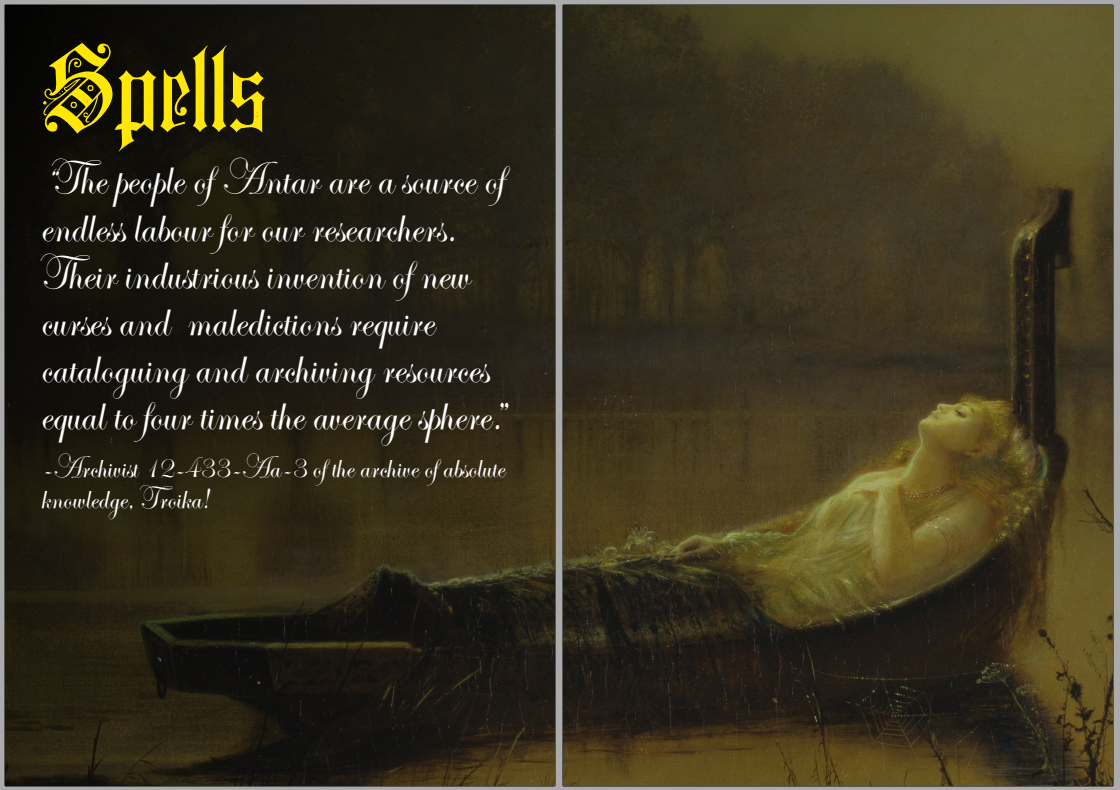
A third section provides an introduction to the city, as well as sample NPCs with a selection of adventure hooks. This is, unfortunately, already past the halfway mark, so the material is not just meagre due to deft but wasteful layout tricks eating up those 36 pages, it is just a very shallow catch. You see some shiny ideas which would be great to elaborate on, but they remain as these little decent sparks, like the “funeral trade” of transporting bodies to and from Antar, or an NPC looking for the perfect glass coffin for the preserved corpse of his beloved. But a lot of it is stating the obvious without making it interesting and useful in a hypothetical game. Finally, we get six spells, not bad for two pages.

Then you get six spells on two very empty pages

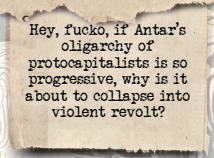
City of the Red Pox also features what I assume to be the author’s anarchist politics. Well, fiction is a way to convey your ideas and pillory your opponents, so a little editorialising does not hurt. Unfortunately, nothing useful is being done with this aspect, except to hammer it home through the equivalent of marginal notes that the State, verily, is Bad; unjust hierarchies are inherent in Capital, and that All Cops Are Bastards. This is in a sense authentically zine-like (in that it reminds you of the Deep Thoughts & Poetry section of the authentic punk zines you may find in the wild), but it is all Tell without Show, and on the level of gems like “Hey, fucko, if Antar’s oligarchy of protocapitalists is so progressive, why is it about to collapse into violent revolt?” (Solution: because the Author made it so.) It is all so tiresome.

Fuckos: rekt

One Zinequest earlier, Visitor’s Guide to the Rainy City demonstrated how much excellent content can fit into a modest little volume, and how to convey the feel of a teeming, decaying metropolis during what may be its final weeks. City of the Red Pox does no such thing, because it barely does anything before calling it a day. The few genuinely nice ideas do not come together to form something great. It has a great premise, but the execution is lacking, and the material is too thin to be genuinely engaging and useful.

No playtesters are credited in this publication

Rating: ** / *****

Saturday, 31 October 2020

[REVIEW] Hunters in Death

Hunters in Death
Hunters in Death (2020)

by Tim Shorts

Published by GM Games

Beginner and low-level

Hello, and welcome to part five of **ZINEMASSACRE*2020**! This year, Kickstarter ran Zinequest 2, their second zine writing promotion campaign. Despite my utter distaste for the idea of a major fundraising platform intruding on a publishing genre for people with more ideas than money, I have to admit Zinequest was successful in motivating a whole lot of gamers to launch their personal projects. While many of them were completely alien to my interests (“A quiet space-faring rpg zine about being alone & not quite being alone.” and “A fluffy D&D Adventure featuring sock puppets, danger and imagination!” are probably for other people), I pitched in for fifteen which looked interesting. Here are the results.

***

One the scale from “meat and potatoes” to “paint-huffing pretentious”, Hunters in Death is way, way closer to the first endpoint. Here are your monster-haunted woodlands, here are your roadside inns and foresters, your goblins and barrow mounds. It is the basic texture of D&D played by the book, and offers more comfort than surprises. It is done decently, both as a coherent whole, and in its individual parts.

The zine provides a small wilderness environment where you can seek adventures. The tiny hamlet of Hounds Head is just one corner of the vast Komor Forest (the author’s home campaign), but its position on the crossroads always attracts peculiar travellers. Hounds Head is small, the proverbial flicker in a points-of-light setting. It has everything an adventurer needs: inn, general store, a smithy staffed by Kovac (a guy whose very name means “Blacksmith”), a chapel, a magic-user’s eccentric residence, and a village leader. More importantly, any direction you head out will make you hit ADVENTURE before you are halfway through the day. There are suitably good adventure hooks to provide a direction if you don’t know which way to begin. Or was that nooses? Yes, someone has been placing nooses around the woods, and hanged bodies have been cropping up with growing frequency. Something is amiss around Hounds Head…

The core adventuring material of this zine consists of three main sections. First, we have a random encounter chart to use during forest expeditions. This starts things on a strong note – more than an afterthought listing a few generic forest critters, this chart includes both commonly encountered monsters and animals, and less frequent locale-specific entries. These meetings can easily develop into mini-adventures of their own, or provide personality and an element of continuity to the campaign. Some of the encounters have sub-varieties, so no two “giant centipedes” encounter will be identical; and monster entries come with a listing of “harvest”, noting the parts a hunter may find valuable to sell. Second is a random table system to seed the 14 barrow sites scattered in the nearby area, generating their environment, inhabitants, and treasures (the grave goods of an ancient people, including their special magic items). This, again, has sufficient variety and surprise to make exploring them an entertaining venture. perhaps you will find a royal treasury, just make sure not to stumble on a Crow temple. The third section describes three mini-adventure locations: a semi-ruined hunter’s cabin that hides a horrifying surprise (this one is a winner, and scared my players witless), a crypt dedicated to a coveted magic item (this is a bit meh), and the mystery of the “hunters” alluded to in the zine’s title.

Hunters in Death is not a zine that will make you go “I could never have thought of this”, but it can fit most D&D campaigns seamlessly. It uses simple concepts and elements, but uses them with skill and fun variety. It has a consistent theme that makes it hang together, with a few genuinely creepy moments. You could take the mini-sandbox and place it in a larger one boxes-within-boxes style, or take it apart and use it as a grab-bag of stuff. I am currently running Hoard of Delusion, a low-level AD&D wilderness/dungeon module as our second wave Covid-campaign, and I found this zine very useful in rounding out the wilderness areas with extra material. It is chicken stock for the tired GM – just add water, some extra ingredients, and heat up to serve.

No playtesters are credited in this publication.

Rating: *** / *****

Friday, 23 October 2020

[REVIEW] A Visitor’s Guide to the Rainy City

A Visitor's Guide
to the Rainy City

A Visitor’s Guide to the Rainy City (2020)

by Rich Forest, with Andrew D. Devenney, Alisha Forest and Bill Spytma

Published by Superhero Necromancer Press

System-independent

Hello, and welcome to part four of **ZINEMASSACRE*2020**! This year, Kickstarter ran Zinequest 2, their second zine writing promotion campaign. Despite my utter distaste for the idea of a major fundraising platform intruding on a publishing genre for people with more ideas than money, I have to admit Zinequest was successful in motivating a whole lot of gamers to launch their personal projects. While many of them were completely alien to my interests (“An absurdly punkrock role-playing game zine.” and “A Forged in the Dark TTRPG zine, where you play as a gang of animals stealing food and garbage from humans in a small town.” are probably for other people), I pitched in for fifteen which looked interesting. Here are the results.

***

How much can you ask from a zine? The publication type tends towards the short and ephemeral, the “I had an idea” thought experiment, or the burst of creativity. Buying zines is like buying bric-à-brac from an antiques store – eye-catching, strange, not too expensive, not too disappointing if it does not deliver on the pitch. However, some of them do, and more – here is one of them. A Visitor’s Guide to the Rainy City is a complete, gameable city in the shape of a 60-page zine. That’s a handful! Perhaps it does not properly belong to the zine genre, and is best thought of as a very compact supplement; something that would normally be 120 pages, but here, you just get the good stuff in half as much. Expressive terseness? I’ve got your expressive terseness right here! At any rate, A Visitor’s Guide is packed – and none of it is a waste.

Hey, the City looks almost
bearable from down here

The titular Rainy City may be the last large city in existence. It always rains – always always, with varying intensity. Much of the rest of the world has been flooded, and other than the occasional shipful of castaways swelling the local population, seems to be entirely under water. Nobody seems to be able to do anything about the situation – the gods are silent, and the great wizard college of the city has been destroyed in some kind of catastrophe. Fires barely light, and in the rainy season, it has to be replaced with expensive alchemical salts. The rotting buildings, under constant rainfall, are home to increasingly strange beings: puddings prowl the cracks and drains, gargoyles haunt the rooftops in a constant power struggle with intelligent gulls, and the creatures of the sea have come out to play. There are new intelligent races ashore – the achterfuss, intelligent octopus people; mermaids and “deepsies” (regular people slowly turning into fishlike beings); and there are others which have adapted to this new life – aristocratic ghouls, bog-dwelling halflings, and so on. Everything has been upended and become uncertain – the city has no unified government, maybe a third of it is gone, and its future is uncertain. Yet life goes on, and this partially submerged, partially ruined metropolis remains full of teeming crowds, business deals, power struggles, crime, and festivities. It is a rather cheerful apocalypse, as related by the upbeat text of the guide’s fictional narrator – here is a great place to have fun, and some exciting adventures. Is it London? Yes, a little bit. Is it Terry Pratchett? You can bet. It is a lot of things, but in the end, it is its own place, and there is none other like it in gaming.

Insufferable hipsters
duking it out in Vagabond Bay
The Visitor’s Guide gives you this city as a travel guide of sorts, first introducing you to general ideas and customs you may need to know, then proceeding with a more detailed breakdown of the Rainy City’s places and people. This is an excellent approach to worldbuilding, since it concentrates entirely on the substantial, without wasting time on things of little concern to the adventurer. Everything is to the point, and no text is wasteful – it all focuses on what makes the city interesting, dangerous, and worth delving into, just like a fine travel guide takes you to the good stuff. Information is either presented to provide adventure pitches – job opportunities, organisations you may want to join (or fight), and exciting locations are given a prominent treatment – or as concentrated flavour with asides on food and drinks, eccentric customs, the importance of hats, and other local colour.

Ms. Stacks, brigand leader
The Rainy City is divided into ten major districts, each receiving a mini-gazetteer spanning around four pages. Each have their own character, from the milling traffic of Old Town and the industrial monotony of Leeve Town through the eccentric aristocracy of Embassy Row or the mage towers of Tower Cliffs, to almost rural hinterlands like the eerie plateau of the Headlands and the marshy, bandit-populated Sump. In fact, they do not just have their own character, they have their own weather – sure, it is always raining everywhere, but the rains of Leeve Town are “Steady. Oppressive. Gray.”, while for posh Embassy Row, they are “Very fine (…) here [the rains] have a cleansing quality.” Beyond this small gimmick, these sections have a notated map, information on law enforcement and criminal enterprise, places you may visit, mysteries and conflicts you may get entangled in, and so on. From doing “roof duty” wrestling trolls, pudding and chimney goblins in Old Town, to smuggling in Vagabond Bay or joining a salvage crew on the Headlands, this guidebook is structured around adventure. There are interesting NPCs like Jenny “Ma” Weaver, a witch who can weave strands of fate, or Orbeg the Multipotent, a wizard “whose tower has a level for every lesser potence he has cast behind him on his path to betterment.” (“Some thirsty-six Orbegs, each less multipotent than the one above, abide in his tower, each assured in its assurity that it will one day be the ultipotent.”)

Cleverly repurposed
witchburning art
As presentation goes, the zine is understated, but just about perfect. There are no fancy layout tricks beyond making sure stuff that belongs together is on facing pages, the maps are placed where they are useful, and the illustrations break up the two-column layout exactly where they are needed. It is not obtrusive, just good at what it does: making the text flow well, and the booklet easy to navigate. I would be remiss not to mention both the excellent map – every quarter of the city having its own characteristic topography, street layout and features of interest – and Bill Spytma’s illustration work that defines the Rainy City just as well as the text does. Illustrations feature redrawn/altered 15th to 16th century woodcuts to great effect, and these are authentic, not to mention very funny if you know them from previous reading materials. In these reviews, I rarely consider production values as an aspect for evaluation: here, I will make an exception, because the art becomes an integral part of the zine.

There are no stats in the zine, nor any game-specific information, really. I am not fully convinced it was written for old-school games at all, but do not let that dissuade you. The setting is strong enough to work in an old-school urban sandbox game, in a 5th edition campaign, it would probably work with some of the indies, and it would make for a hell of a backdrop for the heist-oriented Blades in the Dark (much better than the official setting, which I honestly found disappointing). Hell, you could use it to inspire Thief fan missions, which is of course the highest honour there is. You would need to do some work to make it fit any system, but you would not need to do much to make it work well – the content and structure of the zine would do much of the heavy lifting.

This is sort of an intermediate product. It is a superb trove of ideas if you are a Gamemaster looking to run games in the Rainy City, but it is also a booklet you could hand to your players as a setting guide, and let them pitch you ideas. The information is exactly at the level of detail and specificity where it gives a strong idea of places, people, and conflicts, but does not rob anyone of the mystery of actually exploring and interacting with the milieu. And what a milieu it is! Original and with a strong flavour, yet eminently play-friendly and approachable; large-scale, yet having a good eye for human-level interests. It is enthusiastic and funny – admittedly, you can get a whiff of hipster from the usually wry humour, but let that be its greatest crime. This is just well-done, and modestly priced at that.

No playtesters are credited in this publication, but the Kickstarter pitch reassures us it has been in used in games for fifteen years, and I believe every word of it.

Rating: ***** / *****

Yum yum yum


Thursday, 3 September 2020

[REVIEW] Sunlands

Silvery finish not depicted
[REVIEW] Sunlands (2020)

by Chris Longhurst

Self-published

Low to mid levels

Hello, and welcome to part three of **ZINEMASSACRE*2020**! This year, Kickstarter ran Zinequest 2, their second zine writing promotion campaign. Despite my utter distaste for the idea of a major fundraising platform intruding on a publishing genre for people with more ideas than money, I have to admit Zinequest was successful in motivating a whole lot of gamers to launch their personal projects. While many of them were completely alien to my interests (“Five experiences about communicating with yourself, nature, and others” and “Dreamrs, we are such stuff as dreams are *Powered* on, and our little life is rounded *by the Apocalypse*.” are probably for other people), I pitched in for fifteen which looked interesting. Here are the results.

***

Since the ancient days of gaming when Judges Guild walked the Earth, few have tried to cram an entire hex-crawl setting into a thin, zine-sized pamphlet (honourable mention goes to the infamous Carcosa and the dreamlike Sea of Vipers). Sunlands has tried, and without further ado, succeeded at giving you an entire, functional fantasy region in all of 32 pages.

This is a 17x21 hex area describing a mostly hilly area scarred in a divine confrontation, but now populated by a collection of oddball cultures. Beyond scattered human settlements and their usual fantasyland allies, the Pale Elves (a wood-dwelling elven subgroup with an affinity for riding giant insects) and the Vespix (a wasp-based civilisation based in the southern swamps) have carved out their domains. Much of the area, however, is unclaimed land, where adventurers may encounter strange loners, philosophical monstrosities, and weird ruins. That is, it is a fine borderland setting for exploration- and other travel-based fantasy campaigns.

Hex key

Preceded by a brief introduction and a series of encounter tables for the different terrain types (featuring both general and more specific encounters you might face, from wildlife and general monsters to expeditions, and even some of the major inhabitants of the specific sub-regions), the bulk of the book is dedicated to the hex entries. Unlike the Wilderlands and other hex-based wilderness modules following in its steps, Sunland has a feature of interest keyed to every one of the map hexes. Also unlike the common method, where you tend to encounter whatever the hex hides if you pass through it, it divides hex entries into OBVIOUS and SUBTLE places, and MANDATORY or OPTIONAL encounters. The former will be automatically found and engaged with (and are marked with helpful pictograms in the text – this is a really nice idea), while the others only come up on a thorough search, specific conditions, or random chance (a flat 1:10 roll). Thus, the Sunlands, while very densely keyed, may not actually appear so for every group playing in it; and every group, or even every expedition would find and interact with something else. This is a workable way to build a hex-crawl setting, even if it comes with a hidden effort the players might never appreciate. At least here, most of the basic work is already done for the group. As another bow to usability, hexes reference associated hexes. Want to know where this NPC’s arch-enemy is located? The reference is right there. Want to know where this lost item should be returned to? The zine will tell you. In some cases, these links build small scenarios which may become full adventures. The members of an infamous halfling crime family are hiding out in the Sunlands. Want to catch them? You have your campaign premise.

What kind of place do the hexes describe? The Sunlands is a place of pure gameplay – most locations prompt the characters to action, or have something interesting to interact with. This sort of active engagement is a positive feature of the design. Individually, the hexes offer small encounters, described in short paragraphs, like this (selected at random; 0512 and 1502 are examples of obvious/mandatory encounters):

0312 Someone's still, mid-distillation. There's half a demijon of moonshine to be had, and the owner's nowhere to be seen.

0512 π The small village of PYRE pays lip-service fealty to Sophia of Partisan (0712) but really their only lord and master is the evil fire god XITOCOX. Anyone captured by them will be tossed into the crater (0612) in a secret ceremony.

0915 The medusa stonemason KRISTINA lairs here, in a cave surrounded by statuary. Among the dozens of statues are a stone golem bound to Kristina's command, 2d6 gargoyles, and sometimes Kristina herself covered with grey body paint and practising her 'human statue' routine.

1210 A small dungeon hidden beneath a hill holds some minor threat, and a dust-covered mirror. When someone is reflected in the mirror, it assesses their feelings of guilt and suggests actions of restitution or redemption in curling, silvery script.

1502 β ERIN is lounging about, dressed in mismatched clothes. She claims to have come from a distant planet to experience life here, which may or may not be true. She IS one of the best healers in the Sunlands though.

1609 Situated here, far from anywhere else, CORDELIA owns and operates a breeding stable for horses. Due to a divine curse handed down generations back, Cordelia only exists at night, so while her steeds are fine they also have a tendency to be nocturnal.

This is obviously fine as a springboard for improvisation (which it requires), and also highlights the style of the zine setting. Sunlands is filled with monsters and NPCs demonstrating oddball personalities. Where the Wilderlands is a place of weird ruins and belligerent fiefdoms, and the Sea of Vipers is poetic, this place is filled with jokes, ironic reversals, and anachronisms (from the necromancer who got into the trade because he couldn’t persuade anyone to join his band, to a halfling–dwarf duo trying to invent and test-drive ‘automatic carriages’). Even most of the potential antagonists are more like funny weirdos than typical evil-doers, and if something can be played for a laugh, it is played for a laugh. The style is perhaps best described as now slightly creaky mid-2000s Internet comedy, which, I suspect, would be a stumbling block for some. Comedy settings (as opposed to regular ones generating funny situations) are an acquired taste, and hell, people had the exact same problem with Verbosh, Judges Guild’s excellent mini-sandbox. Much like Verbosh, Sunlands is eminently usable. It is also very silly, underscored by the interior art, sourced from slightly modified Victorian stuff.

Also the Queen of Comedy

Sunlands is a refreshingly no-nonsense product. Beyond the disappointing limitations of the skeletal one-page dungeon genre, but free of the bloat that plagues many professional game settings, this is a zine focused on supporting actual play by providing you with a densely stocked game board. Its presentation and format innovations are small but worth looking into. The jokes can get tiresome, but altogether, this is solidly made, and would serve as a good campaign base.

No playtesters are credited in this publication. 

Rating: *** / *****

Thursday, 27 August 2020

[REVIEW] Vallakia

Vallakia (2020)

by William Cord

Published by Stronghold Press Games

Low levels

Hello, and welcome to part two of **ZINEMASSACRE*2020**! This year, Kickstarter ran Zinequest 2, their second zine writing promotion campaign. Despite my utter distaste for the idea of a major fundraising platform intruding on a publishing genre for people with more ideas than money, I have to admit Zinequest was successful in motivating a whole lot of gamers to launch their personal projects. While many of them were completely alien to my interests (“LARP for 2 players of Robot Girlfriends across the battlefield” and “An rpg zine about 3 sled dogs on a perilous trip home.” are probably for other people), I pitched in for fifteen which looked interesting. Here are the results.

***

Do you think “production values” are often a racket? Do you admire honest homespun values and the good old DIY spirit, even if it makes the best of public domain engravings and cheap layout done in Winword? I sure do, and I am all over these zines! I love them. Except... there is also an unspoken promise here that the content will be good, and it will somehow make up for the sparse exterior with unconstrained creativity and colourful ideas. Ho boy. Vallakia is not that zine.

Nooooo, don't make me go to Vallakia!
What the zine promises is interesting: a micro-setting describing “a small province, underpopulated by humans and overpopulated by monsters”, isolated from the rest of the world by an “impenetrable fog (…) stopping the people from coming or going.” Yes, that is basically Ravenloft, or every other “here be vampires” fantasyland, but even so, micro-settings are a sound idea. The campaign mentions support for a West Marches-style game, with descriptions of the major settlements, a small adventure, and stretch goals – two of which were funded, one for villages, and one for manors. The results make for three 8-page pamphlets set in princely Arial, and illustrated with cheapo public domain art. This is, indeed, my thing, so I backed the zine with enthusiasm. The following review will chronicle the disappointment that followed.

Vallakia is an empty zine. It has virtually nothing in it, at least nothing that would prove useful in helping run a good game. It describes its mini-setting in the most elementary stereotypes of Vampire Country. That alone is no crime. Nobody was realistically expecting something inspired by the real Wallachia (a fairly interesting place, one which would coincidentally make for a cool campaign setting), but perhaps something beyond ideas found in every vampire movie? No chance. We get the fog; we get the small villages huddling in fear; we get the rapacious nobles and the small, brave military force trying to hold back the encroaching horrors. Vallakia is isolated, dark, backwards, and primitive (in a bizarre take, they do not even know blacksmithing, something even shockingly primitive cultures could figure out). Very well, that’s a Hollywood horror movie all right. But there is nothing beyond that. Vallakia commits the most heinous sin of fantasy supplements: it is boring.

The zine describes three towns and a dungeon, none of which have anything truly interesting or original going on. Pinehall has a military garrison and a small church (the church has an aging priest who can heal people), and a tavern with three rooms. Long Farm is a farming town providing “the majority of food for all of Vallakia”. Don’t the other places grow their food? Very peculiar indeed. Anyway, Long Farm has an abandoned Town Council building now used as a garrison, and a brewery. The townsfolk are harassed by creatures of chaos. Finally, in another example of specialisation, Priby supplies lumber for palisades, and operates a lumber mill. Are they not interested in farming? Don’t the other villages cut trees? Not to be a stickler for fantasy realism, but this is so bizarre it almost looks like there is an explanation behind it. Of course, there isn’t. Priby’s woods are terrorised by a necromancer, and the villagers lock their doors all day and night. So we have Soldiertown, Farmtown and Lumbertown, and that’s all there is to know about them: banal, insignificant, clichéd information that does not show any interesting engagement even with the Hollywood-style Vampire Country idea.There is a rule about investments which feels a bit like Darkest Dungeon (upgrading local places of interest can result in various boons), a lazy random quest table with 20 uninteresting results (“OGRE!!!”, “Mayor consorts with demons”, “Troll toll”), and a one-page dungeon. That means a zine-sized page, an unnumbered map, and a key with one-liners like “1 – 3 Kobolds arguing about the best way to cook a human. Gate west is locked and barred.” and “2 – 2 Gnolls laying down. Will join fight in 1 if it lasts 3+ rounds.” This is negligible even by the new fold-out microdungeon standard.

Welcome to Stamati. Population: turnips
Vallakia has two supplements, essentially tripling the page count. Villages describes two podunk villages. To quote the pamphlet, “Stamati is quite the bog-standard village, and I will include it here to remind you that not all villages need a unique twist. In fact, most villages are boring farming settlements until the PCs secure them and invest in their improvement.” True to the author’s word, the village does not have a unique twist, and it is, indeed, a boring farming settlement. Its inhabitants are mostly farmers. The other village, Vasilache (a common surname, this is a bit like naming an American village ‘Smith’, or ‘Johnson’) is more interesting, in that it has a holy woman who has a mysterious connection to the gods. This is, indeed, the only good idea I could find in the zine and its two supplements. There are random tables to create bog-standard villages and generate their bog-standard inhabitants; and they are basically (deliberately?) uninteresting. The second supplement, Manors, is slightly better, in that Vallakia’s noble families are a corrupt, cruel lot, and that’s always better adventure material than dirt farming villages. And yet, it does not offer more than cliché either: Juracken Manor is home to the proverbial vampire viscount who likes peasant-huning, and Karlbad manor is inhabited by a god-fearing frontiersman family. Not even the random tables and the investment ideas help this one.

Vallakia is bad. Not maliciously so, but credit where credit’s due, it is plainly bad. For a semi-commercial project, it feels like bad filler, stretched out with illustrations. The zine and its two supplements are 8 pages each, but only about 14-15 of the 24 pages are text – and it is text set in a remarkably large font to boot. What the adventure lacks in quantity, it also lacks in quality. It is banal and completely useless in either offering, or helping create an intriguing West Marches-style micro-setting. You, random reader, could do much better in a single afternoon.[1] Don’t venture to Vallakia; ‘tis a silly place.

No playtesters are credited in this publication.

Rating: * / *****

_______________

[1] I will hereby put this idea to the test. A post will follow later tonight.

Wednesday, 12 August 2020

[REVIEW] So You Have Been Thrown Down a Well

So You Have Been Thrown Down a Well (2020)

by Madeleine Ember

Self-Published

Low levels (I guess)

Hello, and welcome to **ZINEMASSACRE*2020**! This year, Kickstarter ran Zinequest 2, their second zine writing promotion campaign. Despite my utter distaste for the idea of a major fundraising platform intruding on a publishing genre for people with more ideas than money, I have to admit Zinequest was successful in motivating a whole lot of gamers to launch their personal projects. While many of them were completely alien to my interests (“A tabletop role-playing game about the drama and excitement of skating in a roller derby bout” and “An accessible tabletop RPG in zine form, exploring the intersection of teen angst and crushing capitalism.” are probably for other people), I pitched in for fifteen which looked interesting. Here are the results.

***

So You Have Been Thrown Down a Well
So You Have Been Thrown Down a Well promises a complete adventure, as well as a secondary zine with backgrounds for the Troika RPG. The printed zine uses a flipover format, with the adventure on one side, and the backgrounds on the other (28-28 pages). It is a gorgeous physical object with heavy-duty paper, and stylish art that borrows from the imagery and appearance of Greek vases (the module) and psychedelic art that looks like stuff produced on a risograph (the backgrounds). This blog does not review production values, but for the sake of fairness, it has to be mentioned that as an art project, it is a success.

As a scenario, So You Have Been Thrown Down a Well starts with the player characters being thrown down a well for various crimes (a random chart is included), and having to find their way out through a bizarre underworld. The module text is constructed in the style of choose your own adventure books, where situations or general locations are described on a page or two, and solving the local challenges, the characters can move forward to the next setpiece encounter. Obviously, this format results in the same major linearity issues gamebooks had, with the way leading forward and never really back. Since the players are supposed to try getting out, this is, by itself, is an acceptable compromise, but it does make the adventure very short. There are altogether 11 encounters, of which a party might experience as few as four, and as many as nine. Except for one branch, all detours are illusory, and lead back to the main plotline.

So You Have Been Depicted on a Flowchart

Meaningful player choice rarely enters the picture. The setpieces are fantastic and moody – caverns populated by fungus-infested underworld denizens, an underground city living by really strange traditions, a hive of intelligent insects – but the encounters themselves are mainly lead-in text followed by player prompts which branch off to different results (or, mostly don’t branch off at all). Like in gamebooks, player decisions are not really open. Once the characters arrive in the subterranean city, they are guests at a home, and may follow one of the residents to a secret meeting after holding polite conversation, or not. What happens if the players decide to investigate the city instead? What if they try to find a way out? What if they try to observe the citizens to determine whether they are treated as guests or captives? Here, the module is tremendously unhelpful. Not because a good game aid should spell out these discrete possibilities, but precisely because a good game aid accommodates unforeseen choices. So You Have Been Thrown Down a Well spends a lot of effort on constructing its encounters, but the whole neat structure falls apart once the players get off the plot train. And because the module is written as a gamebook, the writing itself does not function well as a reference – it is too long and too particular about trying to tell its own story to allow a GM and players to construct theirs. The climax of the subterranean city section – creepy and imaginative – is written as a video game cutscene with the players as passive observers, followed by a scene which negates their previous choice whether they went to the secret meeting or not, followed by a climactic fight where they can pick sides, but it does not matter because both choices lead to the same end result (the module does not consider what happen if they pick a side, and it loses).

So You Have Been Thrown Down a Well is rounded out by six Troika backgrounds (character templates), and a random table of 36 items which are on the lolrandumb side (“A postcard: one side with the picture of a pickle on the back of an elephant; the other side saying ‘Wish I weren’t here!’”). The secondary zine, titled A Miscellany of Backgrounds, contains 12 more character templates, from Gourd Golem (intelligent, mobile compost heap) to The Capsician (a scientist studying horrendously strong spices). Some of these seem interesting to play, although putting them together in a single adventuring group is sure to destroy any sense of verisimilitude or thematic cohesion. But hey – they come with full-page art plates, and the art is indeed lovely; bold, colourful, with a strong 60s/70s pop art sensibility.

So You Like Weird Lines and Spirals?

So You Have Been Thrown Down a Well is perhaps best described as a simulacrum product. It is a pretty, often imaginative art album that happens to be in the form of an RPG zine, Roy Lichtenstein-style. Its table utility is dubious, and it does not really play to the strengths of the adventure module format. It is fascinating, and probably inevitable that old-school gaming, a game approach founded on actual play and table functionality would eventually wrap around and become an aesthetic to exploit, and perhaps even put on a pedestal in a modern art gallery. However, I will note that Silent Titans, Patrick Stuart’s super-indulgent art-project-to-end-all-art-projects artpunk module is not just art, it is a playable scenario too. So You Have Been Thrown Down a Well is surely art. But is it a game?

No playtesters are credited in this publication.

Rating: ** / *****