The State of the Fanzine & Other Projects
![]() |
| Invincible. |
![]() |
| Invincible. |
![]() |
| The Hall of Mirrors stretches beyond the Two Infinities... |
There is “it’s so over”, there is “we are so back”, and there is “it is what it is”. 2024’s blogging was definitely “it is what it is”. The blogging spirit left me, and that means I wrote all of 10 posts over the year. This was a better option than forcing it: if you do something, you should try to do it well, and I felt I was running out of interesting things to say in the form of blog posts. The nuts-and-bolts talk migrated to Discord and published materials, while I felt like my reviews were getting a bit repetitive. This means some of the truly excellent stuff that came out this year ended up unreviewed. Running a review blog demands having your finger on the pulse of the scene, which I didn’t, so it wouldn’t be a fair sampling either if I picked and chose a few things I liked. Fortunately, new contestants have stepped up to run their own reviews on a consistent basis. Ben Gibson of Coldlight Press writes them regularly (including the random itch.io pick, which is always fun in the same way Russian Roulette is a great party game), and Prince and Bryce are as busy as ever.
For the record, here are the reviews I did do since last time:
This produces an annual average of 3.7, quite above the eight-year total of 3.1. With this sample size, the stat is not really meaningful, so it is only noted here for curiosity. However, continuing the trend from last year, it also seems that the true bilge has moved away from old-school gaming, while high-quality material has emerged more prominently. This means nature is healing: if you are looking for good stuff, you are more likely to find it, and you will find more of it. There is a good number of people, many of them new at publishing, who know what they are doing.
Recently, I have gotten back into posting play reports. More short-form
and bird’s-eye than previously, I do these on Discord and collect them into
blog posts. Discord has a character limit, so it helps you to focus and not
overdo it (which used to be a problem, and the reason I had to abandon doing it).
This seems to have started a trend on the CAG server, where posters are now
posting regular dispatches from their games. This is a good development, as it
provides a look into how people run their campaigns, and what their groups are
up to. On the community level, it puts the spotlight on actual play, the most
worthwhile, but often least visible aspect of gaming (a remarkably private
activity). Maybe this brevity is really how it should be done; it recalls early examples
from Diplomacy zines that are still enjoyable almost 50 years on.
![]() |
| Sword & Magic at MondoCon, Hungary |
This year, EMDT has published 13 releases, so what was lost on the
blogging side was made up elsewhere. These include three larger hardcovers,
which took a few years to get into shape. First and foremost are the Sword
and Magic 2nd edition rules and the accompanying Gamemaster’s
Guidelines. These books, written for the Hungarian audience,
present a complete old-school game that’s not quite canonically “OSR” in its
rules (it emulates, but does not reconstruct, old TSR editions), but fits well into
the Classic Adventure Gaming spirit, with a strong sword & sorcery vibe.
The rules will remain for the local audience (although I am aware of two
partial translations into the English, one of which I own as a physical copy!),
but the GM’s book shall receive a translation under the title Gamemaster’s
Guidelines Beyond Fomalhaut. The shall undergo some editing so
it is less rulebook and more OSRIC supplement, but most of it is a translation
job – the illustrations, layout, and other bells and whistles are mostly done. This
is going to be my main 2025 project.
I have also been publishing the Erillion materials in the Hungarian,
which has given me the opportunity to do some polish, commission new
illustrations, and add new adventures that didn’t appear in Echoes From
Fomalhaut. Ultimately, these will form the basis for Erillion,
Land of Adventure, an English hardcover with all the campaign
materials in one place. I also had the privilege of publishing T. Foster’s
excellent Melonath Falls,
with a translation by Istvan Szabadi. Trent is working on an English edition of
the full campaign Melonath comes from under the title The
Brink of Calamity, so you should watch out for that one when it
arrives.
![]() |
| Sword & Magic translations, courtesy of Cameron Hawkey and Terrible Sorcery |
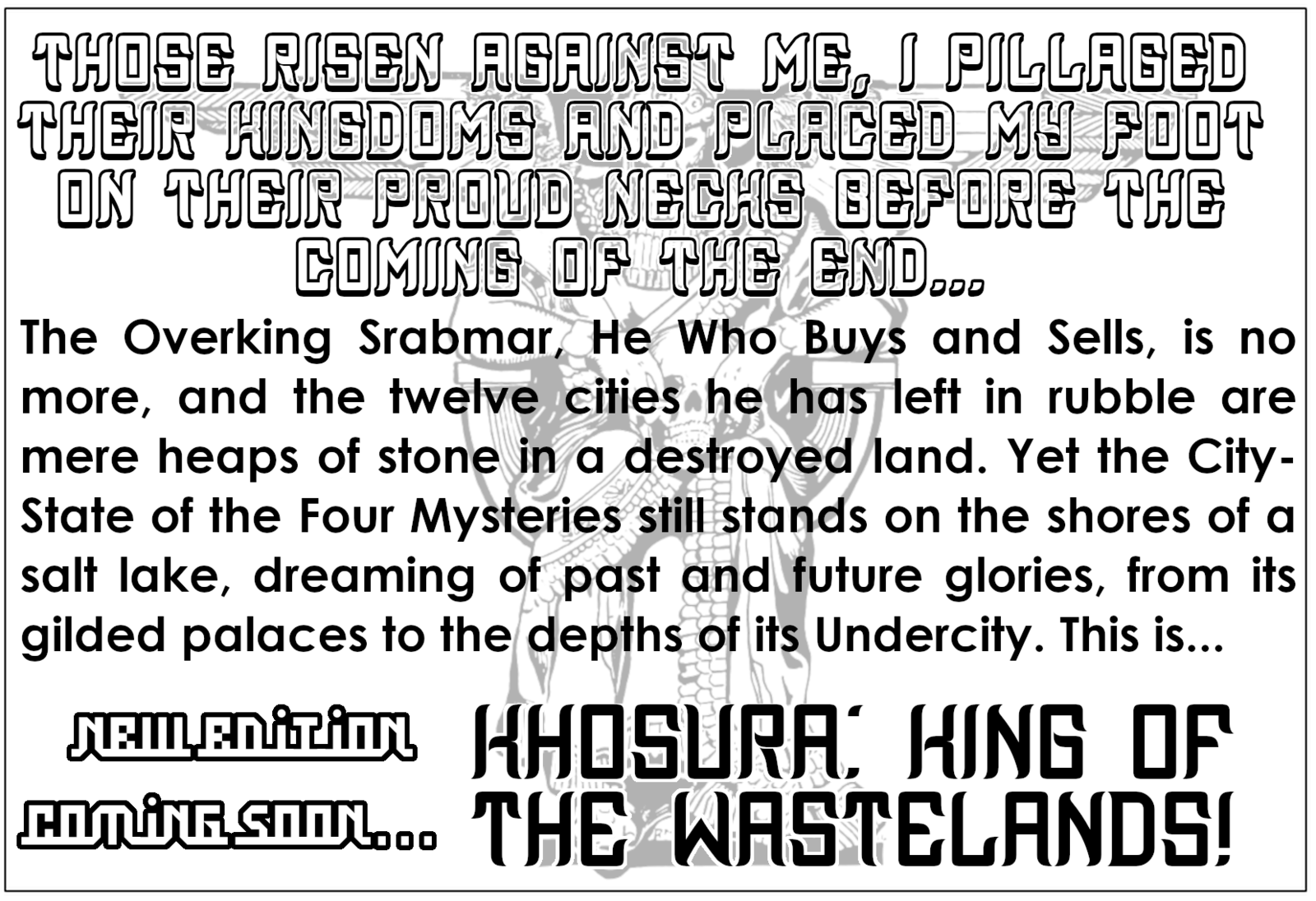
In the English, the main release was Khosura: King
of the Wastelands. It got delayed (mostly because of the need to wrap
up Sword &Magic, an expected time-sink that turned into the customary even
larger time-sink), but in the end, it turned out fine. I have been very happy
with the illustrations and cartography; the contributors did a great job on
these. Khosura is the sort of regional sandbox I have long wanted to release,
with a combination of city, dungeon, and wilderness adventures. Perhaps the
best balance is smaller modular adventure/setting materials and the occasional
large book like Khosura (first released in bits and pieces over multiple Fight
On! issues). Khosura opens the door for further Fomalhaut stuff; a revised
players’ gazetteer first (the one in Fight On! is from 2008), and others later
(Urmalk the Boundless in
Echoes #12 was the first thing from the most recent campaign to see the light).
I also published an issue of Echoes,
although it could have been two – the next one’s probably for early next year. Chomy’s
No Artpunk winning Webs of Past and Present
received an edition, along with Cloister of the Frog-God and
Drifting Lands, a
campaign gazetteer for the setting where Erillion, the Twelve Kingdoms, and
Kassadia are set. This has been a fairly good year, all things considered.
![]() |
| "The Keep on the Borderlands for Assholes" Rides Again |
Old-school gaming started as a highly specific thing: a movement to rediscover old D&D versions, play styles, and design concepts. There was always slightly more to it – Gamma World and Encounter Critical were early examples of non-D&D systems that fit into this sphere – but ultimately, it was about identifying and separating a distinct form of gaming that was very different from the modern mainstream. Over time, as the concept of old-school games broadened, the “OSR” became something that could be about anything as long as it was tentatively connected to the mechanics, concepts, or overall vibe of old D&D; or not even that. The term became meaningless, and “anything goes, everyone is welcome” just led to the consequences these phrases always do: an unintelligible mess. Whatever meaning the OSR label had was lost.
Fortunately, this trend has not led to the complete dissolution of old-school gaming. On the contrary, the fascination with this particular tradition has been revived in smaller, more precisely focused communities. This involves a return to the original creative wellspring, but ironically, also the early old-school gaming of the 2000s, a “revival of a revival”. This took a few years to re-emerge in a coherent way, but these centres are now sufficiently strong and lively again to sustain activity, organise contest, and cultivate excellence in old-school gaming. There is a renewed community in place that’s smaller, but just large enough to occupy a good place on the hobbyist / small press boundary, and strongly quality-oriented. The Classic Adventure Gaming Discord in particular has become a good hub for both old hands and new people, and maintains a high signal-to-noise ratio.
This community
is not wide open. It is a walled garden, or perhaps a stronghold on the borderlands,
standing proud against the lowly horders of the Mörklings and other artpunk mutants.
Jokes aside, while the OSR became a movement about “anything”, CAG is about “something”.
It has more strongly defined preferences about doing things, and hews closer to
the original games, particularly Gygaxian AD&D. That carries the spirit of
exclusion, of setting boundaries, and of more strict definitions. There are
gates that are being kept and watched. Some things don’t belong neatly, or at
all. This is the price of emphasising the specific, but also the precondition
for maintaining a distinct creative vision. This should be familiar to observers
of the modern world in general: communities have to be a bit defensive and a
bit active in policing their boundaries to maintain their cohesion against the great
flattening and interchangeability of hyper-globalisation. This offers benefits
of cultivating something not found elsewhere, something with its own flavour or
intellectual distinction, and a community capable of making something high-quality.
Anyone can make generic parmesan cheese or dessert wine in industrial quantities,
but proper Parmigiano Reggiano or Tokaji are a cut above the rest, and they are
that way because there are limitations and quality standards in place with
respect to who can make it, and how. These qualities deserve protection.
![]() |
| A Tough Nut to Crack |
Striving for excellence in the emerging CAG community has been particularly fruitful. No Artpunk has emerged as a module writing contest with a strong creative vision, a healthy competitive spirit, and a relentless dedication to quality. NAP-III, dedicated to high-level adventuring, has produced 700 pages worth of strong material in a neglected genre. This is a return to AD&D tradition, a lot of which was dedicated to levels 9 and up. It was reinvigorating to rediscover low-level “survival D&D”, but it is just as exhilarating to see powerful characters operating in a complex, highly challenging environments. The contest provided just that kind of material, in spades. While Prince of Nothing (who should be known as King of Nothing based on recent developments) will be taking a break from running the contest this year, NAP has a worthy successor in the Adventure Sites Contest (although these are short-form adventures, which do sacrifice some worthwhile complexity). Standalone adventures, drawing on CAG principles, are now starting to appear.
Other signs of revival are also afoot. In Europe, Cauldron Con is now in its second year, and set to expand in 2025 after running out of space in 2024 (available registrations were filled up in a few days, leaving only a long waiting list). Fight On! has finally returned from its long slumber, riding on a mighty purple worm while being pursued by dragon-riding adventurers. A strong issue #15 has been produced, and #16 is in the works. It is delightful to see it back, and particularly that it is not an afterthought or a nostalgia ride – it is just Fight On! as it has always been.
There are challenges left. There is the risk of dilution – expanding too quickly but losing the culture, as had happened before. However, the main one is found in the dominant communication platform. Discord is an excellent venue for real-time discussion and building a community; however, it is less accessible than forums and blogs if you are not on that particular server, or you have missed the last few weeks’ talk. This is a structural weakness that has also affected 4chan’s /osrg/ megathread, which has a good focus, but little preserved memory. You can dig up Dragonsfoot, K&KA or OD&D Discussion threads from 2005, but Discord talk from three weeks ago is just gone. This places a long-term emphasis on actual, published materials which can stand the test of time, and on codifying what is being discussed in zine articles, well-reasoned blog posts, and other kinds of effortposting.
What works for our new domain, though, is its scale: it is small enough to be personal, relatable and cohesive, but large enough to leave a footprint and provide value to the participants. Gaming is rooted in friend groups organised on the bottom-up principle and voluntary association, and this spirit of camaraderie and fruitful exchange is what makes creative communities flourish. May ours withstand the great tests, and achieve even greater glories! Here is to new horizons!
![]() |
| And we shall look at the OSR in the sun from the Salisbury Plain... |
![]() |
| The Hall of Mirrors shifts... |
This blog started on 5 August 2016, making early August the time of the year to engage in stock-taking and irresponsible conjecture. Adjusted for inflation, this means early October. This will be a slightly laconic report: most of the things I have to say are fairly close to last year, and I don’t wish to repeat myself too much.
This year, Beyond Fomalhaut’s activity amounted to 28 posts, which seems to be the constant (the last two had 29). 18 of these were reviews, and that’s not including the stuff I read but didn’t review. Pattern recognition has helped a lot in weeding out much of the dreadful stuff, but from the clunkers that have snuck through, there would have been no joy in eviscerating most of them. I also failed to review some genuinely good material, including titles recommended by their authors. For that, I apologise: sometimes, the stars are just not right, or I didn’t have much that was worth saying.
On the average, the 19 reviews scored at 3.3, slightly above the seven-year total average of 3.11. Some of this year’s best have come from edited collections. The No Artpunk Contest has produced a high-quality lineup this year, and I haven’t even finished reviewing these adventures. One time can be luck, but two times is skill, and skill can be improved and honed through the spirit of competition and self-improvement. In the Hall of the Third Blue Wizard was more of a mixed bag, from really strong stuff to one of this year’s worst efforts, but I can see it becoming another collection worth watching. Among the other titles, we can see the continuing trend where the shovelware people have largely moved on from the core of old-school gaming towards more distant systems, so a lot of the crap has just disappeared.
Here are the year’s results and special highlights:
All in all, this was a good year for well-made adventures, and the variety of styles is good to see. It would be decent, though, to see the same quality in wilderness and city adventures, or even good situation-based scenarios. This is underexplored territory, on which more later.
![]() |
| Sword & Magic Covers by Peter Mullen and Cameron Hawkey |
This year, EMDT released eight titles, with two more to follow next weekend. Some of these are major Hungarian publications: the Hungarian Helvéczia boxed set with two regional supplements last December, plus the soon-to-be-published Sword & Magic are the key titles. This sort of took the wind out of my sails elsewhere, so the zines have been more modest. I published one issue of Echoes (although a fairly thick one), the second issue of Mr. Volja’s Weird Fates, and two modules: The Forest of Gornate and Istvan Boldog-Bernad’s excellent low-level death-fest, The Well of Frogs. Gornate has received a Czech edition, and Outremer Ediciones has recently concluded a successful Kickstarter for the Spanish release of Castillo Xyntillan.
The largest undertaking of 2023 has been the second edition of Sword & Magic, a slow-burn project finally reaching fruition. The original edition of the game was published on 15 October 2008 (a few days after the similarly imaginatively titled Swords & Wizardry), and the release of the new one is planned for 15 October 2023, exactly 15 years later. Writing and producing two thick hardcovers (168 and 268 pages, respectively) and a 80-page regional supplement is no laughing matter even if it is a revised edition, a lot of groundwork has already been laid, and I had the Riders of Doom on my side to give advice, do thorough proofreading, and help shape the rules from the broadest to the most obscure. It was exhausting, endless, and it feels really good to see it done. What remains now is to receive the bound books and start shipping.
This game shall not be translated – there
are enough old-school systems to pick from, and translating, producing and
supporting Sword & Magic in a second language would be beyond my
means. However, that does not mean there will be no dividends for the
English-speaking reader. The second volume is planned to see release as an
OSRIC supplement under the title Gamemaster’s Guidelines Beyond Fomalhaut.
This will be a comprehensive guidebook to creating and running old-school adventures
and campaigns, ranging from basic and advanced GMing techniques, optional
rules, to an in-depth coverage of adventure design, campaign management,
fantastic worlds, and even a simple mass combat / domain management system (it
is not ACKS, but it is mine). The guideline section is supplemented with
several monsters including extensive random encounter tables; treasures of all
sorts, and several random inspiration tables from adventure concepts to
fantastic civilisations, curses, islands and that sort of thing. The idea is
something offering practical help for novice GMs getting into old-school games,
and further advice and a smorgasbord of stuff for experienced people. The book’s
Hungarian version is written, illustrated and laid out, so there is a completed
manuscript there that “only” needs to be translated and slightly revised for
the international audience. Now that is 268 pages of “only”, which is an
obstacle. I cannot promise a fast-tracked release with my day job and other
projects, but as they say, “I’m on it”.
Potion of Extra-Barbarism
In the “wanted to do but didn’t” category, we have Khosura: King of the Wastelands, the much-delayed city and wilderness sandbox module. This is another case of “only”, where a lot of the work has already been done, but the plans for Q1 2023 proved fabulously optimistic. Perhaps a year later would be workable?
![]() |
| Final Proofs With Small But Obvious Error |
This year seems to be continuing previous trends, which are not as exciting as grand upheavals and radically new stuff, but sometimes, this sort of quiet rebuilding is for the better. It does make for a shorter closing section, too, but them’s the breaks. For years, old-school gaming was drifting apart and losing focus, slowly diminishing its value. That process is probably complete. On one hand, this produces games which offer a lighter form of old-school gaming, tempered with the aesthetics and design concerns of games like 5e. The success of projects like Shadowdark and OSE / Dolmenwood demonstrates the demand for these middle-of-the-road solutions. These are probably ideal for disgruntled 5e players who are looking for something simpler and more free-flowing, but they will somehow have to find a way to preserve the virtues of old-school play from the influx of dysfunctional playing practices and the deluge of shovelware that success brings.
To an extent, you can also see some old hands returning to the scene: a new edition of Swords & Wizardry has been published (and don’t overlook the AELF License it comes with – this is the quiet background work you would only notice if it was not there); Labyrinth Lord and Dragonslayer seem to be focusing on B/X in their own way, and there are rumblings around OSRIC as well, with a new edition targeted as new players instead of publishers, and solid VTT support in Foundry. Adventurer, Conqueror, King is getting a second edition, and Sword & Magic also fits into the trend. It remains to be seen how much creative energy these projects can muster. The specific challenge they will have to navigate (and this is one I am acutely aware of) is that successful Kickstarters catering to a base of collectors is not quite the same as relaunching living games which produce healthy creative communities and good offshoots. Shiny new games have a starting advantage here, while second editions, reprints, and expanded editions have to play to slightly different strengths to succeed in the long run.
![]() |
| A Voyage to Thellas With Seven Voyages of Zylarthen |
As a third group, creative communities with a renewed focus on the core of the old-school experience are also thriving, in smaller size and a less commercial form. This is no longer the same as the OG old-school community found on Dragonsfoot, Knights and Knaves, or the OD&D Discussion forums – all of which have largely fallen quiet over the years – although it shares some people and objectives with these places, and it resembles them in their heyday. Their members were often people discovering old-school ideas as a fresh thing, and they have moved from this rediscovery to self-improvement and continuous refinement. Things like the No Artpunk Contest or the Classic Adventure Gaming podcast (which now has a promising discord) are two examples of creative efforts coming from these places, but there is more. These are not large endeavours, but many of the guys involved have a high batting average, and this makes their materials trustworthy – you can expect something good when you come across their adventures, even if the production values are homemade and there are occasional weird spots. Even some of the best adventures from In the Hall of the Third Blue Wizard come from these quarters.
There are still places which are not explored sufficiently well by this latter group. They have gotten great at dungeon design, but much fewer have tackled wilderness scenarios, and only the mighty Buddyscott Entertainment, Inc., has delved into cities (as far as I can tell). Nobody has really made a properly old-school situation-based adventure that does not suck. The NAP-II collection was overall very solid, but it was all dungeons. In this sense, Fight On! and Knockspell magazines had more to offer, and Dolmenwood promises yet more. I would love to see a wilderness pointcrawl, a complex sandbox area, a strong open-ended city adventure (in the vein of Istvan Boldog-Bernad’s Shadows of the City-God and Well of Frogs – OK, I published them, but I published them because Istvan is the absolute master of this sort of thing), or a setting gazetteer. The NAP-III collection’s focus on high-level adventuring should deliver good content in an underserved area (hopefully some extraplanar material as well), but perhaps there should be room for a “Not a Dungeon” contest, too.
So that’s where it stands now, I think. Work in progress, some of it looks like a pile of stones and timber, but it is getting better where it matters.
Get to work, dogs!
![]() |
| Motivation Will Be Provided |
We have very good news! You have just won a CAR!!!* The CAR* will be made available to you completely FREE of charge for the next two weeks, after which the General Terms and Conditions will come into effect. You are free to use the CAR* either on routes we recognise, or on routes that do not conflict with the provisions of current or later versions of the General Terms and Conditions. We REALLY want you to enjoy the freedom of DRIVING WITH US! ™ Unfortunately, many people abuse the freedom of DRIVING WITH US!™, so we are forced to reserve the right to terminate the CAR GIFT CONTRACT of those who would abuse it. This is for your benefit.** By signing the CAR GIFT CONTRACT, you agree not to pursue any legal action or other claims against the issuers of the CAR GIFT CONTRACT. We reserve the right to alter the CAR GIFT CONTRACT and the General Terms and Conditions at our will.
With the CAR GIFT CONTRACT entering into force, your previously purchased passenger vehicle will expire, and its ownership*** will revert to our company.
* As stipulated in
our draft contract, the definition of “CAR” is “two rear-view mirrors and a
carburetor.”
** The relevant
criteria are contained in the current and later versions of the General Terms
and Conditions, as defined and interpreted by our current and future employees.
*** According to
the provisions of the General Terms and Conditions, “ownership” rights belong
to the party issuing the CAR GIFT CONTRACT.
![]() |
| C'mon, buddy. Just sign the contract. |
[This is obviously not gaming related.]
That's terror.
With one of the larger swamps drained and the political commissars dismissed, the grift ecosystem will become more competitive and overcrowded, while gaps in the enforcement system emerge. If more companies and institutions did something similar, it would overwhelm and implode the control system. Since it could not feed its army of woke enforcers, it would not not be able to successfully harness its own distributed network as an effective weapon against single, isolated targets. In the last decade, the managerial elites have, in effect, successfully centralised the distributed systems of the Internet, and gained dictatorial power over the individual, and even the individual organisation. Whether this is a coordinated effort by the managerial elites or an end result of impersonal social forces (or more likely, the former exploiting and leveraging the latter – large-scale social "hacking"), this is where we have been heading.
An uncontrolled Twitter alone does not win the war for a free Internet, but it allows people to actually fight battles, which they currently can't without swift and brutal counter-action. There is a good reason platform ownership is so important to the managerial class. A reformed, reasonably open Twitter would be a constant hole in their control scheme, from which further cracks could spread outwards, and which would allow their opponents to speak up and organise.
The totalitarian Chinese-style information management model they desire cannot exist in a free society, because then their leverage, the ability to snuff you out for non-compliance is gone. Individuals could just walk away from them or say "nah" to their unhinged demands. Imagine campus radicals in an environment that is even halfway like the 1990s. It just would not work, because their views are weird and repugnant to normie. It would be hilarious if they couldn’t just terminate you for even laughing at them. If Twitter is indeed opened up, other companies may also get the idea that the whole ESG/Blackrock/woke control model is harmful to their interests (a lot of them obviously think so privately, if only because it restricts their own power). It is not the beginning of the end, but at least it is in the end of the beginning.
This is why the
Twitter deal is so significant, and why it will be good even if Based Freeze
Peach Man is not going to deliver on every hope people have pinned on him. (It
is itself an abnormality that so much hinges on the whims of one super-rich
guy, but there you have it.) At least he gave us a battleground and a fighting
chance.
Yes, JC. In fact, I do.
If you read this in the Deus Ex Liberty Island Guy voice, you are not off the mark. We all live in the world of Deus Ex now – but that is for another post.
[Note, as an
exception to the normal way things are done on this blog, this post is not open
to comments. You can notice the irony. In
a free world, such decisions and disclaimers would not be, and perhaps once
will not be necessary.]
![]() |
| An Autumn Landscape |
This blog started on 5 August 2016, making early August the time of the year to engage in stock-taking and irresponsible conjecture. Unfortunately, duties at my day job have haunted most of the year (and continue to usurp valuable time I could spend blogging), so here we are. Autumn is the best season anyway.
Beyond Fomalhaut’s activity this year was as much as in the last: 29 posts, of which 19 were reviews. Obviously, I am being left in the dust here by Messrs. Lynch and Nothing, but a good many of these reviews were long-form discussions of really complex, good stuff, which took time to think over and grasp properly. These also reflect changes in old-school publication patterns, where activity has decreased, but size and complexity has gone up (more on this later).
The average score for the 19 reviews ended up at 3.3, above the six-year total average of 3.09. It was a fine catch, and there are multiple reasons why this is so. First, selection bias. The No Artpunk contest has raised the average: this was a bumper crop of adventures by people who either knew what they were doing, or were making a jolly good effort to Git Gud. Two of the top scores came from this contest, and three more were in the “very good” category. Even the mid-ranking ones were clearly ambitious and showed signs of promise. The second reason is that the market has become cleaner; a lot of the grifters and shovelware artists polluting DriveThruRPG have departed for other lands, and pattern recognition makes it ever easier to avoid the releases which will inevitably be disappointing. These are still reviews of things I hoped to be good. The third reason is related to the second. Zinequest is winding down after the absolute winners who were making a lot of money on it cancelled the guy who was running the programme at Kickstarter (here, I refer the readers to the immortal Snake Poem), and the alternative game jams have not created much of interest to old-school gamers.
So here are the results and the highlights:
As in previous years, man proposes, God disposes: there were a few books I promised to review but didn’t. I will try to get to these reasonably soon. And again: sometimes, the reviewer reads something and has nothing to say that has not already been said. Some of the high-profile, oft-discussed projects have therefore not received their due – they were good or they were middling, but other people already explained why.
![]() |
| Old-School Gatekeepers |
Last year, EMDT released six full titles (and three more which were a part of larger releases), including two boxed sets; this year was invariably more modest with four. One of these was a Hungarian Helvéczia module, Isle in the Mist, a fairy-haunted locale. Mr. Volja also completed his first adventure compilation, Weird Fates, vol. 1, which collects four one- or two-session scenarios. These are a different style of old-school than what I tend to do; more whimsical and improvisation-oriented, but a lot of fun at the table. Volume 2 has now been drafted and awaits editing, and a third volume is at the concept stage. So on my side, two issues of Echoes were published. These are both heftier volumes, and I have been happy about the range of materials therein. Unfortunately, no new issues are expected this year, but #11 is in its early stages.
Other people have been more diligent. I am really pleased about the release of Helvéczia’s Spanish edition, a mighty effort by Outremer Ediciones. Tackling the hardcover/boxed set combo is a project with many moving parts, bottlenecks and unexpected challenges (I can attest to it), but they did it, and the final result is a beauty, so I must thank them for their hard work. As I understand, people have already started to develop their own ideas and materials for the game while Outremer was demoing it, and a domain management system, as well as a regional supplement are in the works. If you create a game, you really cannot ask for more. Since Spain is the original homeland of picaresque novels, it will be fascinating to see where these ideas will go – hopefully, we will also get to see them in English some day.
It is also great to see that The Vaults of Volokarnos has received a Czech edition, where it is being sold along with the Old School Essentials boxed set. This is doubly pleasing not just because you get to see your work receiving a release in another Central European country, but also because this adventure was specifically written as an introductory dungeon for novice players and gamemasters – all the while trying to introduce not just standard dungeoneering tricks, but the scope, difficulty and complexity of old-school dungeons. Volokarnovy katakomby – as the title goes in Czech – is labelled with the “K.O.S. 1” letter and number designation. I sincerely hope there will be more from Czech designers, in one way or another, for the same reasons mentioned with Helvéczia: it is bound to create something new, interesting, and hopefully good.
![]() |
| The Spanish Boxed Set (image courtesy of @websterfreeman_) |
Last year was the time when large projects that took years to complete were realised. This year was a time for more sowin’ than reapin’, and sometimes, progress can be slower than you would like. Accordingly, a lot of my efforts have gone into the Hungarian edition of Helvéczia, where I have set myself a firm deadline for this December. This involved a lot of editing, some translation, and the logistics of production. Thankfully, my printers are a real help, even if the owner’s Helvéczia character was swallowed by Hell along with his horse in the mountain pass of Hohenwart after failing to settle a debt with the Devil. Of potential interest to English gamers is that the Hungarian edition will feature a different regional supplement than Ammertal and the Oberammsbund (which was already included in the original 2013 boxed set), along with a new set of adventures. All of these will be translated in time. Likewise, I have a partially translated adventure collection, and this will also be coming in 2023.
![]() |
| Khosura Rises... |
My other big plan for the year which did not come to fruition has been Khosura, King of the Wastelands. This is a regional supplement for levels 3 to 7 (or so, it really depends on how the players approach things, from careful infiltration to all-out action), describing the eponymous city state, its vast and interconnected Undercity, the surrounding wastelands, and multiple smaller adventures set therein. So, a sword & sorcery sandbox with lots of sand, both literally and figuratively. About 75% of this stuff appeared in various Fight On! magazine, while the rest comes from old campaign materials. Khosura is fairly far along, with a splendid cover and some really nice art pieces already coming in, and cartography and writing in progress. If it were not for real life-inflicted delays, it would be an Autumn release as a hardcover with a map envelope; as it goes, it is planned for Q1 2023. Escape from the Pits of Lamentation, delve into the Tomb-Complex of Ymmu M’Kursa, plunder the Tower of Birds and navigate the ancient customs and rigid laws of the City State of the Four Mysteries – as barbarian conqueror or decadent thief, priest in a city of jealous gods or shadowy illusionist in a land of mirages!
I have one more English release planned for 2022 – and again, it is a firm one, with a self-imposed deadline for early December – and that is The Forest of Gornate. This is a large wilderness pointcrawl set around the same city as Shadow of the City-God, and one I am particularly proud of (particularly as I used to have doubts about the pointcrawl format, and I think this one is actually good). It fell through the cracks last year, but now, it is going to be done. The Four Dooms of Thisium still lies in a distance. We will get there, eventually.
I also had the opportunity to have my picture taken with Dr. Peterson and perhaps a zine, but while this idea had some attraction, it also felt vaguely ominous, plus it would have also cost me more money than realistically worth. So that didn’t happen, but we did hold a Zine Summit with Messrs. Ignatius Umlaut and the Settembrini clan in Café Erdős, a decent place in Budapest, after hosting Ignatius for the opening game of our new Seven Voyages of Zylarthen campaign. I think this was a better idea.
![]() |
| Me and the boys meeting the Artpunkman foe. Deus Vult! |
It happened subtly, and you can miss it if you don’t look in the right places, but there has been marked improvement in old-school gaming over the last year. Simply put, there is less stuff, but more of it is good, mainly thanks to a bunch of relative newcomers putting an honest effort into understanding the craft of classic games. For a few years, what used to be called “the OSR” became so broad and unfocused that it had also become diluted. Success brings its own problems, and having to become a vehicle for every idea under the sun, only linked by a vague aesthetic (and since the dreadful, twee Corporate Memphis nightmares have taken root in some corners, not even that), led to a loss of the core identity of the old school. To quote someone I often agree with, “A game style that can be anything ultimately does not mean anything. It has no point to make and no strong features to distinguish it and give it a peculiar charm, a creative edge”.
![]() |
| The OSR, 2022 |
The actual news is that if you look carefully, you can see the first products of a reinvigorated, smaller but more youthful old-school scene. People who often had zero contact with pre-d20 D&D have been discovering the classics, and getting acquainted with the actual design principles and aesthetic behind them. This interest, fortunately, goes beyond simply using a generified B/X, and extends to understanding the finer points of the advanced game, the underlying logic of old-school adventure design, good campaign structures that transcend the level of adventures (West Marches-style games are an example), and the practical issues of gameplay. Actual play-based communities in turn produce not just a common knowledge base, but better supplements that serve actual play as well. The big picture starts to re-emerge.
Some of the commercial ground has been ceded. Hobbyist DIY efforts are not always glamorous in their presentation, even if they are very solid in their content. This does not make tons of Kickstarter money, but then neither did OSRIC. Even greats like the Heroic Legendarium (which I solemnly swear to review next year) can arrive in the simplest of packaging. There is no harm in books looking good, cartography looking clean, and layout being functional (although Good Layout has become first a fetish, and then a vehicle to sell overpriced coffee table books). But they are no substitute for good writing, and that means both Idea and Craft. Those who master one are standing on a strong foundation, and those who master both can produce the best of the best. Gilded framing does not a great painting make, even if it can enhance its beauty. You can do a great job with the modern equivalent of Judges Guild’s production values, and much of this year’s best has been just that.
The fruits of the Reconquista have already been good this year. The No Artpunk Contest, organised and judged by Prince of Nothing, and attended by 19 contestants, has been a mustering ground for people both learned and learning. The entries were uniformly a cut above the norm, and some delivered outstanding adventures that will be remembered for years to come. It was a contest that invited as much discussion and reflection as it had entries, and it will improve us. This year’s field looks even leaner and meaner, promising a Herculean task to make a final judgement about the best. Some of that effort, in turn, will find broader recognition and produce a new bounty of the Good Stuff. These are promising signs. The uncomfortable question remains (this is something you also ask yourself reading Bryce’s reviews): if the principles of good design can be learned with a little effort, why didn’t so many people publishing “old-school” adventures get even the basics correctly? That’s right. They were too lazy to.
Don’t be those guys. Aim high, practice
your D&D-fu, maintain your castles and together, we can topple Sturgeon’s
Law and burn it to the fucking ground.
![]() |
| Greetings, Warlord! |