Tuesday, 29 March 2022

[REVIEW] Fractious Mayhem at Melonath Falls

The Chair
Fractious Mayhem at Melonath Falls (2021)

by Trent Smith

Self-published

Levels 5–8

Hello, and welcome to part SEVEN of **THE RECKONING**, wherein entries of the infamous No Artpunk Contest are taken to task. This promises to be both a treat and a challenge, as the competing entries were written with an intent that is close to my heart: to prove, once and for all, that the power of old-school gaming is found in a fine balance between finely honed and practical design principles, and a strong imagination. That is to say, it is craft before it is art, and this craft can be learned, practiced, and mastered. The following reviews will therefore look not for basic competence – it is assumed that the contest participants would not trip over their own shoelaces or faint at the sight of their own blood – but excellence. The reviews will follow a random order, and they will be shorter than Prince’s original pieces. One adventure, the contest winning Caught in the Web of Past and Present, shall be excluded for two reasons: one, the author plays at my table (and I have previously played in his one-offs); and two, I am going to republish it in an updated edition. With that aside, Deus Vult! Let Destiny prevail!

* * *

Consider, my brethren, the Parable of the Chair. How simple it looks! On four legs it rests, and a seat and a back it does possess. Naught more does a chair need – and it can sometimes do with even less. How come, then, that so few good chairs are being made, and that those dabblers who can not assemble a simple chair have set their eyes on fancier upholstery, obscuring the fact that the fruit of their work is scarcely fit for sitting on? Falsehood and clumsy workmanship lurk there. But these pretenders are easily unmasked, for their vile tricks melt away at once before the simple command: “Makest thou a good chair!”

Supreme skill is revealed in simplicity. High concept and fancy presentation can conceal faulty game writing just as much as too much spice can mask spoiled cooking ingredients. In a simple, straightforward design, everything is transparent. Can you work under the limitations of the general toolkit? Can you create “good vanilla”? This is a true test (note, not a “one true way”!) of design ability. Consider the deceptive simplicity of Keep on the Borderlands, the tutorial dungeon crawling of In Search of the Unknown, or the plain “orcs in a hole plus some tombs” premise of Borshak’s Lair. They are often dismissed as uninteresting and basic, their popularity only ascribed to nostalgic memories and a large print run (Borshak’s is an obvious exception – it has been virtually forgotten, even though the fanzine where it is found is relatively easy to obtain). Yet that cannot be the cause, as people who are introduced to them in our time, with no previous experience, love them just the same. Truthfully, they are not particularly deep or sophisticated experiences: they are elementary, even primal. Keep was allegedly written and playtested relatively hastily; there is nothing to suggest Borshak’s is anything but a zine article. On the contrary, many have tried to crack the “basic humanoid adventure” code, and failed. Very few remember TSR’s later efforts in this area, and few of the new old-school humanoid lairs have a reputation comparable to B1 or B2 (meanwhile, megadungeons have a modern canon). And this leaves the aforementioned as examples of pure, effortless craft.

The previous considerations serve to make the case for Melonath Falls, a humanoid lair adventure for mid-level characters. A multi-level complex of four, loosely connected caverns behind a mighty two-tiered waterfall, it is a low-key homage to Gygaxian adventure design which does nothing “special”, except do every “simple” thing expertly. A band of xvarts (why xvarts? and why do they crop up so often in great modules?) are operating from the caverns behind the falls, harassing the river and the rough lumber town downstream. The setting is quintessential North American frontier myth: grandiose natural wonders, outposts of civilisation populated by hard men not afraid of getting their hands dirty and ruled by charming individuals named along the lines of “Boss Bowlton” (indeed, the lumber town is scummy enough to present trouble for characters looking for a place to rest and store valuables without getting gutted), and a dangerous wilderness teeming with hostile tribal civilisations beyond the realm of men. Setting is not the main concern of the adventure, although the background it sketches up with a few broad strokes and later backwards references add a layer of intrigue to the baseline scenario.

Mighty!
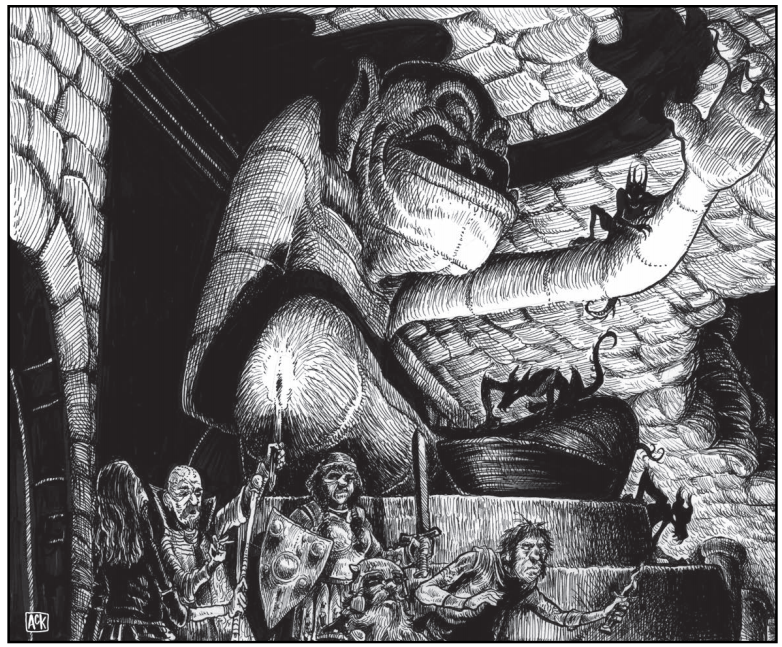
The meat is the network of four caverns opening from the waterfall face. These entrances are connected by various treacherous routes, some obvious and extremely hazardous, and some only made available to players who can think about the environment and don’t fall prey to routines which will just channel them into danger. (While there are diagrams illustrating this all-important front sections, if there is one thing this module would need is a player handout giving the players exactly what they see – the written descriptions are exact, but long enough to miss details.) And here, we get the real core of the adventure: what on first sight looks like a vertical B2 homage in fact works like a WG4-style murder machine, where a gang of relatively weak monsters are operating from entrenched defensive positions to repel and harass much more powerful intruders. The xvarts of Melonath Falls are ready with rocks, harpoons and nets, deceptive and treacherous terrain segments, a freight elevator exposed to observation and missile fire, axes ready to cut ropes in a desperate situation, and a xvart Magic-User with a push spell, one of AD&D’s “never memorise” spells, used here for that “fractious mayhem”. Not quite Normandy, but it will take tactics and party discipline to clear the bottleneck – almost hopeless for a normal force, but then a mid-level party should have just enough extra juice to clear the obstacles with some trouble. Break out that Swiss army knife and get to work on the problem.

Just like the B2/WG4 reversal from fun smurf-killing excursion to deadly meatgrinder, the caverns do not connect quite the way you would expect them to based on knowing previous adventure classics. The two lowermost cave systems are inhabited by incidental monster groups unconnected to the xvart levels, and only connect to the main adventure core through obscure and hazardous connections – or, in the case of cave B, not at all. Adventurers who get it into their heads to just go in through an undefended rear entrance may either not find that back entrance at all, or waste a lot of resources doing so. There are climbing hazards, other environmental dangers, bizarre vignette encounters (a mushroom garden with a very strange gardener), and cleverly hidden treasure. The final cavern, on the top, is a strange enigma and easily missed.

Fractious Mayhem
The main caves are a more conventional environment (your usual combination of barracks rooms, a shrine, a prison, chief’s quarters, stolen good, the mostly unused caverns, etc. – all the common notes are being hit), where the remaining, lurking foes are supplemented with a landscape of finer-grain complexity which are an excellent test of player resourcefulness. Here, you can go deeper and mess around with stuff for fun and profit. Valuables will seem sparse on a surface scan, but some of the non-obvious stuff is rather neat, and it adds up. There are interesting choices to be made – how to get rich on stolen trade goods that are, technically, still owned by somebody, or what to do with loot pieces which are valuable but heavier than their gp weight, or connected to organised crime. The xvarts are allied to a company of shady wererats – mutual benefits, mutual distrust. The rat god may appear in person and give you the smackdown of your life if you mess with his temple (no stats, alas!) These minor touches contribute a lot to the “campaign-level” impact of the module, the stuff that happens afterwards. There are hostages, and a few NPCs to interact with. Unexpected possibilities like triggering a marble elephant figurine in enclosed spaces (ouch!) There is always a layer of very Gygaxian misleading and deception, which draws the players’ attention in one direction to hit them from another (or steer them away from the really good stuff). There are a few spots where it seems a bit “too clever” (a mild case of the “hidden depth” problem you find in RJK modules) – certainly, this is a module for highly skilled players. You have to see behind the façade and notice the odd detail or error in the pattern to get ahead. Some players who are not into this style of play would probably see the module as frustrating, while others would get a kick out of it.

The presentation is utilitarian – mostly clear two-column text, could use the occasional visual anchor because the information density can get very high in tight spots. Italics and boldface were invented for a reason, and were used in the TSR modules to good effect, so why not use them here? Likewise, another editing pass (or even map notations) to add cross-references to show how reinforcements and other forward/backward links work in the caverns would be useful, and even important to the flow – although all this can be added with a little effort. The content, however, is gold, without rushing forward to convince you of its originality – it is just there. It is also highly Gygaxian, but not in a tryhard way. The homage is obvious, but the personal take is clearly there too. Here we return to the chair analogy: if Melonath Falls was a chair, it would be the unassuming hand-me-down your eyes might skip over when appreciating the décor, but after a few hours of sitting, you would get up without any discomfort or back pain. How odd… A chair for sitting? Who has heard of such a thing?

This publication was not playtested (the author ran out of time due to the contest deadline), and it would no doubt be a little tighter if it was. Still, a mighty good effort.

Rating: ***** / *****

Saturday, 19 March 2022

[REVIEW] Reckoning of the Gods / Into the Shadow Realm

Reckoning of the Gods /
Into the Shadow Realm
Reckoning of the Gods / Into the Shadow Realm (2019)

by C. Aaron Kreader

Published by Studio 9 Games

Level 3

Dungeon Crawl Classics is its own little world in old-school gaming with its own adventure design standards. Open-ended campaign play is the established ideal of old-school gaming; a polished tournament experience seems to be what DCC fans like most. These are inevitably generalisations, but they are true enough to form a pattern. DCC’ success is partly rooted in its heavy convention presence, and this is also this experience that the modules tend to champion. Just like TSR’s tourney modules had a profound effect on how AD&D was seen and played in the 1980s, so have tournaments tempered our image of DCC: a large emphasis on funnels and lethality, high-concept settings drawing from pulp fantasy turned up to eleven, a degree of linearity (where maps serve more as illustrations rather than a depiction of territory), and a focus on inventive set piece encounters instead of, say, exploration procedures. Many of these assumptions carry over to Reckoning of the Gods / Into the Shadow Realm, a double module released as a third-party product.

Reckoning of the Gods is a personal project, since it was not only written, but extensively and professionally illustrated by C. Aaron Kreader. These production values, while not the subject of this review, would be lavish even for an official Goodman Games release; and if you own the PDF version, you can easily use the illustrative materials to create a whole illustration booklet for your game. There are three illustration-maps, all of custom make. Impressive stuff.

Dare you enter my magic realm?
The module itself is split into two sections. In the first, the characters have been sent to brave the home of an insane and powerful magic-user who has offended the gods, and must therefore be righteously punished (the adventure hook involves a divine “or else” quest). The home of Moxicotl the Great is a trans-dimensional puzzle dungeon / gauntlet where physics, realism, and, indeed, the very laws of interior decoration are mere toys for a deranged sorcerer. We see the principles of DCC’s design in play: no effort is wasted on empty space, or even side tracks.  Every encounter is a meaningful “special” room (setpiece encounter), and everything is in the realm of high fantasy (both in the “powerful magic” and the “bong wizard” sense). It follows in the tradition of White Plume Mountain and The Ghost Tower of Inverness by cranking up the heat and never relenting; quick, decisive action and puzzle-solving are required to get through successfully. The adventure starts with the characters getting dropped into a deadly field of poisonous flowers, followed by magical platforming, a hothouse with living plants, a reverse-gravity room with a floor pattern puzzle and an upside-down treasure chest, a waiting room with more than meets the eye, and a timed confrontation with a devil in a room that’s on FIRE while your characters are probably trapped in a hanging CAGE. All in a day’s work – and that’s just the first stage of a third-level adventure. High energy or high calories? Depends on how you like your poison – but it is strongly oriented towards concentrated action and high stakes.

The second adventure, Into the Shadow Realm, is the section where things become even more interesting. Having been transported to the volcanic peak known as Mount Karkaroc in pursuit of the dragon’s hoard Moxicotl was looking for, the characters must navigate two parallel dimensions to reach their destination. The Maker’s glove, a magic item obtained in the sorcerer’s workshop, allows the party to shift from plane to plane, between the active volcano and its dark simulacrum in the Shadow Realm. Where they find their progress blocked or hazardous in the real world, they can try their luck on the other side… if they can learn the other plane’s peculiar laws and hazards. This second adventure is still quite linear, and does not fully exploit the potential of the wondrous glove, but there is a good effort being made to make the ride interesting, and open up things a little. Here, the fiery realm of the active volcano is contrasted with a dead night-world; both sides containing the ruins of a dwarven outpost with the lair of their respective dragon – the fiery and treacherous Woetalon on one side, and his projection, Wurmshade, on the other. The encounter areas are written in duplicate with different challenges on both planes – a handful if we add it up, but making for a relatively small, although dense dungeon if plane-switching is kept limited. Fighting the dragons is a sucker’s bet, but there are good options for just making off with part of the hoard… with severe consequences for those who get caught.

That Guy, Again!
This double module embodies both the good and the bad of DCC. It dares to be fantastic and play with high magic. The encounters are well planned out, with room for puzzle-solving, environmental challenges, plus a whole lot of meticulously choreographed combat. The multiplanar expedition is inspired, especially once Into the Shadow Realm gets into the wild combinations and plane jump hijinks you can come up with. There is no point of the adventure where it really lags. The flaws are also typical for DCC. It is very linear, and while creative problem-solving is involved, there are strong rails keeping you on track. I hate to break it, but if your map works as an illustration, it is probably not a very large or complex map (that’s beyond “Wow Loops Non Liner!!!”). One comes away with the idea that the module is stronger on the individual encounter level than the structural level where the pieces come together. But that’s also a common DCC problem.

The premise itself is a railroad, and at the end of the adventure, your plane-hopping item is snatched away by the jealous gods before you can plan those sweet heists you just wanted to pull off, while even your memory is wiped of the preceding events. That’s disappointing. Perhaps a charged item would be less obtrusive than divine dickery? Finally, it is a bit too much at once. Fantasy and verisimilitude have a tricky balance, and while I usually advise people to err on the side on the side of the former, this is an adventure where a little less could have been more. This adventure is about excess, not restraint. If you like tournament-style gaming that’s heavy on the magical puzzles and energetic combat, it will definitely be “a polished tournament experience”. Altogether, decent and functional.

This publication credits several playtesters, as well as multiple GMs and editors. Indeed, the resulting text is polished, and the editing is conspicuous by the lack of obtrusive segments. This module should be easy to use at the table, without any weird layout wizardry.

Rating: *** / *****

Wednesday, 9 March 2022

[BEYONDE] The Book of Gaub (2021)

The Book of Gaub
The Book of Gaub (2021)

edited by Paolo Greco, with contributions by Charlie Ferguson-Avery, Evoro, The Furtive Goblin, Isaak Hill, John Gregory, Rowan A., Paolo Greco, and Jack Shear

Published by Lost Pages

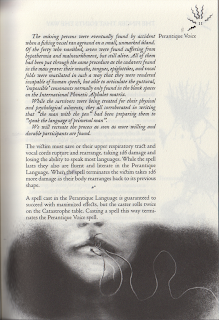
This is not a review of a creepy spellbook-supplement-thing: I lack the familiarity with modern occult horror games, especially those which inhabit the more obscure corners of old-school gaming, to write a proper one. While The Book of Gaub uses “OSR” style statistics, it is for all intents and purposes outside the scope of D&D-inspired gaming as most of us understand it: therefore, the following post will be more recommendation than proper criticism. Essentially, The Book of Gaub is a grimoire of stuff for horror games set in the 20th century, accompanied by several “micro-fictions”, or small pieces of flavour text. The tone and content mainly recall the antiquarian horror stories of M. R. James (although with more blood and guts), the grotesques of Franz Kafka, and some of the more recent horror writers; it avoids associations with the Mythos, although you could use it as a basis for a good Call of Cthulhu campaign to replace tiresome Old Squidface.

Who is the mysterious Gaub? Not even this book tells us; we only get to know him by way of a creepy hand with seven spindly, crooked fingers (including one that “does not, will not, and has not existed. Ever”). These charmingly named fingers (“The Finger Under the Floorboards”, “The Finger Gnawed to the Bone”, etc.) are associated with 49 spells, a handful of creatures, occult items, and magical phenomena. Mr. Gaub has certainly been around, and you can find his handywork in many unwholesome events. The setting around the hand of Gaub is a modern world of gloom, of deformities and medical horrors, of abandoned houses and sickening, miasmatic urban environments, of sadistic authority figures and reclusive malformities.

No Pain, No Gain
Most spells in The Book of Gaub are specific enough and weird enough to carry the premise of a whole adventure; and since each is accompanied by a small vignette of a story, many of them come with a basic idea sufficient for an adventure hook or at least element. Herein, we find spells such as “Perdivagrant” (all of them have strange, fanciful names), a spell that leads a lost company back to a known starting point, while travelling through strange and unsettling landscapes; “Pamphagous”, which evokes an insatiable hunger in the target that will probably lead to horrible consequences; “Orgiophant”, which results in a terrible proliferation of extra limbs on the hapless victim; or “Lichoscope”, a reanimation spell that only preserves the animated corpse while the caster keeps looking at it (much to the horror of the intellect now once again inhabiting it). As seen above, the spells become useful in specific situations you often need to set up carefully beforehand (not unlike the magic of Helvéczia), and many of them are closer to plot devices than direct utility magic. But on their own, they are creepy and highly imaginative. (Props to the authors and the editor for the consistent tone and unity of vision.)

The book is more than a simple grimoire. Each of the different fingers have associated occult paraphernalia: “a doll made of hundreds of burnt matches bound together” (will snuff out fires, but requires the owner to start fires or it will go and make one of its own); “a dull stethoscope that does not work” (but it will scream if used on an injured or diseased area); or “a ring of 2d6 skeleton keys” which will cause doors locked with them to disappear and leave behind a barren wall. There is a table for 100 magical catastrophes (which might result in the stars taking an unpleasant interest in the caster, a being of luminous beauty visiting during his or her next rest, or a premonition of being followed by something).

I was particularly impressed by the imaginative selection of monsters: the Corner Beast (whose glimpse you might just catch out of the corner of your eye, and whose presence is not registered by careless bystanders even if it kills), the Squeak (an enormous conglomerate of dead rodents resembling a rat king, eager to devour everyone in a house and identified by “too many mouse holes”), or the Dear Reader (this book-shaped monster not only reads YOU, it trades secrets in exchange for other secrets and blood). The monsters come with minimal stats, but useful descriptions describing not only their abilities, but their wants, the omens that betray their presence, and their use in occult stuff (for example, the Squeak can be fashioned into a handkerchief which can imbue liquids it is dipped into with potent, deadly rat poison). Finally, a collection of adventure hooks is also offered – maybe a bit hit or miss, but where they hit, they hit.

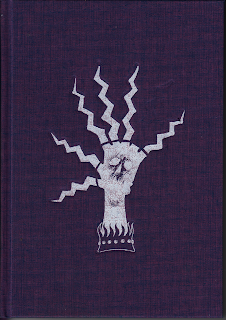
The Book of Gaub looks the part of an occult folio you might find in the seedier kind of bookstore, bound in sickening lilac cloth depicting The Hand as a creepy white impression, and supplemented with a bookmark. The paper is nice and the layout is quite elegant, a deliberate echo of the Arts & Crafts movement. Things are indexed and easy to reference. There are numerous illustrations of sickly and scurrying things, many of them reminiscent of Scrap Princess’ better work (although without the nightmarish intensity). Not only is the book pleasant to carry and read, but you can also use it as a prop of… itself. If I am allowed a parting shot: handy!

A Shrieking, Skittering Little Bundle of Love

Monday, 28 February 2022

[REVIEW] Dust and Stars

Since the module has no
cover, here is the next best thing
Dust and Stars (2021)

by Settembrini

Self-published

Levels 9–12

Hello, and welcome to part SIX of **THE RECKONING**, wherein entries of the infamous No Artpunk Contest are taken to task. This promises to be both a treat and a challenge, as the competing entries were written with an intent that is close to my heart: to prove, once and for all, that the power of old-school gaming is found in a fine balance between finely honed and practical design principles, and a strong imagination. That is to say, it is craft before it is art, and this craft can be learned, practiced, and mastered. The following reviews will therefore look not for basic competence – it is assumed that the contest participants would not trip over their own shoelaces or faint at the sight of their own blood – but excellence. The reviews will follow a random order, and they will be shorter than Prince’s original pieces. One adventure, the contest winning Caught in the Web of Past and Present, shall be excluded for two reasons: one, the author plays at my table (and I have previously played in his one-offs); and two, I am going to republish it in an updated edition. With that aside, Deus Vult! Let Destiny prevail!

* * * 

As discussed in the review for Tower of the Time Master, tower adventures are hard. The constraints of narrow, vertical spaces – which are by and large also limited by the “realism” of height – do not leave much room for extensive or  creative floorplans, so these adventures have to find other things to excel at. While Time Master was outstandingly creative with its interior spaces but playing safe with its room descriptions, Dust and Stars goes the other way in designing a fantastic tower.

This is a high-level AD&D adventure, a very different genre from the OSR’s common “dirt farmer” aesthetic, or the “sweet spot” of mid-level adventuring. This is the point where challenges head into the stratosphere while PC capabilities proliferate unpredictably, leading to unexpected creative solutions. What if the Magic-User enters the dungeon through another plane, or a complex magic puzzle is devastated by an anti-magic field? What if I put the portable hole in the bag of holding? (This is where those DMG edge cases come from.) Conversely, what if the dangers come from unexpected fronts, the puzzles are tough and have no pre-set solution – say, a crucial item is encased within the interior of a stone statue, or a chamber is guarded by ethereal mummies? Creative magic use and reality hacking are to high-level AD&D what ten-foot poles and coils of rope are to its low-level counterpart – it is about being faced with the impossible or improbable, and doing it nevertheless. And of course, you still have to fight your battles on your own terms, or face the consequences. These are the expectations – how does the module stack up?

In Dust and Stars, we visit a tower left behind from a devastating space/time war and shielded from the world by reality-warping magic. An outpost for astronomical research and magical spacefaring, it is an oddity in your standard fantasy world – high-tech by way of super-magic, but certainly sufficiently advanced to be indistinguishable as either to your average dirtfarmer-tier guy. Therefore, the effects of adventuring in this tower are either bound to be revelatory about the nature of the greater world beyond what is “known” (something handled deftly, but with risky consequences in DeepCarbon Observatory), or it is bound to be integrated into a campaign where the characters already know a lot of things going on behind the scenes. This element of the adventure – inscrutable magical technology, bits and pieces of information connecting to a broader context – is handled in a way that the tower can work as a complete mystery, or it can work as a place to find crucial campaign information, or an important item.

There are no navigation- or exploration-related challenges herein, and for all the background, the tower is kind of a monster zoo from a functional perspective – you mostly move from door to door along the tower’s staircases and corridors, defeat the creatures inside (most rooms have some kind of tough monster inside; a few may be negotiated with but most are inimical to mankind), and ponder the clues left behind. This slightly static approach, combined with a gated final area, represents a weakness in the design. The ultimate foes, the star-born sentiserps (high-HD snake guardians) are melee brutes, where the main challenge is how to defeat them without nuking the site. Yet it also has to be said that the combat opportunities are fun, with a variety of opponents requiring different strategies – unleashed elementals, a rakshasha, a bodak with its death gaze, etc. There is something for everyone, including nasty surprises for those proceeding ethereally or unleashing their psionic powers.

Then there is the exploration and investigative part, where the place becomes quite fascinating. Removed from their original context, the artifacts and background elements of the author’s campaign make for a hell of a weird collection of enigmas, a bit like landing on Easter Island and pondering its great stone faces. There are mysteries to untangle and bizarre devices to mess with, fun treasure (a set of slide rules which will fetch a great price, but only from a mathematician, or a set of precision lenses for a telescope, or… particularly valuable erynies panties?!), hints of cosmic going-on, and just a few opportunities to invite great disaster on a planetary scale (“However, the inclined DM may decide that only the continent is destroyed”, he wrote, generously). This is the kind of adventure that would leave character who stay on the surface level non-plussed, while those who enjoy experimentation, non-standard problem-solving, and putting together vague clues would find it memorable. Much depends on whether the GM can convey the tower’s stories to the players – will they see all the complexities, or just weird stuff to breeze through? There is a relationship chart that may enter play – but it is very likely not to. Some sort of play notes on monsters’ communication potential with the players may be good. Then there is a plot-critical steel door that needs a specific key to access... but what if the answer is “LOL, passwall / teleport / disintegrate / dig”? At this level, it is highly likely the party will come in flying through the tower roof, wallhack-style. If they can take it apart this way, a steel door will not stop them.

This contest entry is obviously a snapshot of a larger campaign that had grown rich and complex over years of play, and it is a bit limited by only being what it is. The contest may not be the best introduction to it. The tower is nice as a legendary locale if you are willing to work with it, and you are prepared to accept the premise (specifically, quasi-magical technologies, although not necessarily starfaring). It is a bit like something out of Moorcock’s stories, or Spelljammer but not lame. That’s an accomplishment.

This publication credits two groups of playtesters.

Rating: *** / *****

Wednesday, 23 February 2022

[REVIEW] The Temple of Hypnos

Better opium than copium
The Temple of Hypnos (2021)

by Olle Skogren

Self-published

Level 5

Hello, and welcome to part FIVE of **THE RECKONING**, wherein entries of the infamous No Artpunk Contest are taken to task. This promises to be both a treat and a challenge, as the competing entries were written with an intent that is close to my heart: to prove, once and for all, that the power of old-school gaming is found in a fine balance between finely honed and practical design principles, and a strong imagination. That is to say, it is craft before it is art, and this craft can be learned, practiced, and mastered. The following reviews will therefore look not for basic competence – it is assumed that the contest participants would not trip over their own shoelaces or faint at the sight of their own blood – but excellence. The reviews will follow a random order, and they will be shorter than Prince’s original pieces. One adventure, the contest winning Caught in the Web of Past and Present, shall be excluded for two reasons: one, the author plays at my table (and I have previously played in his one-offs); and two, I am going to republish it in an updated edition. With that aside, Deus Vult! Let Destiny prevail!

* * *

Just how much stuff is there in your usual old-school game? How far can you go with the basic building blocks? Give a bunch of  creative and driven people the same general kit, and you will find out soon enough. One of them will make The Keep on the Borderland, but with completely new and completely fun content. Another will build a vampire castle. A third will do the island on the back of a giant turtle, with djinns. And some weird guy will just mess with the Lego pieces until they run DooM, thus proving once and for all that DooM can run on anything. The Temple of Hypnos is a module that makes dirt simple D&D look and feel like some bizarre sword and sorcery hallucination, without actually changing anything in the rules. The module takes your D&D adventure to the temple of a Greek-style mystery cult dedicated to dreams, and now a site of mysterious disappearances. Something evil has set foot inside the bucolic sanctum, and turned it to its own malign purposes. There are multiple strong hooks to reel in the company – stealing an idol’s enormous silk tunic for a giant who is too large to enter the temple, helping an insomniac magic-user recover her ability to sleep (can relate… can relate), or beating a force of 100 men intent on sacking the place by… well, plundering the best stuff first.

Not everything about the module is about clever reskinning, but clever reskinning is definitely a central part of it. It is an old and very useful GM trick to “invent” bizarre new monsters by just describing the equivalent of a 2nd or 3rd level Fighter as “a slim humanoid figure, with lush green leaves sprouting from its torso, and roots in place of its limbs”, or “a cadaver in a terrible monster mask, grey from volcanic ashes clinging to the desiccated flesh”. The Temple of Hypnos runs with its theme by describing everything in a way any specific D&D element might look like in the context of the dreaming temple. What were “zombies” are now “sleepwalkers”, semi-catatonic worshippers lost in opiate dreams. “Bugbears” become “brutes of Hypnos”, described as “large men, their shaggy hides and goblinoid faces hidden in robes of midnight blue and beaten copper masks in the image of Hypnos. Their voices are droning and monotone due to the way the mouths of the masks are shaped”. Damn, that’s good! Satyrs, of course, fit right in. The priests are really Magic-Users. It is not a radical idea, just a smart, thorough implementation. Everything in the module radiates outwards from the central premise, and balances variety with internal cohesion flawlessly.

But there is strong craft there, too! As the adventure hooks suggest, this is an open-ended module that can be played in multiple ways. There is a central situation/problem in the form of a night hag who has taken possession of the temple, and who is now a formidable master of this environment in more than one way (recalling Strahd’s role in the original Ravenloft – she has a battle plan, and a fallback option). However, there are many ways towards this problems, and not a few around it – dealing with the night hag is only one option. What the adventure does is introduce a roster of enemies and NPCs who inhabit the temple area, the night hag’s behaviour, an adventure-specific mechanic (“drowziness points”, to simulate the characters slowly drifting towards sleep and dreaming), and then use these elements in different combinations through the room key. The main challenge then becomes to adapt to this environment, learn the patterns, and either disable/evade them or turn them to your advantage. This sort of “environmental hacking” is always satisfying to see in a module, and The Temple of Hypnos provides ample opportunities to engage in it. There are alternate degrees of risk-taking for an enterprising party – do you dip your toes or go in deep? Mess with the barricaded section which is probably barricaded for a very good reason? (Editor’s note: it is barricaded for a very good reason.) You decide. Help the temple’s priesthood, put an end to them, or just sneak out with some nice prize? Your call.

The room key first describes the temple grounds with 6 loosely keyed areas. This is stage-setting, although you can see the craft already from the interesting nature of the situations you encounter – “field of opium poppies and edible herbs worked by 2d6 zombies overseen by acolyte of Hypnos (2nd level) and “30’ doric column overgrown with vines. A satyr at the top piping a languid tune that carries far” are the kind of images that stick. It is, however, the temple where the author’s creativity is on full display. I was fully on board when I hit on this gem in the Anointing Room (4):

“Ceiling only 10' high. Bronze squid with leather sack body hangs from the ceiling. Black stains on the floor. Pulling its two longer tentacles it squirts fragrant black oil (olive, soot and herbs – adds 1 drowziness). If emptied completely the oil will cover the entire floor of the room.”

Hell yes! This is why I signed up. This little detail is perfect – the strangeness of an artificial suspended squid, the ritual use, the fragrant black oil, and the consequences of using this temple device – it encapsulates the essence of weird fantasy in a single side encounter. “It is going to be a 5, right?”, I asked myself with some concern. “Of course”, I responded, reassuringly.

The locations make sense as the mysteries of a weird dream religion, like an enchanted garden of sleepers crossed by a milky stream laced with diluted poppy milk, or an orgy around the triumphant idol of Hypnos. They are also highly interactable – there is a lot to do in a multi-layered environment, from looting the precious décor (which is where the treasures are mostly hidden) to messing with the temple denizens to interacting with weird dream experiences. Audible and visual cues are used to lead deeper into the complex (or, in a memorable case, to “a domineering satyr (…) teaching an increasingly frustrated bugbear the harp”), or into devious traps (such as a pool inhabited by a multitude of shadows). The treasures are fun, and it takes some attention to find the really good stuff, like an antelope horn hanging from a wrist strap on the limp left arm of a priest (wand of magic missiles), or a library of rare works on scrolls. This is a high-density dungeon. The encounters are close to each other, and they often involve a lot of “stuff”, sometimes all kinds of moving parts on stage at once. While the writing is excellent, it takes GM processing power, especially if a multi-room situation develops – so read carefully, underline, and prepare to be tested!

Much about The Temple of Hypnos recalls the better Judges Guild products: a willingness to think beyond the basics without actually breaking the game with runaway rule inflation (it is almost all core), creative encounters, the care taken to make the scenario useful for very different gaming groups. Most of all, though, it is the willingness to go fantastic, and let the alien beauty of the imagery guide you. It is all very well done. Highly recommended. And damn good showing from a module with zero production values.

This publication credits a playtester (was it a solo game?) and a proofreader.

Rating: ***** / *****


Tuesday, 15 February 2022

[REVIEW] Vault of the Warlord

Vault of the
Succulent Grapes
Vault of the Warlord (2021)

by Justin Todd

Self-published

Levels 1-3

Hello, and welcome to part FOUR of **THE RECKONING**, wherein entries of the infamous No Artpunk Contest are taken to task. This promises to be both a treat and a challenge, as the competing entries were written with an intent that is close to my heart: to prove, once and for all, that the power of old-school gaming is found in a fine balance between finely honed and practical design principles, and a strong imagination. That is to say, it is craft before it is art, and this craft can be learned, practiced, and mastered. The following reviews will therefore look not for basic competence – it is assumed that the contest participants would not trip over their own shoelaces or faint at the sight of their own blood – but excellence. The reviews will follow a random order, and they will be shorter than Prince’s original pieces. One adventure, the contest winning Caught in the Web of Past and Present, shall be excluded for two reasons: one, the author plays at my table (and I have previously played in his one-offs); and two, I am going to republish it in an updated edition. With that aside, Deus Vult! Let Destiny prevail!

* * *

One of the good ways to make an adventure more enjoyable is to place it within a broader context, ranging from a home base and a handful of rumours to a wilderness section to a full-blown mini-setting. If done well, this can pay off handsomely. Now you do not simply have an adventure location, but you have a place where you can learn about it, hire retainers and buy equipment for expeditions, and talk to NPCs who will also have an active interest in helping you succeed or setting you up to fail. Getting to the adventure may be more than a matter of GM exposition; it may be a risk, or a matter requiring preliminary exploration. Consider Keep on the Borderlands, and why it is superior to a hypothetical TSR module just called “B2: Caves of Chaos”. This is a solid formula to get more bang for your buck, since even a few pages of extra material can greatly enlarge the scope of an adventure. (There is a point where it starts to go into diminishing returns, but we will discuss The Marmoreal Tomb on a different occasion).

As might be expected, Vault of the Warlord is a smallish dungeon with an enlarged scope, turned into a complex adventure combining investigation, wilderness exploration, and dungeon crawling. The module revolves around the titular resting place, now located somewhere near Pine Lake, a peaceful rural backwater introduced in broad strokes. The Vault’s exact location has been lost, and finding the way to one of the entrances requires local investigation. This element opens up the range of options before the characters. There are multiple ways into the Vault, all involving quite different approaches, from following in the footsteps of previous adventurers (whose remains will be found later) to cracking the mystery of the local interest groups (as usual, not everyone in Pine Lake is who he seems), or even partially draining the lake to reveal a now submerged entrance (this will also alter the dungeon’s half-flooded areas considerably). There are simple, interesting decisions embedded in the module, with simple, interesting consequences following from them. They are not illusionary choices; they matter. The easiest way to the dungeon has no return option. Others will come with better, and rather different information to solve its challenges, but perhaps their own baggage.

Mr. Pac-Man? What are you doing there,
Mr. Pac-Man? Oh NOOOOO!!!!
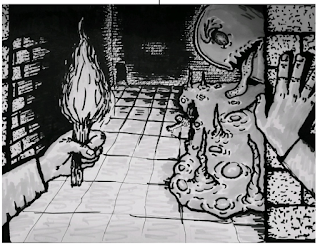
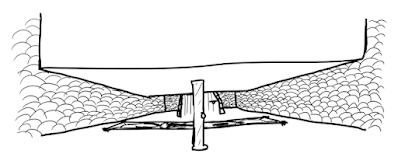
The dungeon, with its 27 areas, is short, compact, and heavy on the kind of punchy dungeon rooms which are fun to mess with. It is also a place which has seen the passage of time (considerable environmental damage, flooding, tunnelling), attempts at looting (sprung, half-sprung, and malfunctioning traps, dead adventurers still shuffling around), and previous tomb robbers making things worse with their meddling (an enormous stone block trap suspended slightly above ground, resting precariously on an upright immovable rod switched to the “ON” position). High interaction, strong environmental storytelling, and interesting (perhaps slightly illogical, considering how small the place is?) random encounters combine into a good mixture. The rooms give you enough rope to hang yourself with, but also enough footholds to turn to your advantage, perhaps even massively. There are some really funny ways to die in here (c’mon… push that button! try to get that rod!), and there are encounters with no easy, straightforward solutions (such as an enormous patch of black pudding which can easily engulf much of the dungeon if let loose), or which will massacre the reckless (the burrow of a basilisk). It is the good kind of funhouse environment, which makes just enough sense to let you suspend disbelief, but otherwise encourages and rewards player creativity. Monetary treasure is very scarce except for the odd magic item you may pawn off (but most parties won’t) – this “XP-poor” environment is noted by the author in a transparent fashion.

The module features terse, matter-of-fact writing. It could stand to be a bit more ornamented, but this is more personal preference than objective truth. The homespun interior art is stickman level but funny, which is vastly more than could be said about anything WotC and its ilk are doing. What stands out is how helpful the text is. The adventure communicates ideas clearly and efficiently, presents its underlying assumptions in a fair way, features effective play advice to customise the module for your group (this is rarely done beyond generalities) or complicate it further to put the thumbscrews on the party. There is good advice in running the module as a one-shot, and even offers eight example characters who come with simple personal hooks for more variety. This is a lot of support for most possible situations. It is not layout hocus-pocus: it is clear, effective advice.

Vault of the Warlord is elevated above the norm by the care that has gone into making it work smoothly, but particularly by how the simple premise of robbing an old, decrepit tomb is turned into a rich, open-ended scenario which offers a lot of ways in, and perhaps even more possible outcomes. It is not big, but no effort has been spared to make it work smoothly. Impressive, and looks like tons of fun.

This publication credits three groups of playtesters. All this effort shows!

Rating: **** / *****

Pusssssh the button. Pussshhhhhhh the button!
Push the button!!!!!


Friday, 11 February 2022

[STUFF/NEWS] The Nocturnal Table on Chartopia, Red Room Interview, Echoes #09 in PDF

News on the march! Here are a handful of things of interest while yours truly wrestles with the Deadline Gods (none of which has to have anything to do with gaming, sadly, except for delaying various projects in the making).

* * *

Mind the Lepers
The Nocturnal Table on Chartopia!

Tuirgin has been kind enough to adapt The Nocturnal Table to Chartopia. After EOTB’s excellent Fantasy Grounds integration, this is a web-based implementation of the supplement. You can just click on the link, and roll up stuff for those nighttime adventures. It is all free, at your fingertips, and offers you most of the supplement's content.

For instance… adventurers Yakko Sarxs, Zeep Ulbem, and Mark the Marrakian learn from clandestine sources that an important meeting will take place “by the benches at the peacock mosaic… wear a rose”, and they swear to get there before the intended target!
  • They head out to the market – it is daytime, and they meet 2 Drunks (LVL 1), offering them some work. Declining the offer, they start looking for a suitable rose seller.
  • They encounter a “Jovial yogi selling opium, as a last-ditch gambit” (the GM gives him 1:6 to know of a rose seller, but comes up empty), followed by a “Paranoid, perverted lord selling advice, to corner the market, who miscalculates the price”. This is apparently someone who knows the market, but seeing that the characters are in need, gouges them for a hefty sum. In any event, the rose is acquired!
  • The peacock mosaics are in the Thieves’ Quarter. On the way there, the GM rolls for another daytime encounter: 14 Sailors/Pirates (Fighter 2), confronting the party by trying to stop them. Not eager to blow their chance, the characters grudgingly bribe the sea scum… but note them for further retaliation. By the time the altercation is over, night falls…
  • In the Thieves’ Quarter, the GM first rolls for local colour: the characters note “Stone arms (4) propped against brick wall.” Odd! An encounter from the Nocturnal Table proper follows… “(384) Wererats (2d4 (5)), carrying diseased rags in enormous bundles, and scattering them everywhere.” Hooded, hunched men and women are donating colourful rags to the local lepers and beggars – a spectacle the characters choose to avoid (the consequences will manifest in a few days anyhow…)
  • Arriving near the peacock mosaics, the GM rolls again for local colour to set the scene, and a simple nighttime encounter to see what kind of passersby are to be found nearby. A “sleeping dog cradles carved bone-hilt dagger (15 gp)” near the benches, and a “Mercenary (Fighter 8)” tries to seduce one of the characters with a ballad, attempting to lure them into a nearby dive… but noticing the rose worn by Zeep Ulbem, he gestures to them to come closer, and inquires whether they have come for the Brotherhood contract. Zeep Ulbem nods curtly.
  • The man leads the company to a nearby storefront, and knocks twice in rapid succession. A panel is slid open, and they are welcomed into a dimly lit store, stocked with… “miniature drums” and “ritual mummies”. The shopkeeper, who introduces himself as Invenor, reaches into his robes while the adventurers wait nervously for the next step.
This is the kind of improvised stuff you could cook up with these tables on a step-by-step basis, or you could spice up a premade adventure as well. It is all free (although you can also purchase the supplement in print and PDF), and it is all courtesy of Mr. Tuirgin. Much appreciated!

* * *

The good Melan is in the Lodge, and
cannot leave.
Prestigious Interview!

Yours truly has been interviewed on video, and a very special place it was! Having spread beyond the Black Lodge, The Red Room is a new Youtube channel from Portugal (but broadcasting in English), featuring reviews, commentary, and interviews with various villains of the tabletop RPG scene. This conversation has followed the successful crowdfunding campaign for the Spanish edition of Helvéczia (€6700 out of €5500!), and it mainly focused on this game – its aims, sources of inspiration (including the original picaresque novels of the 17th century), historical context (and the liberties it takes with history), bestiary, why the Old Swiss Confederation is an ideal adventure setting, and how far you can take the game in various odd directions. This has been a blast – thank you for having me on! Are the owls what they seem?

* * *

Echoes Fom Fomalhaut #09 in PDF!

The newest Echoes issue is up on DriveThruRPG, and features 60 pages of stuff, including a new setting to the northwest of the Isle of Erillion, an adventure set there, and a B/X dungeon for first-level characters… lots of first-level characters, as it turns out! Bring lots of character sheets, and a good number of followers.

The next issue will be #10, a nice number indeed. I expected it to come out this time of the year, but, again, real life has had me chained to Winword, Excel, and other unholy things for the last few months, and that has thrown a spanner between the gears. Realistically, late April or early May looks possible. I am also translating a handful of Helvéczia adventures for the Spanish edition, and once I have them in English, it makes sense to publish them as well. And of course, other projects are on the table as well: a forest adventure I am particularly fond of, as well as a guest contribution centred around an old well… The Well of Frogs!

Oh FU