 |
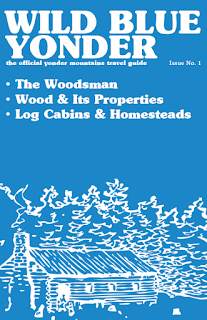
| Wild Blue Yonder |
Wild Blue Yonder #01 (2021)
by Jon Davis
Published by Sivad’s Sanctum
Low-level
Hello, and
welcome to **ZINEMASSACRE*2021**! Last year, Kickstarter ran Zinequest 3, their third zine
writing promotion campaign. This venture seemed to be ill-starred, as not only did
many of the projects suffer from delays and disappearing authors (a.k.a. “the
old cut and run”), but this may actually be the last significant venture under
the name for reasons which are both funny and disappointing. These reviews will
focus on the zines I funded AND which actually got released – let’s see how it
goes.
* * *
If you want to
start a weird game experiment, start a zine. It might just find an audience,
and in the worst case, you are not out of too much money. Of course,
Kickstarter changes the equation a little (once you are funded, the risk is firmly
on the buyers’ side), but the basic idea stands. Wild Blue Yonder (also
the title of a Werner Herzog movie – relation to this project unknown) takes
the framework of Old School Essentials, and takes it somewhere entirely
else than originally intended: the Yonder Mountains, a backwoods area on the
edges of modern civilisation. The time and place is distinctly late 19th
century America, perhaps somewhere along the Appalachians. The Yonderfolk, the rural
inhabitants of the Mountains, possess simple, homespun wisdom, and know much
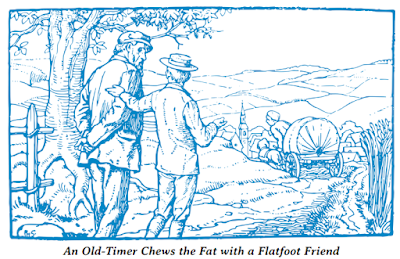
about this territory. In contrast, Flatfoots are outsiders bringing
new ideas and fashions from industry to the labour movement. Deep and old forests hide small agrarian
villages living by old customs, while early mines dig up the mountains,
small-scale factories are springing up, and loggers are slowly starting to
clear away the dense old growth forests. This model of industrialisation preceded
massive big-city industries, and is best remembered through campfire songs like
Sixteen Tons (quoted
on the back cover) and such fare – dirty, brutish, and more beneficial in the
long than the short run.
 |
| Free Candy Not Depicted |
The zine is
dedicated to presenting this world of wise old tramps, tradition-bound
townsmen, industrial barons and them crazy city folks with their new gizmo
fads. The strength of the setting lies in the telling: it makes a convincing
argument that this is a setting worth visiting, with its own folklore, customs,
and deeper mysteries. There are human conflicts, from love and hatred to Tradition
vs. Progress, folkloric beings based on strange old men, chapters on local fare
(Yonderfolk have a notorious sweet tooth for rock candy, enjoy fried pumpkin
rinds fried in lard, and wash it down with apple beer or a swig of strong hooch)
or types of wood (metal is scarce in the Yonder Mountains, so household items
are made of maple, log cabins of poplar, and magic items of white ash). The
issue also presents the Woodsman class, who are basically Rangers with a deep
spiritual connection to trees, a town, and four critters (giant groundhogs and
wampus cats are two of them).
As a flavourful
presentation of a lovely rural setting, Wild Blue Yonder is a success. The
question with these settings is always “So what am I supposed to do with this?”
The answer in the zine is not entirely convincing (see below), but to its
credit, a large rumour table offers 36 potential hooks, from “The feud
between the Walshes and the Marshes was started over a misplaced stew pot if
memory serves” to “The Moon-eyed People see better at night than in the
day, often times you’ll see their eyes shining from the dark hillsides.”
You might also get the idea that the right answer is “what everyone else is
doing”, so probably situation-oriented scenarios (thwart the dastardly plans of
those industrialists!) and some light dungeon crawling. The Kickstarter comes
with two pamphlet dungeons (a format that makes one-page
dungeons look downright respectable), which also serve as a practical
demonstration (but see below). Big Rock Candy Mountain is an entirely
linear expedition to a lost gem mine with seven keyed locations and a 2d6 random
encounter chart, while I Remember Uncle Elijah is an investigative module
in the sleepy village of No Pine, where children are disappearing. The pattern of
disappearances is entirely random, and there are no meaningful clues to really “investigate”
or “solve” the mystery, at least within the adventure’s scope as written. I don’t
know, man. Perhaps it is one of those deep things. Volja?
Then there is the
editorialising, which I suppose is to be expected with these NuSR things. Not
only does the setting have Correct Politics, but we will be surprised that NPCs who
share the Correct Politics are sympathetic, wise,
and ultimately good of heart; while those who do not share the Correct Politics are greedy, unsympathetic, and Up to No Good. For example, Old-Timers
are wise in the ways of healing, good advice, and a bit of folksy magick, while
the Sons of Cludd are intolerant religious fanatics who “have a reputation as
ruthless inquisitors and torturers of those they deem as heretics and witches”.
Well, there’s a hard decision. Likewise, the Paimon Coal Company is a gang of obvious
evildoers to the last clerk, company store employee, and Sherrif (all ~ are
bastards), while good folks in town host secret labour union meetings and work as
child preachers paying off a family debt. When they have character flaws, they
are sympathetic character flaws or charming tics, or something they are not at
fault for. Even the famed Paimon Prowler (a now extinct OSR critter) would be
impressed.
The above
weirdness notwithstanding, this is a decent “idea” zine, and a
compelling setting crafted with vivid strokes and obvious love. The writing is
good, and the ingredients are there for a campaign. You probably will not run a
game here (and see below), but wouldn’t you like to? This is a quaint, timeless,
and out of fashion world that feels a bit like home. When you read that “Some
folk from Chat’nuga are in town, and they got themselves an automobile!”,
wouldn’t you want to play a few tricks on them until they go right back to Chat’nuga with their gizmo widgets? Darn straight, sonny.
The zine is
released as “UNPLAYTESTED WITH PRIDE”. Weird flex but OK.
Rating: *** /
*****
 |
"They even gave a strange little jump as they
fucked right back to wherever they came from!" |